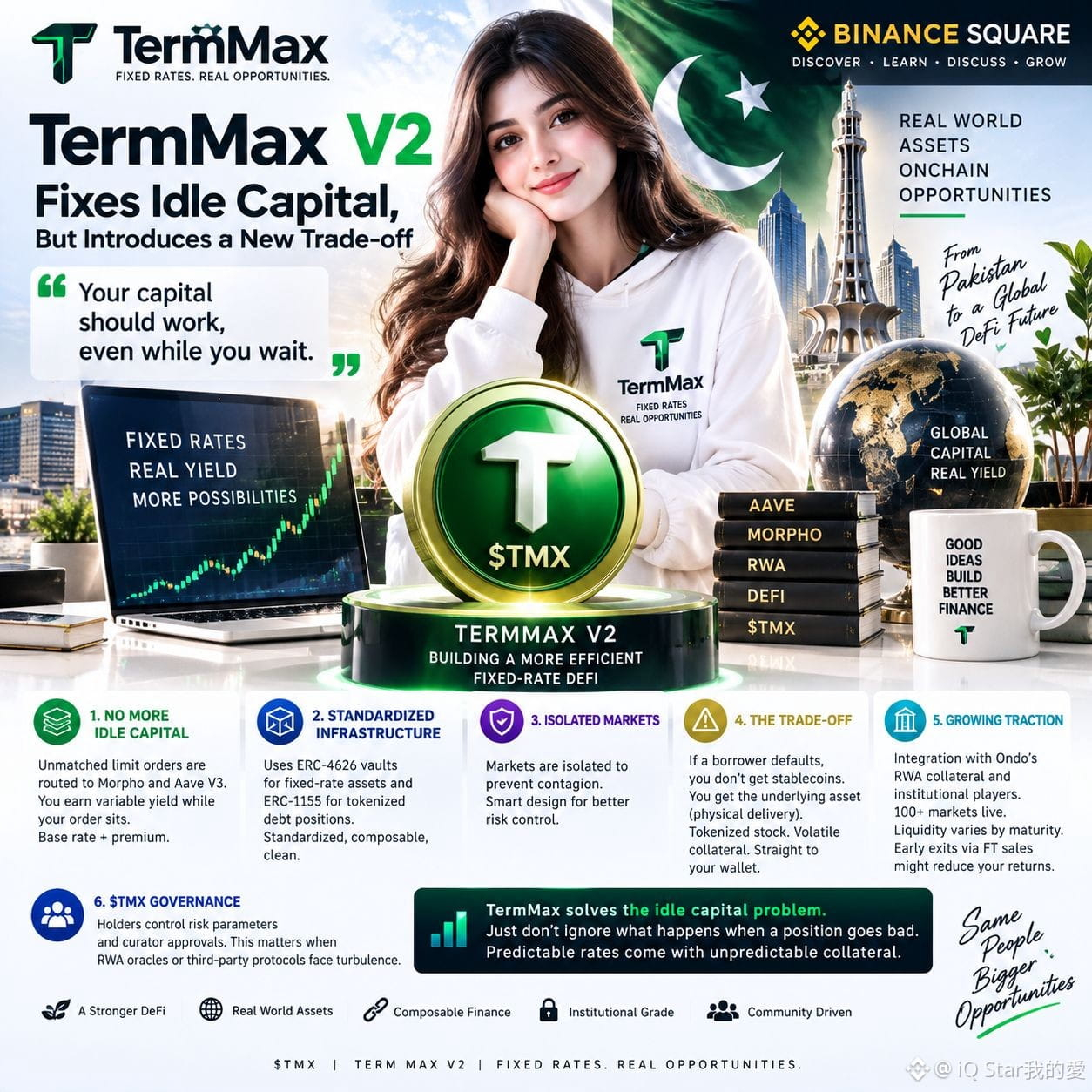

@TermMax V2 is solving a problem fixed-rate DeFi has had for a long time: what happens to capital while you wait for an order to fill?
Normally, predictable rates can come with an ugly cost — idle liquidity.
TermMax V2 attacks that problem with Composable Base Yield. Vaults can use underlying yield sources such as Aave and ERC-4626-compatible vaults like Morpho, allowing capital to keep generating base yield while waiting to be matched.
That changes the equation.
You are no longer simply choosing between fixed-rate exposure and putting capital to work elsewhere. TermMax is trying to make the waiting period productive.
But there is another side to the story.
Fixed-rate lending removes one type of uncertainty: rate volatility.
It does not remove every type of risk.
Collateral, liquidity, maturity and execution still matter. A predictable lending rate does not automatically mean a predictable exit.
And this is where TermMax gets more interesting than a simple “fixed-rate DeFi” narrative.
V2 also introduces Atomic Orders, Smart Unwind and an Order Aggregator designed to improve liquidity efficiency and execution across the protocol.
TermMax is essentially trying to make fixed-rate positions more composable instead of leaving capital locked into one isolated strategy.
The key question isn't just:
“Can TermMax offer predictable rates?”
It is:
“Can predictable-rate infrastructure stay liquid, productive and efficient when market conditions change?”
That is the part I would watch closely.
Fixed rates solve rate uncertainty.
They don't make liquidity risk disappear.#TermMax $TMX
Normally, predictable rates can come with an ugly cost — idle liquidity.
TermMax V2 attacks that problem with Composable Base Yield. Vaults can use underlying yield sources such as Aave and ERC-4626-compatible vaults like Morpho, allowing capital to keep generating base yield while waiting to be matched.
That changes the equation.
You are no longer simply choosing between fixed-rate exposure and putting capital to work elsewhere. TermMax is trying to make the waiting period productive.
But there is another side to the story.
Fixed-rate lending removes one type of uncertainty: rate volatility.
It does not remove every type of risk.
Collateral, liquidity, maturity and execution still matter. A predictable lending rate does not automatically mean a predictable exit.
And this is where TermMax gets more interesting than a simple “fixed-rate DeFi” narrative.
V2 also introduces Atomic Orders, Smart Unwind and an Order Aggregator designed to improve liquidity efficiency and execution across the protocol.
TermMax is essentially trying to make fixed-rate positions more composable instead of leaving capital locked into one isolated strategy.
The key question isn't just:
“Can TermMax offer predictable rates?”
It is:
“Can predictable-rate infrastructure stay liquid, productive and efficient when market conditions change?”
That is the part I would watch closely.
Fixed rates solve rate uncertainty.
They don't make liquidity risk disappear.#TermMax $TMX