
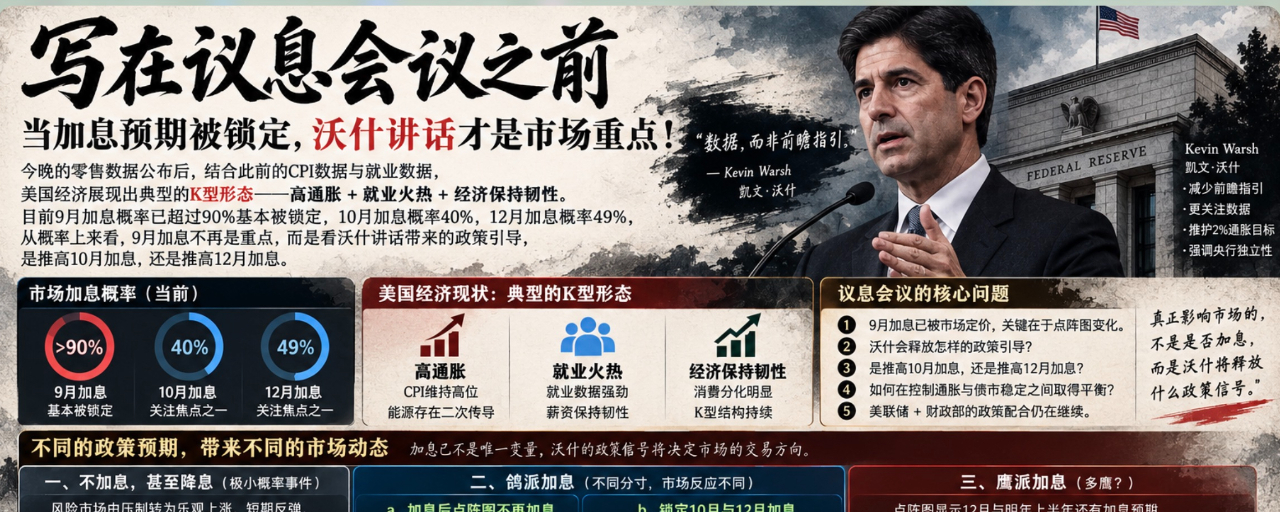

Ahead of the policy meeting, once rate-hike expectations have been locked in, it’s the Fed Chair’s remarks that are the market focus!
After tonight’s retail data release, together with the prior CPI and employment data, the U.S. economy has shown a typical K-shaped pattern—high inflation + strong employment + the economy maintaining resilience.
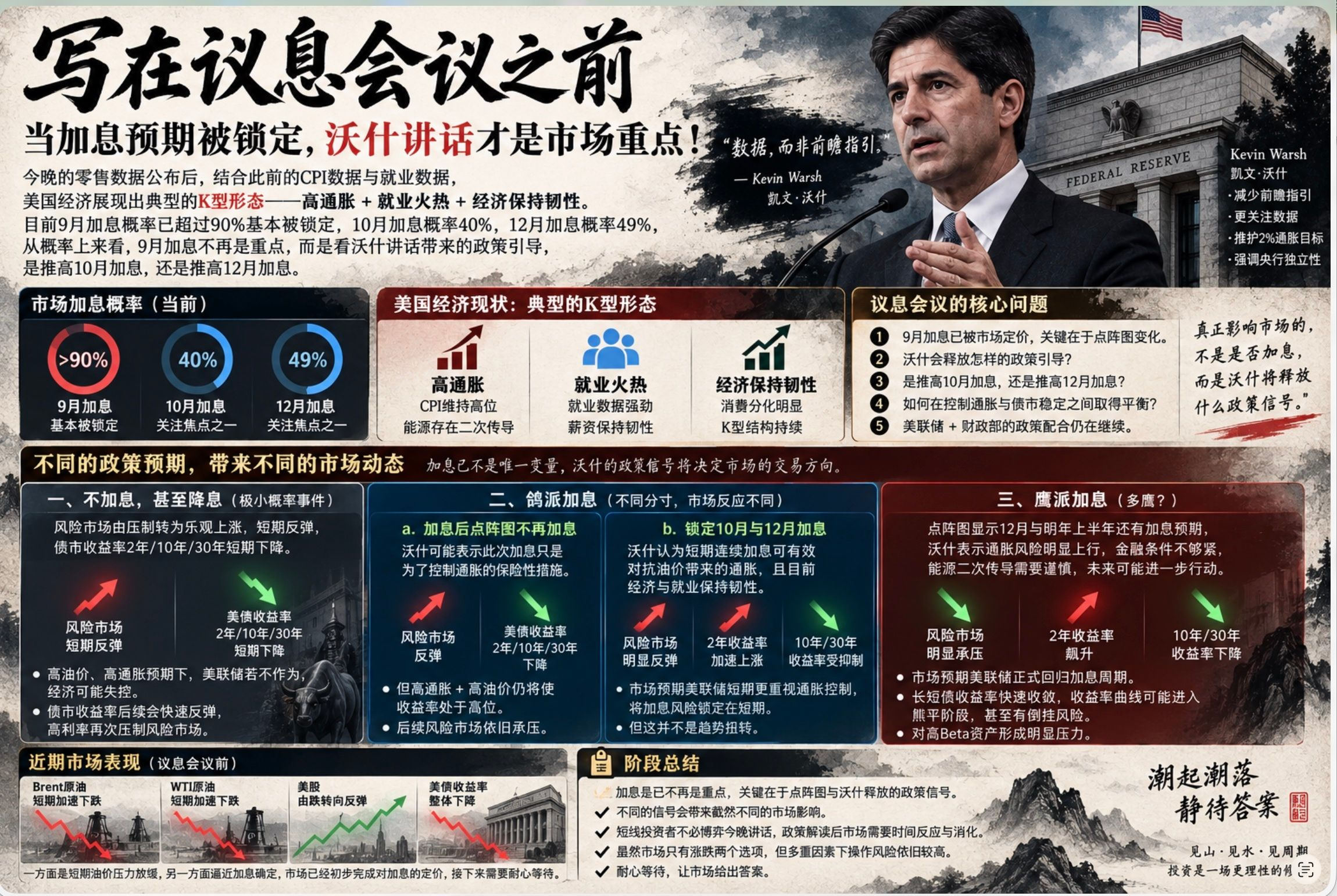
And currently, the probability of a rate hike in September is over 90%, which has basically been locked in. The probability of a rate hike in October is 40%, and in December it is 49%. Judging by the probabilities, a rate hike in September is no longer the focus. Instead, it depends on the policy guidance brought by statements from the Fed Chair—whether they will push up the likelihood of a rate hike in October or in December.
According to the prior policy of focusing on data following Waller’s reduction of forward guidance, the current data does indeed give Waller more policy room. However, Waller still needs to consider the issues in the bond market, because we are currently in a phase of policy coordination between the Federal Reserve and the Treasury.
Different expectations lead to different market dynamics:
No rate hike, even a rate cut—extremely low probability.
The risk market shifts from suppression to optimistic gains: a short-term rebound. Bond market yields for 2Y/10Y/30Y decline in the short term. But then the market will face a key question: under high oil prices and high inflation expectations, if the Fed doesn’t act, will the economy get out of control? Bond yields will rebound quickly afterward, and high interest rates will once again weigh on the risk market.
Dovish rate hike—more doves? Under different degrees, market performance differs.
a. Rate hikes while the dot plot shows no need for further hikes. In combination with Waller’s view, this rate hike is only an insurance measure to control inflation. The risk market rebounds: yields on the bond market for 2Y/10Y/30Y decline, but the market still has to face high inflation plus high oil prices, which will keep yields at elevated levels. In the next stage, the risk market will face similar pressure.
b. Rate hikes. The dot plot locks the rate-hike expectations into October and December. In line with Waller, short successive tightening cycles can effectively counter inflation driven by high oil prices. Also, the economy and employment are currently showing resilience. The market expects the Fed in the near term to prioritize controlling inflation, locking in the risk of additional hikes into the short term. This situation will effectively suppress long-end yields: the 2Y yield accelerates upward. The risk market rebounds noticeably, but this is not a trend reversal.
#美联储加息是否已成定局 Hawkish rate hike—multiple hawks?
A rate hike is confirmed, and the dot plot shows that there are still expectations for hikes in December and the first half of next year. In line with Waller, inflation risks have clearly moved upward: financial conditions are not tight enough, and any second-round transmission from energy should be handled cautiously. There may be further action, and the market will expect the Fed to officially return to a rate-hike cycle.
At this point, the risk market is under clear pressure: 2Y US Treasury yields surge, while 10Y/30Y yields decline. The risk market faces pressure. But at this time the bond market also carries some risk: yields on short- and long-duration bonds converge quickly. If the 2Y yield rises too fast, it could push the bond yield curve into a bear-flattening phase, and even create the risk of inversion.
Stage summary:
So, for tonight, whether there is a rate hike or not is no longer the key issue. The focus is on what the dot plot—along with the signals released by Waller—tells the market, and how different interpretations of these signals lead to different impacts on the market.
For short-term investors, I don’t think it’s necessary to debate Waller’s speech tonight. After policy is interpreted, the market needs time to react and interpret. Although the market only has two options—up or down—under multiple factors, operational risk remains high.
Before the FOMC meeting, Brent and WTI prices accelerated their short-term drop. US stocks turned from falling to rebounding. Treasury yields declined. On the one hand, near-term oil-price pressure eased; on the other hand, as the hike became increasingly certain, the market had already completed pricing in the rate hike. Next, we simply need to wait patiently!