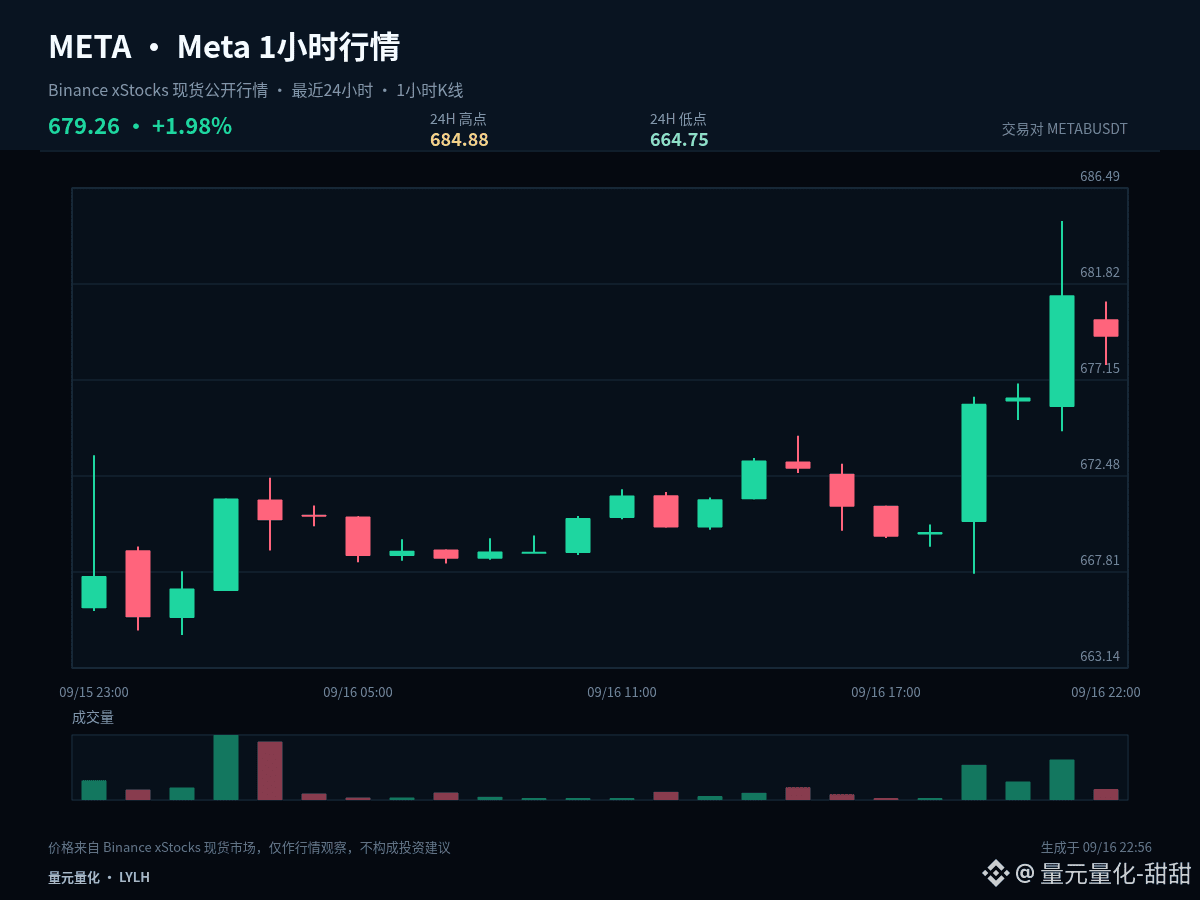
$METAB #META From a layout perspective, the focus is not on chasing fluctuations that have already occurred, but on determining in advance where you are willing to wait. Current price: 679.26, 1 hour -0.30%, 24 hours +2.21%.
Currently, 1 hour -0.30% and 24 hours +2.21%; the two periods have not formed sufficiently clear alignment in the same direction. In a range-bound market, the tolerance for chasing highs and selling lows is lower. It’s more suitable to use upper-band confirmation to identify direction, lower-band confirmation to assess support/continuation, and the midline only as the line dividing strength and weakness.
The first observation zone is 674.815, used to judge whether a normal pullback has ended. The second observation zone is 664.75, used to judge whether a deeper retracement can form support. On the upside, pay attention to 684.88. After a breakout, you’ll need a pullback confirmation to avoid mistaking a brief wick-through for an already-open trend.
Existing positions can be handled in stages based on key levels, so you don’t have to make all decisions at once. Those who are currently in cash should wait for breakout confirmation or pullback stabilization. For US stock targets, also note the volatility caused by trading-session transitions; your plan should be based on price conditions, not let emotions replace execution.
The purpose of scaling in isn’t to continually reduce average cost, but to control the pace while the structure remains valid. Once a key support fails, you should stop the original layout plan and wait for a new price range to form.
For short-term positions, the key is not to predict every individual candlestick, but to ensure that entries, reductions, and exits are based on evidence. Do less without confirmation. If key levels fail, redo the plan. Control single-trade risk first, and then discuss potential upside.
#SKHynixInTalksToMakeMemoryChipsInUS
Currently, 1 hour -0.30% and 24 hours +2.21%; the two periods have not formed sufficiently clear alignment in the same direction. In a range-bound market, the tolerance for chasing highs and selling lows is lower. It’s more suitable to use upper-band confirmation to identify direction, lower-band confirmation to assess support/continuation, and the midline only as the line dividing strength and weakness.
The first observation zone is 674.815, used to judge whether a normal pullback has ended. The second observation zone is 664.75, used to judge whether a deeper retracement can form support. On the upside, pay attention to 684.88. After a breakout, you’ll need a pullback confirmation to avoid mistaking a brief wick-through for an already-open trend.
Existing positions can be handled in stages based on key levels, so you don’t have to make all decisions at once. Those who are currently in cash should wait for breakout confirmation or pullback stabilization. For US stock targets, also note the volatility caused by trading-session transitions; your plan should be based on price conditions, not let emotions replace execution.
The purpose of scaling in isn’t to continually reduce average cost, but to control the pace while the structure remains valid. Once a key support fails, you should stop the original layout plan and wait for a new price range to form.
For short-term positions, the key is not to predict every individual candlestick, but to ensure that entries, reductions, and exits are based on evidence. Do less without confirmation. If key levels fail, redo the plan. Control single-trade risk first, and then discuss potential upside.
#SKHynixInTalksToMakeMemoryChipsInUS