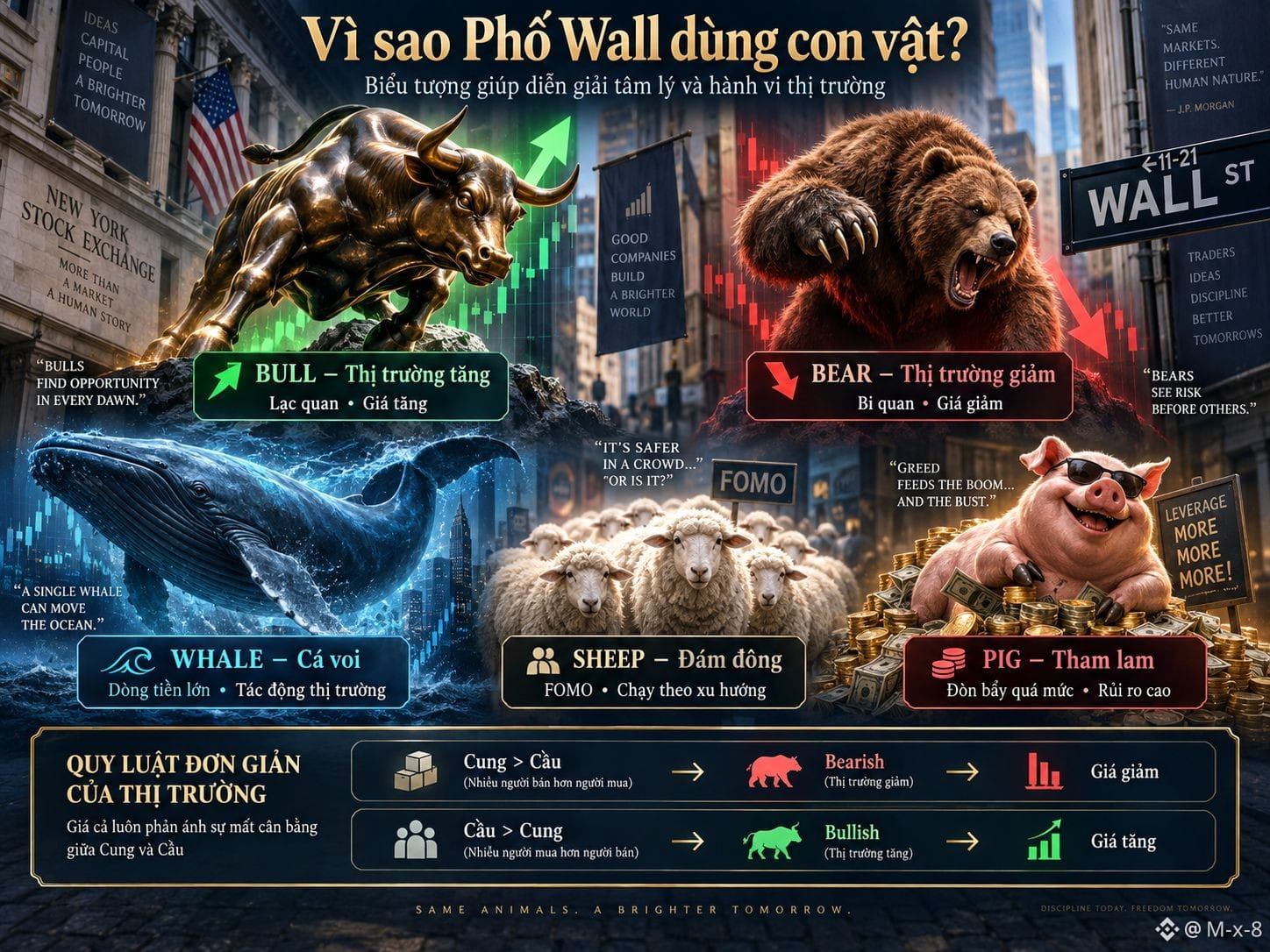
Wall Street uses animal imagery because it turns very complex market behavior into intuitive, easy-to-remember pictures.
🐂 Bull – Bull = the market going up: bulls usually thrust their horns from bottom to top → symbolizing rising prices, an optimistic mindset, and buying.
🐻 Bear – Bear = the market going down: bears usually swipe their claws from top to bottom → symbolizing falling prices, a pessimistic mindset, and selling.
🐋 Whale – Whale = big-money players: only institutions/individuals with a sufficiently strong position to influence liquidity and price.
🐑 Sheep – Sheep = the crowd: often refers to investors who chase trends, driven by FOMO.
🐖 Pig – Pig = excessive greed: the Wall Street saying “Bulls make money, bears make money, pigs get slaughtered” refers to greed, holding a position for too long, or using risks that are too large.
Key point: Bull and Bear are not just decorative symbols. They reflect two fundamental forces in the market:
Demand > Supply → 🐂 Bullish → Price ↑
Supply > Demand → 🐻 Bearish → Price ↓
🐂 Bull – Bull = the market going up: bulls usually thrust their horns from bottom to top → symbolizing rising prices, an optimistic mindset, and buying.
🐻 Bear – Bear = the market going down: bears usually swipe their claws from top to bottom → symbolizing falling prices, a pessimistic mindset, and selling.
🐋 Whale – Whale = big-money players: only institutions/individuals with a sufficiently strong position to influence liquidity and price.
🐑 Sheep – Sheep = the crowd: often refers to investors who chase trends, driven by FOMO.
🐖 Pig – Pig = excessive greed: the Wall Street saying “Bulls make money, bears make money, pigs get slaughtered” refers to greed, holding a position for too long, or using risks that are too large.
Key point: Bull and Bear are not just decorative symbols. They reflect two fundamental forces in the market:
Demand > Supply → 🐂 Bullish → Price ↑
Supply > Demand → 🐻 Bearish → Price ↓