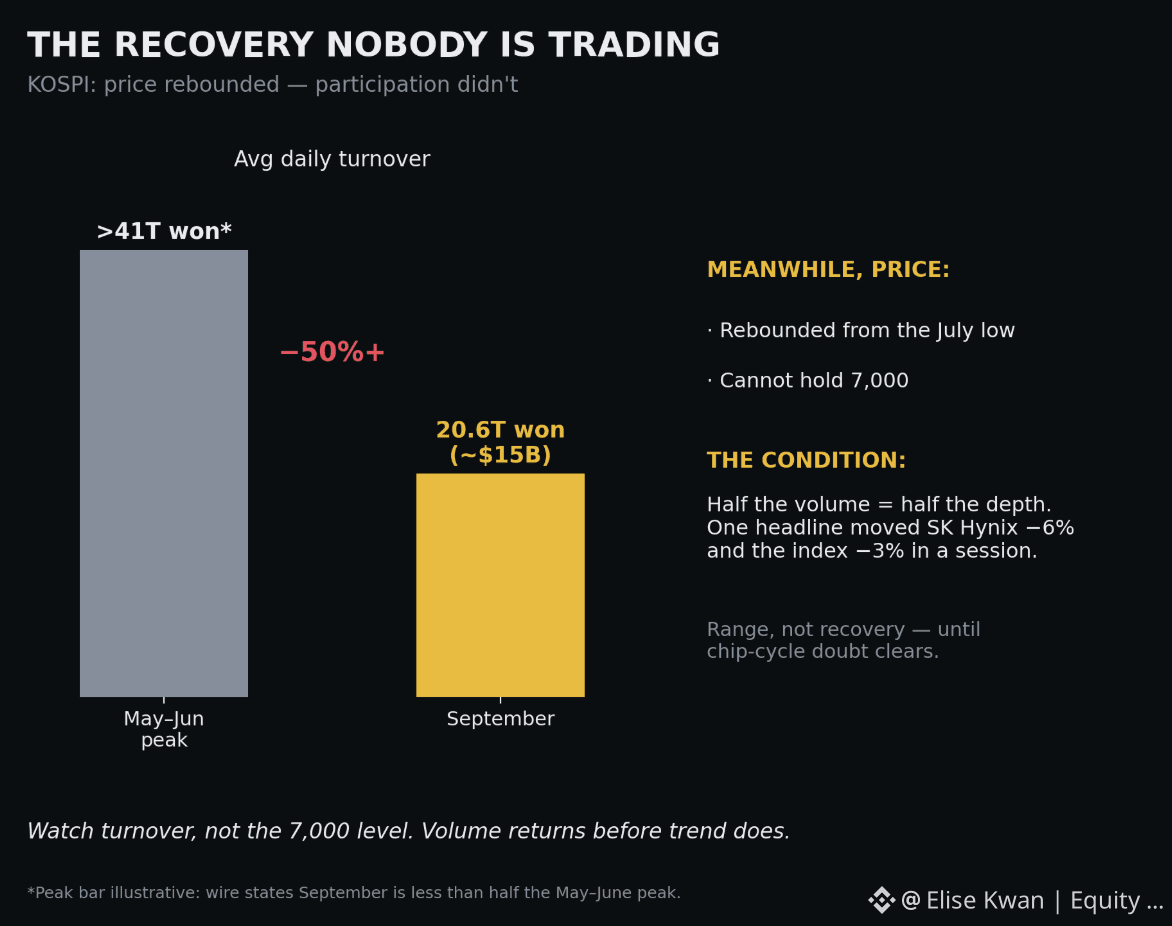
Korea's most important chart right now isn't price. It's volume.
KOSPI average daily turnover in September: 20.6 trillion won (~$15B) — the year's lowest, and less than half the May-June peak. Over the same stretch, price rebounded from the July low but cannot hold 7,000.
Price recovering on half the turnover is a specific condition: the buyers who made the rally — the retail AI wave — left, and didn't come back for the rebound. What's holding the tape up is thin.
Why it matters mechanically: depth. A market rebuilding on low participation has less capacity to absorb a shock — the 6% SK Hynix day proved it, one headline moving the whole index 3%.
The analyst framing fits the tape: range, not recovery. Falling volatility + falling turnover = neither side has conviction. Exit condition is chip-cycle clarity, and that's decided by hyperscaler demand — not in Seoul.
Watch: turnover, not the 7,000 level. Volume returns before trend does. #positioning #flows
KOSPI average daily turnover in September: 20.6 trillion won (~$15B) — the year's lowest, and less than half the May-June peak. Over the same stretch, price rebounded from the July low but cannot hold 7,000.
Price recovering on half the turnover is a specific condition: the buyers who made the rally — the retail AI wave — left, and didn't come back for the rebound. What's holding the tape up is thin.
Why it matters mechanically: depth. A market rebuilding on low participation has less capacity to absorb a shock — the 6% SK Hynix day proved it, one headline moving the whole index 3%.
The analyst framing fits the tape: range, not recovery. Falling volatility + falling turnover = neither side has conviction. Exit condition is chip-cycle clarity, and that's decided by hyperscaler demand — not in Seoul.
Watch: turnover, not the 7,000 level. Volume returns before trend does. #positioning #flows