#mstr交易量超越摩根士丹利
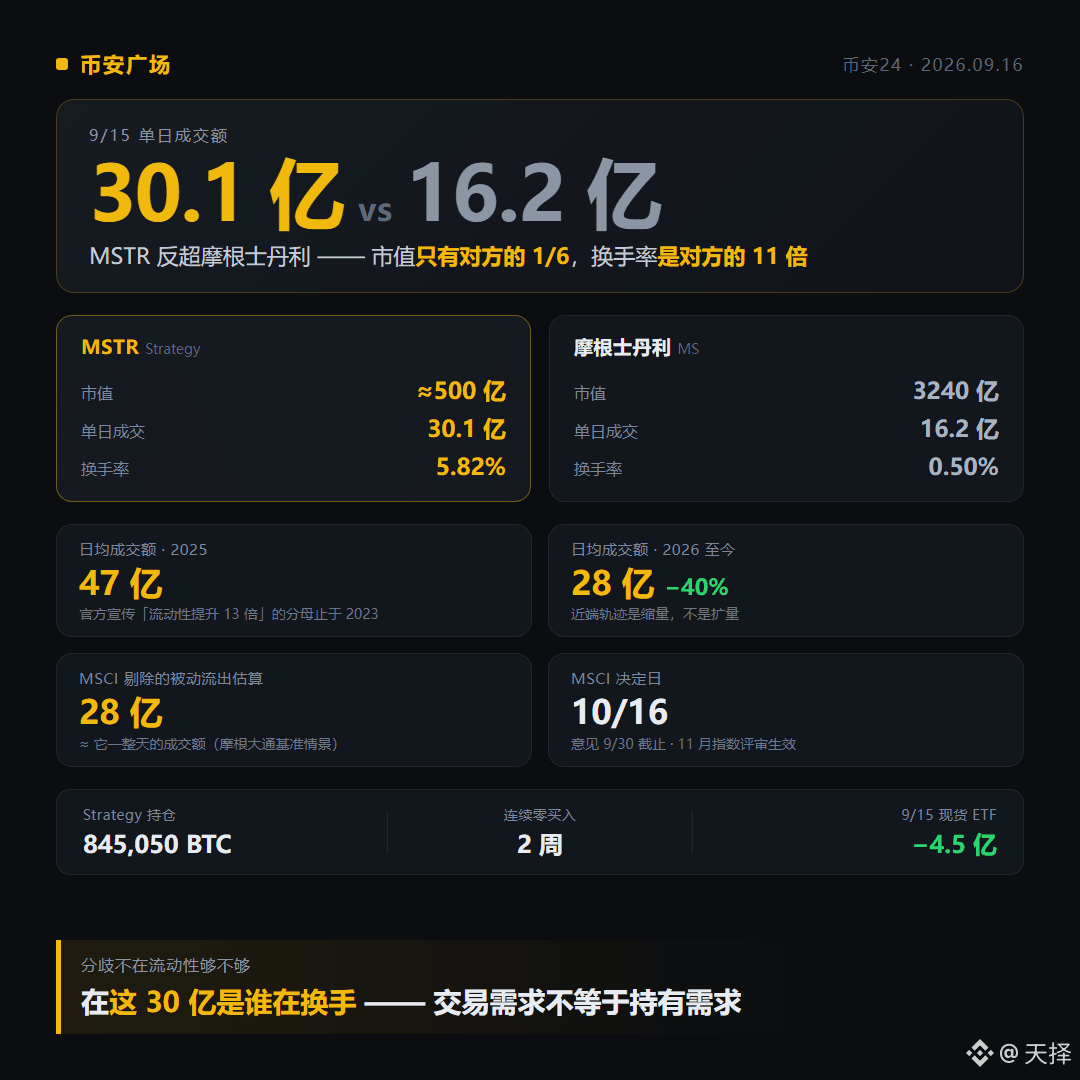
A company with a market value of 50 billion, on 9/15, had trading volume exceeding Morgan Stanley’s trading value of 324 billion.
▪️ MSTR traded $3.01 billion; ranked 26th among US stocks that day
▪️ Morgan Stanley traded $1.62 billion; turnover rate 0.50% vs. 5.82%
▪️ Average daily trading value: 2025 was 4.7 billion → 28 billion from 2026 to date
The gap isn’t in fundamentals—it’s in turnover. MSTR is no longer being treated much like a company; it’s more like a high-leverage note on Bitcoin.
Strategy promotes “13x liquidity improvement,” but the base is the average daily 300 million from 2020–2023. The real near-term is lower volume—average daily trading value of 2.8 billion from 2026 to date, down about 40% from 2025.
High turnover doesn’t necessarily mean strong demand. On the same day, spot ETF net flows were out by $450 million, the biggest single-day outflow since June; Strategy has also not bought BTC for two straight weeks. Demand with leverage is still there, but leveraged exposure is the first thing to be closed out. 75,000 is still the observation line.
Watch three things: ① The 10/16 MSCI decision (comments due by 9/30). JPMorgan estimates passive outflows of 2.8 billion, roughly equal to its daily trading volume; ② When Strategy resumes buying BTC; ③ Whether ETF fund flows can turn positive.
When a 50-billion company has daily trading volume exceeding an investment bank worth 324 billion—has liquidity improved, or has it become a tradable instrument? What do you think?$BTC $MSTR
A company with a market value of 50 billion, on 9/15, had trading volume exceeding Morgan Stanley’s trading value of 324 billion.
▪️ MSTR traded $3.01 billion; ranked 26th among US stocks that day
▪️ Morgan Stanley traded $1.62 billion; turnover rate 0.50% vs. 5.82%
▪️ Average daily trading value: 2025 was 4.7 billion → 28 billion from 2026 to date
The gap isn’t in fundamentals—it’s in turnover. MSTR is no longer being treated much like a company; it’s more like a high-leverage note on Bitcoin.
Strategy promotes “13x liquidity improvement,” but the base is the average daily 300 million from 2020–2023. The real near-term is lower volume—average daily trading value of 2.8 billion from 2026 to date, down about 40% from 2025.
High turnover doesn’t necessarily mean strong demand. On the same day, spot ETF net flows were out by $450 million, the biggest single-day outflow since June; Strategy has also not bought BTC for two straight weeks. Demand with leverage is still there, but leveraged exposure is the first thing to be closed out. 75,000 is still the observation line.
Watch three things: ① The 10/16 MSCI decision (comments due by 9/30). JPMorgan estimates passive outflows of 2.8 billion, roughly equal to its daily trading volume; ② When Strategy resumes buying BTC; ③ Whether ETF fund flows can turn positive.
When a 50-billion company has daily trading volume exceeding an investment bank worth 324 billion—has liquidity improved, or has it become a tradable instrument? What do you think?$BTC $MSTR