
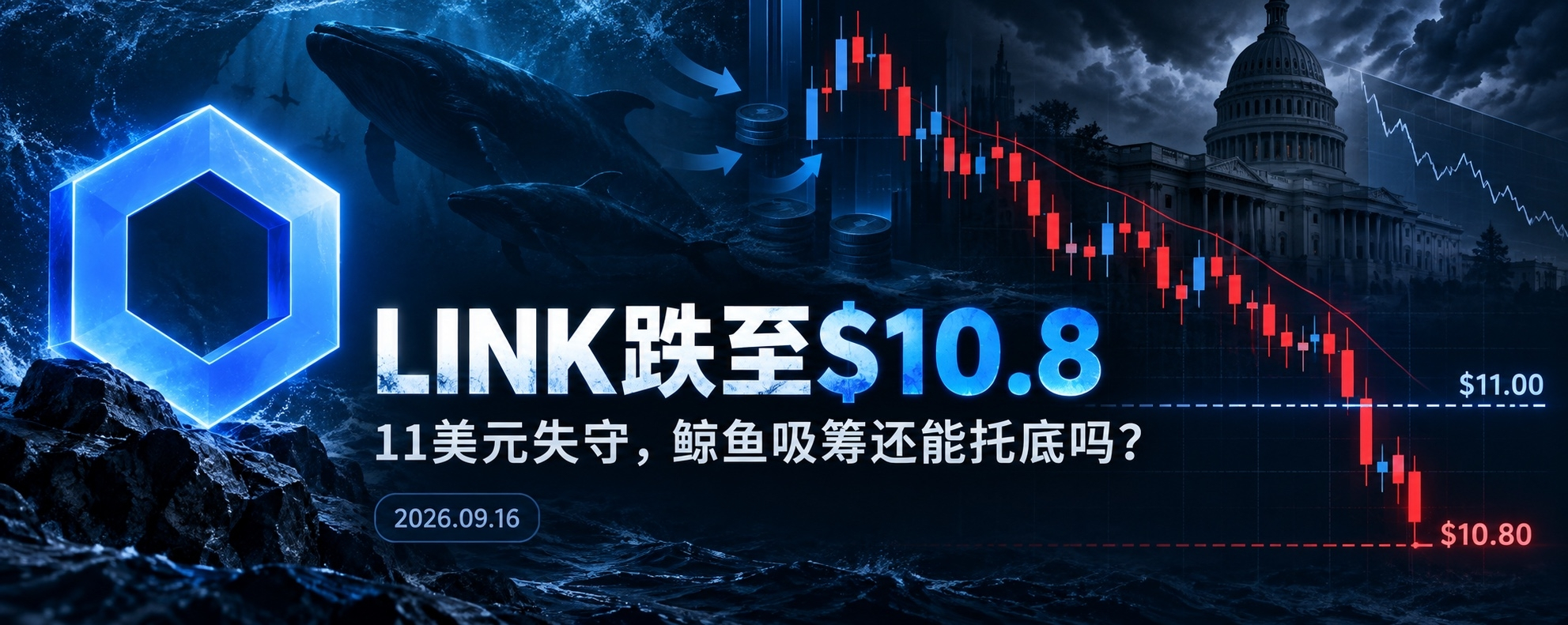

Data benchmark: September 16, 2026 at around 20:30 Beijing time. The primary market reference is the Binance LINK/USDT spot market.
The nature of LINK tonight has already changed. Yesterday, the market was still debating whether $11.2 could form a local bottom, but today the price has further fallen below $11. The latest trade is about 10.80 USDT, with roughly -5.35% over the past 24 hours and a range of about $10.68–$11.49.
It should be noted that the Binance public price introduction page is still stuck on cached data from September 15. Therefore, this article did not use the outdated quote of $11.57 shown on the page as a live price; instead, it relies on a LINK/USDT market snapshot at the time of execution. Binance’s LINK market page is used only to verify the trading reference.
The core issue tonight has become:
In the recent period, whale accumulation, Reserve increases, and fundamental expansion haven’t prevented LINK from breaking below $11. Whether $10.68–$10.80 can stop the decline will determine whether this selloff is the final round of panic release or whether the adjustment continues down toward $10.
1) Bull/bear tells: a high-volume break below $11 means the short-term structure is clearly weakening
Today’s LINK isn’t a slow bleed; it’s an accelerated pullback continuing after yesterday’s failed breakout.
On September 15, price once surged to $11.94 but failed to hold above $12. Today, the 24-hour high fell further to about $11.49, and then it broke below both $11.25 and $11.00 supports; the lowest point touched $10.68. The current price is only about 1% above the intraday low, indicating the market is still stuck in a weak zone and hasn’t shown a convincing V-shaped rebound with force.
Based on the recent $13.68 peak, LINK’s cumulative pullback is about 21%. Technically, this is no longer ordinary day-to-day range-bound volatility, but a clear medium-term correction.
According to market-wide statistics, LINK’s total trading volume over the past 24 hours is about $434 million, larger than the past few days. Prices falling alongside higher volume suggests both selling and stop-loss selling are being actively released, rather than the drop being caused purely by insufficient liquidity. The latest market snapshot also places LINK’s quote around $10.79, with a 24-hour decline of about 5.8%, consistent with the direction of the market when executed. Cross-validation of market data
Tonight, key levels need to be redrawn:
$10.65–$10.80: immediate support. This is the current low area and the zone being contested, but it hasn’t yet proven that it’s being held.
$10.30–$10.50: next support. If $10.65 breaks, price may search for turnover from earlier around here.
$10.00: the psychological and structural defense line. If it breaks down on high volume, the medium-term judgment also needs further downgrading.
$11.00–$11.15: first resistance. The former support has turned into rebound resistance.
$11.35–$11.50: short-term repair confirmation zone. Only by regaining and holding above it can we negate part of today’s breakdown.
$11.80–$12.00: strong resistance. Yesterday’s spike-and-reversal has already validated that supply is sufficient in this area.
The conclusion given by volume and price is very direct:
Selling pressure is expanding, and the bulls have not formed an effective counterattack yet. Even if there’s a rebound around $10.68, until price regains and holds above $11.15, it can only be defined first as an oversold repair.
2) On-chain positioning: whales have bought before, but they can’t keep being treated as “accumulation today”
The widely cited recent data shows that during a roughly 17% LINK pullback, certain large addresses increased their holdings by a cumulative 10.36 million LINK within about 96 hours, which is about $120 million at the statistical price.
This set of data can show that large capital did absorb positions above $11, but it is not purchases newly added on September 16, and it also cannot be repeatedly rewritten every day as “whales bought another 10.36 million LINK today.” Whale accumulation reports
Today’s price has already fallen further to $10.8, which also shows an important fact:
Whale accumulation can provide potential absorption, but it doesn’t equal building a price bottom that can’t be broken.
Meanwhile, supply risk in the opposite direction hasn’t been fully eliminated. Previously tracked addresses cumulatively transferred about 2.41 million LINK to Coinbase over roughly three weeks, including a single transfer of 620,420 LINK on September 7. Transfers to exchanges are confirmed on-chain facts, but whether those LINK have already been sold can’t be determined from the transfer records alone. Large transfer record
As of tonight, we haven’t found any new record sufficient to confirm that this address made another large deposit on September 16, and we also haven’t obtained reliable evidence showing that the previous 2.41 million LINK has already all been transacted. Therefore, the correct way to put it is:
Earlier, there was clear potential supply from exchanges;
In the recent period, there has also been whale pullback and accumulation;
Today there’s no new one-way evidence strong enough to support either “whales are broadly bottom-fishing” or “whales are collectively fleeing.”
A breakdown in price indicates that short-term selling pressure is temporarily overpowering the absorption capital.
Regarding the top 20 and top 100 addresses, tonight there are still no continuous snapshots after cleaning labels across exchanges, custodial wallets, smart contracts, cross-chain bridges, and project addresses—so it’s not possible to reliably calculate how much LINK net changed over the past 24 hours. Changes in an uncleaned “rich list” can’t directly represent whale buying or selling, and this article does not fill in fictional numbers.
The more reasonable conclusion on positioning right now is:
In the medium term, large holders may be absorbing, but the short-term position structure has weakened; whether exchanges continue to see net inflows matters more than repeatedly citing old whale buy data.
3) Fundamentals have not suddenly deteriorated, but they can’t temporarily withstand the exit of risk capital
As of tonight, no major negative announcement from Chainlink official has been found that was published on September 16 and could, by itself, explain the move in the market. Therefore this selloff looks more like the combined result of market sentiment, regulation, and macro risks rather than a sudden major problem with Chainlink’s technology or business.
At this stage, the main fundamental storyline still holds:
CCIP continues to expand cross-chain asset and institutional settlement scenarios;
RWA, stablecoins, and reserve verification remain important growth directions for Chainlink;
Data Feeds and Data Streams continue to enter more on-chain markets;
Chainlink Reserve is trying to convert part of network revenue into LINK demand;
The Transaction Value Enabled disclosed on the official website is still on the scale of tens of trillions of dollars. Chainlink official website
Recently, Reserve added about 91,100 LINK, bringing the total supply to about 5.86 million LINK. Its long-term significance is that Payment Abstraction can convert part of on-chain service fees and enterprise payments into LINK, then funnel it into Reserve, thereby establishing:
Network adoption increases → service revenue grows → converted into LINK → Reserve accumulation
This is a path closer to value capture by the token than simply “announcing new partnerships.” Chainlink Reserve mechanism
But Reserve purchases can’t be overhyped. The additional 91,100 LINK is only on the scale of millions of dollars, while LINK’s daily trading volume reaches hundreds of millions of dollars. A single reserve increase isn’t enough to offset the market’s concentrated sell pressure.
So, basically, there’s no contradiction between fundamentals and price:
Fundamentals determine the long- and medium-term value ceiling, while liquidity and positioning determine the short-term price path.
What’s happening tonight is exactly the second line taking the lead.
4) External market: regulatory crackdowns and Fed risk simultaneously suppress high-beta assets
LINK is clearly weaker than BTC today, but BTC itself is also in a state of risk contraction.
As of the same period, BTC is about $75,943, down about 1.27% over 24 hours, with an intraday low of about $75,039. BTC near four-week lows increases the amplification effect of volatility for altcoins across the board.
The U.S. Senate failed to advance the CLARITY Act, increasing uncertainty about the regulatory path for digital assets. After the news release, both BTC and related crypto stocks came under pressure at the same time. (Wall Street Journal) Market coverage
Meanwhile, the Fed’s rate decision has not yet been released. The market broadly expects a 25-basis-point hike, and the yield on the U.S. 10-year Treasury has already reached about 5.04%, nearing the highest levels since 2007. A high risk-free yield reduces willingness to allocate capital to high-volatility tokens. Reuters bond market coverage
This explains why LINK’s decline is significantly larger than BTC’s:
LINK rose earlier from about $7 to $13.68, accumulating more profit-taking positions;
After failing to break above $12, technical-driven capital began cutting losses;
Regulatory uncertainty hit the entire crypto market’s risk appetite;
U.S. Treasury yields rose above 5%, further compressing the valuations of high-beta assets;
Previously, whale buying was insufficient to absorb the concentrated short-term supply being released.
Therefore, today you can’t just use the explanation “the project fundamentals are still great” to explain away or rebut the price decline. The external capital environment is directly influencing LINK’s pricing.
5) Bull/bear logic: short term turns bearish, medium term drops to neutral-to-bullish
Judgment for today
Short term: bearish.
Medium term: neutral to bullish.
Evidence that shorts have flipped on in the short term includes:
The $11.25 and $11 support levels were lost one after another;
The intraday low fell to $10.68;
The decline came with increasing trading activity;
Yesterday’s spike to $11.94 had already confirmed failure;
BTC fell to near its four-week lows;
Regulatory risk and interest-rate risk still haven’t been fully digested.
There is no direct flip to bearish in the medium term because:
No major reversal has appeared in Chainlink’s business adoption;
Reserve is still building the mechanism that converts revenue into LINK;
Recently, there really have been large-address accumulations during adjustments;
CCIP, RWA, and institutional finance continue to form multi-cycle support.
But we must admit that the safety margin for a medium-term bullish bias is declining. If $10 is also broken down effectively, the price structure will begin to challenge the prior rally logic.
Conditions for turning the view back to neutral
LINK needs to complete:
Hold $10.65–$10.80
→ Reclaim $11.00–$11.15
→ Hold firmly on high volume above $11.35–$11.50
→ BTC regains $77,000
→ Large exchange inflows don’t continue increasing
Only after completing the first two steps can we confirm that today’s break is possibly a false breakout; after it holds above $11.50, short-term views can be upgraded from bearish to neutral.
Conditions for turning back bullish
The true short-term bullish confirmation still requires:
Trading volume expands and price breaks back above $11.80–$12.00.
If it’s only a rebound from $10.7 to $11 but can’t hold above $11.50, it should still be treated as a technical repair within a weak structure.
Triggers for further downside
If this happens:
**A valid break below $10.65**
The rebound can’t reclaim $10.80
BTC breaks below $75,000
LINK exchange net inflows increase, **
In the next phase, focus on monitoring $10.30–$10.50.
If $10.30 also can’t form absorption, the market will most likely test the $10 psychological level. After a high-volume break below $10, the medium-term rating needs to be downgraded from “neutral to mildly bullish” to “neutral.”
Today’s conclusion
What truly matters for LINK today isn’t just a ~5% drop, but:
After the failed break above $12 yesterday, $11.25 and $11 supports were lost in succession, and the market has begun testing whether $10.68–$10.80 can become a new absorption zone.
Previously, whale accumulation and Reserve growth still carry long-term significance, but they have not formed buy-side support strong enough to prevent a short-term breakdown. Fundamentals remain healthy, which only means Chainlink’s long-term logic hasn’t been disproven—it doesn’t prove that $10.8 is already the bottom.
The next six signals worth watching most:
Can $10.65–$10.80 be held;
Can the rebound quickly reclaim $11;
Does the trading volume on the decline start to fade;
Whether there are new large LINK transfers into exchanges;
Can BTC hold $75,000;
Will the Fed decision and the interest-rate path further suppress risk assets.
Today’s view: bearish in the short term, neutral-to-bullish in the medium term.
Until LINK regains stability above $11.15, don’t announce a bottom too early; if it breaks $10.65, move the risk observation zone down to $10.30–$10.50.
