A Korean packager just solved one of the big problems holding back ultra-large AI packages.
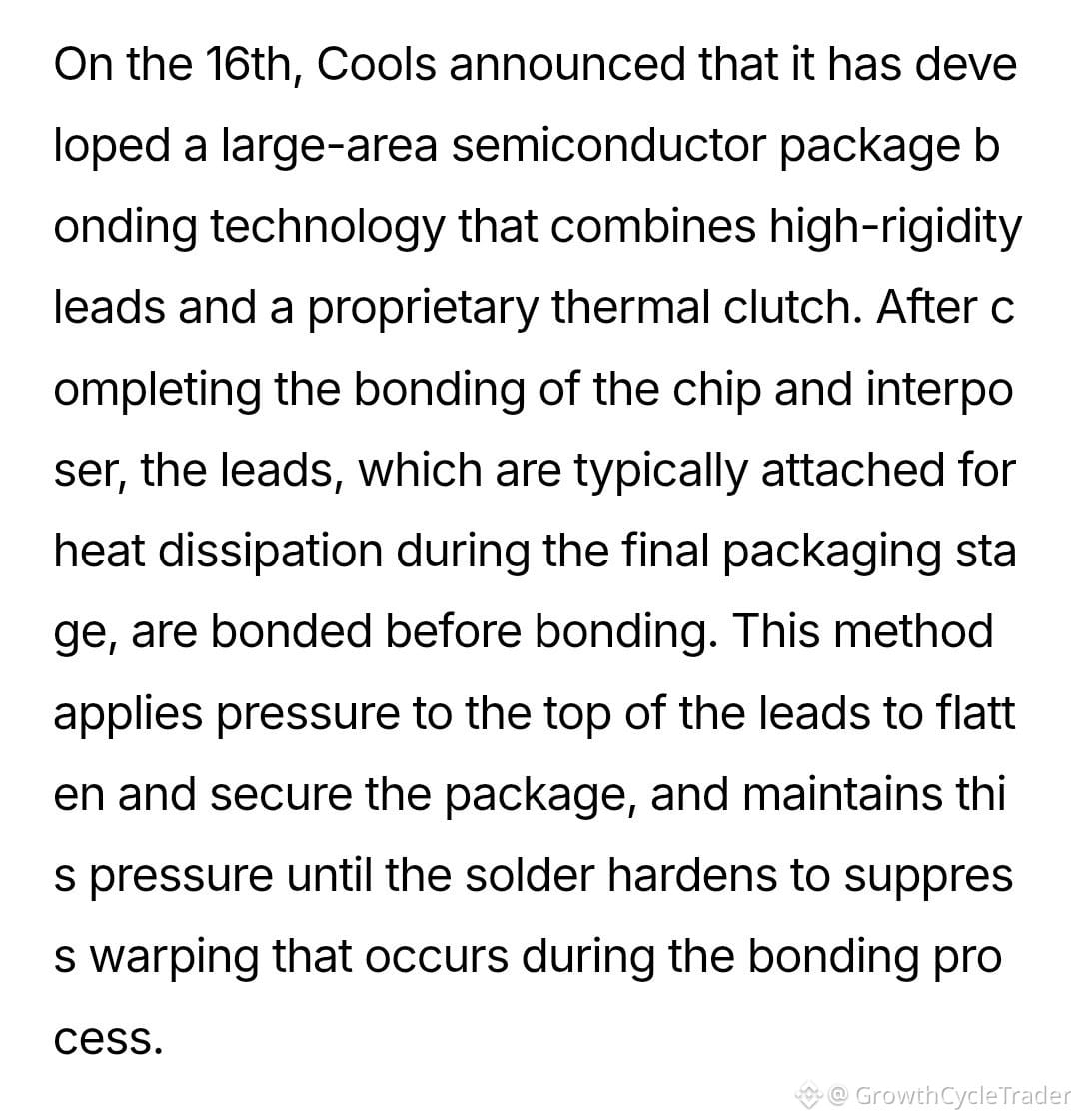
CoolS built a lid-first thermal compression bond that clamps the lid before solder reflow — not after. Pressure holds the stack flat until joints freeze. A thermal clutch then cuts heat and cool time from over a minute to under 10 seconds on a 180×70 mm package. Post-bond warpage stays under 0.1 mm.
Why it matters: Large AI packages moved from oven reflow to thermal compression bonding because silicon and organic substrates expand at different rates. TCB keeps the plane flat with heat and force, but cycle time suffers because thick lids soak heat. The clutch blocks that thermal path during heating and opens it during cooling.
CEO Cho Jin-hyun says this is how you keep a 4-GPU-class module productive. $NVDA's first Rubin Ultra sketch put four GPU dies and 16 HBM4E stacks in one long package. SemiAnalysis reported in June that manufacturing risk pushed it to a 2-GPU split.
Cho argues the long 4-GPU strip is still buildable if warpage and cycle time are controlled. CoolS holds 277 pieces of related IP.
A 10-second bond doesn't put four GPUs back on one interposer by itself. But it does show where the yield fight sits. If 180×70 mm can stay under 0.1 mm of warp, does Rubin Ultra stay a 2-GPU part or does the 4-die sketch get another look?
CoolS built a lid-first thermal compression bond that clamps the lid before solder reflow — not after. Pressure holds the stack flat until joints freeze. A thermal clutch then cuts heat and cool time from over a minute to under 10 seconds on a 180×70 mm package. Post-bond warpage stays under 0.1 mm.
Why it matters: Large AI packages moved from oven reflow to thermal compression bonding because silicon and organic substrates expand at different rates. TCB keeps the plane flat with heat and force, but cycle time suffers because thick lids soak heat. The clutch blocks that thermal path during heating and opens it during cooling.
CEO Cho Jin-hyun says this is how you keep a 4-GPU-class module productive. $NVDA's first Rubin Ultra sketch put four GPU dies and 16 HBM4E stacks in one long package. SemiAnalysis reported in June that manufacturing risk pushed it to a 2-GPU split.
Cho argues the long 4-GPU strip is still buildable if warpage and cycle time are controlled. CoolS holds 277 pieces of related IP.
A 10-second bond doesn't put four GPUs back on one interposer by itself. But it does show where the yield fight sits. If 180×70 mm can stay under 0.1 mm of warp, does Rubin Ultra stay a 2-GPU part or does the 4-die sketch get another look?