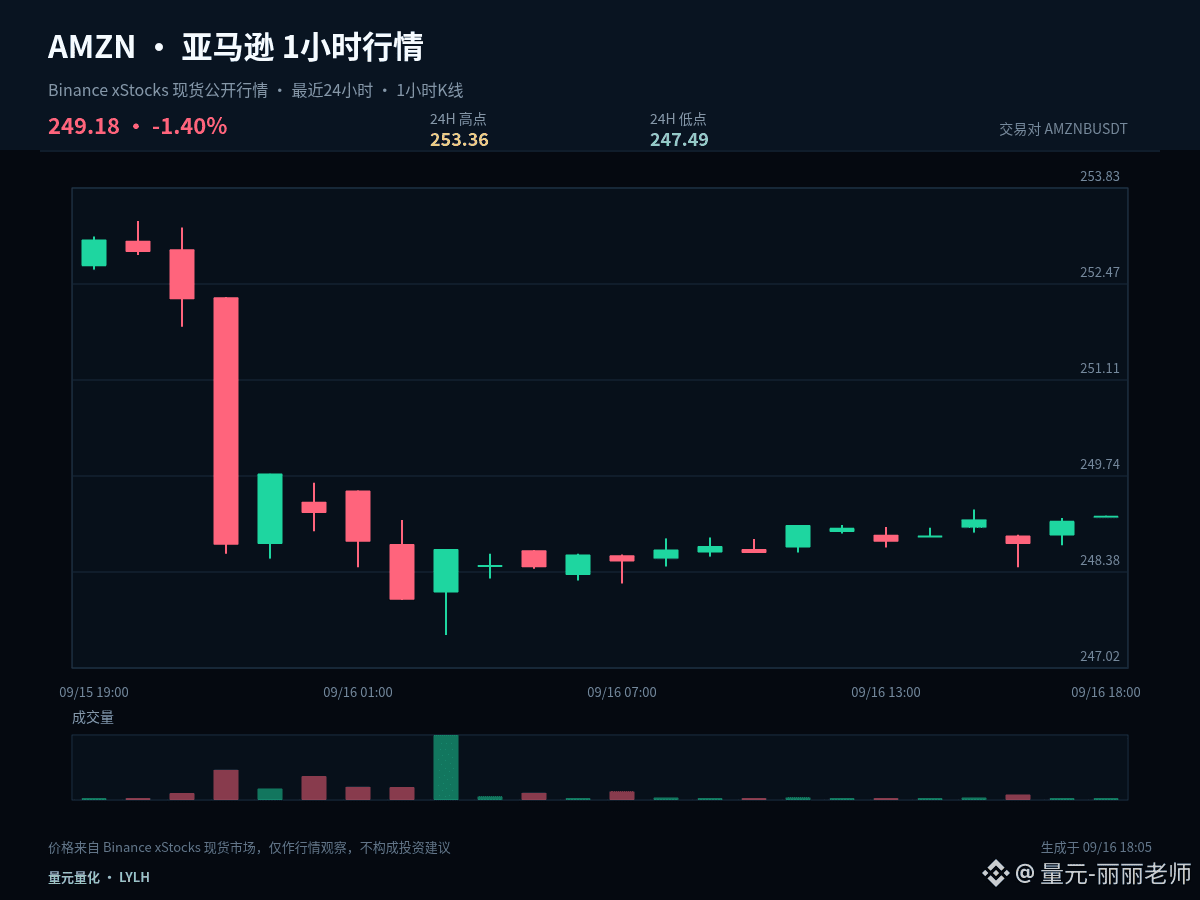
$AMZNB #AMZN has not yet formed a clear one-sided direction; the 1-hour and 24-hour rhythms are still pulling against each other. At this stage, focus on the boundaries of the range rather than the color of every single candlestick.
Currently, 1-hour is +0.03% and 24-hour is -1.21%, and the two cycles have not formed enough clear same-direction coordination. In range-bound conditions, the tolerance for chasing or selling off is lower. It’s more suitable to use confirmation at the upper boundary (for direction) and confirmation of support at the lower boundary; the midline is only used as the line between strength and weakness.
I will treat 250.425 as the short-term long/short pivot: if it holds, it indicates the pullback remains within a controllable range, and afterward there is the possibility to test 253.36 again. After an effective break below it, don’t rush to enter; instead, wait for a new stable structure to appear around 247.49.
There are three ways to handle the next path: if price effectively holds above 253.36, wait for a pullback that doesn’t break and then re-evaluate for continuation; if price breaks down below 247.49, prioritize controlling risk and wait for new support; if it continues to oscillate around 250.425, treat it as range rotation and don’t repeatedly chase a direction in the middle of the range.
Position management should differentiate between swing (medium-term) and short-term trading. For existing swing positions, first check whether the structure is broken—don’t be repeatedly shaken by a single 1-hour candlestick. Short-term positions should be executed around support, resistance, and close confirmations. If you’re currently in cash, you don’t need to chase price in the middle of the range; waiting for a clearer level usually has the advantage.
If the next 1-hour candle closes above 250.425, the structure will become more proactive; if it closes below, remain cautious. Which path are you leaning toward right now?
#ArgentinaCommitsToOECDCryptoReportingBy2029
Currently, 1-hour is +0.03% and 24-hour is -1.21%, and the two cycles have not formed enough clear same-direction coordination. In range-bound conditions, the tolerance for chasing or selling off is lower. It’s more suitable to use confirmation at the upper boundary (for direction) and confirmation of support at the lower boundary; the midline is only used as the line between strength and weakness.
I will treat 250.425 as the short-term long/short pivot: if it holds, it indicates the pullback remains within a controllable range, and afterward there is the possibility to test 253.36 again. After an effective break below it, don’t rush to enter; instead, wait for a new stable structure to appear around 247.49.
There are three ways to handle the next path: if price effectively holds above 253.36, wait for a pullback that doesn’t break and then re-evaluate for continuation; if price breaks down below 247.49, prioritize controlling risk and wait for new support; if it continues to oscillate around 250.425, treat it as range rotation and don’t repeatedly chase a direction in the middle of the range.
Position management should differentiate between swing (medium-term) and short-term trading. For existing swing positions, first check whether the structure is broken—don’t be repeatedly shaken by a single 1-hour candlestick. Short-term positions should be executed around support, resistance, and close confirmations. If you’re currently in cash, you don’t need to chase price in the middle of the range; waiting for a clearer level usually has the advantage.
If the next 1-hour candle closes above 250.425, the structure will become more proactive; if it closes below, remain cautious. Which path are you leaning toward right now?
#ArgentinaCommitsToOECDCryptoReportingBy2029