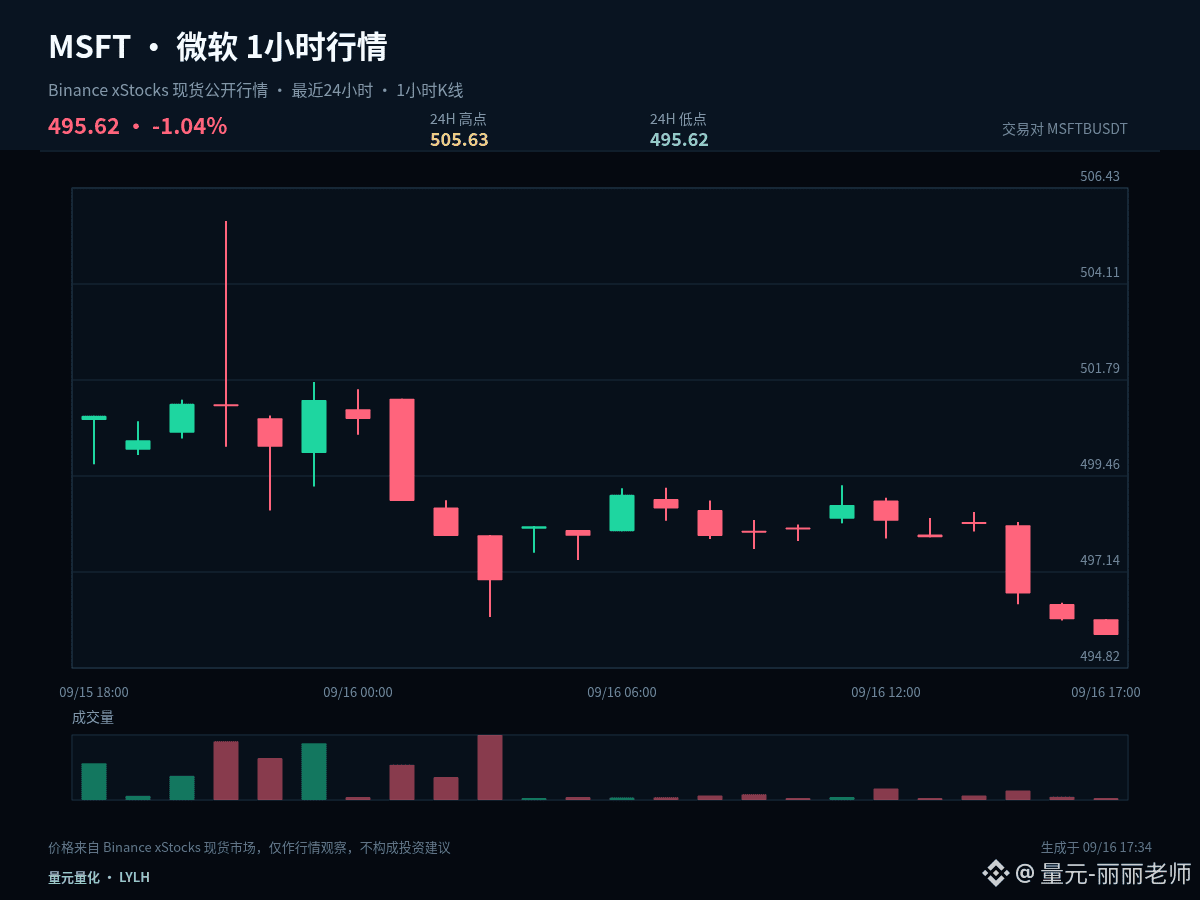
Entering the market only after the hype surrounding $MSFTB #MSFT has built up requires careful assessment of its current position. Currently, it's down 0.08% in the 1-hour chart and down 0.81% in the 24-hour chart; the already completed price action cannot be assumed to be replicable.
$MSFTB #MSFT has returned to near its 24-hour low. The next step is to observe the weakening of selling pressure and confirmation of support. Don't rush to predict a reversal until a bottoming structure is established.
In a weak market, it's easy to mistake a rebound for a reversal. Until 500.625 is recovered, observe the recovery; if it breaks below 495.62, it indicates a lack of effective support below.
The subsequent path can be handled in three ways: If it effectively holds above 505.63, wait for a pullback that doesn't break below before assessing the continuation; if it breaks below 495.62, prioritize risk control and wait for new support; if it continues to oscillate around 500.625, treat it as a range-bound trading pattern and avoid repeatedly chasing the direction in the middle.
Position management should distinguish between medium-term and short-term. For existing medium-term positions, first check if the structure is broken, don't be repeatedly influenced by a single 1-hour candlestick; short-term positions should be executed based on support, resistance, and closing confirmation. Those without positions should not chase prices in the middle of the range; waiting for a clearer position is usually more advantageous.
Missing a move won't directly cause a loss; chasing at the end of a fluctuation without a plan will put your position in a passive position. The focus of short-term positions is not predicting every candlestick, but ensuring that entry, reduction, and exit are based on evidence. Trade less without confirmation; if key levels fail, revise the plan, control individual risk first, then consider subsequent potential gains.
#MSTRTradingVolumeSurpassesMorganStanley
$MSFTB #MSFT has returned to near its 24-hour low. The next step is to observe the weakening of selling pressure and confirmation of support. Don't rush to predict a reversal until a bottoming structure is established.
In a weak market, it's easy to mistake a rebound for a reversal. Until 500.625 is recovered, observe the recovery; if it breaks below 495.62, it indicates a lack of effective support below.
The subsequent path can be handled in three ways: If it effectively holds above 505.63, wait for a pullback that doesn't break below before assessing the continuation; if it breaks below 495.62, prioritize risk control and wait for new support; if it continues to oscillate around 500.625, treat it as a range-bound trading pattern and avoid repeatedly chasing the direction in the middle.
Position management should distinguish between medium-term and short-term. For existing medium-term positions, first check if the structure is broken, don't be repeatedly influenced by a single 1-hour candlestick; short-term positions should be executed based on support, resistance, and closing confirmation. Those without positions should not chase prices in the middle of the range; waiting for a clearer position is usually more advantageous.
Missing a move won't directly cause a loss; chasing at the end of a fluctuation without a plan will put your position in a passive position. The focus of short-term positions is not predicting every candlestick, but ensuring that entry, reduction, and exit are based on evidence. Trade less without confirmation; if key levels fail, revise the plan, control individual risk first, then consider subsequent potential gains.
#MSTRTradingVolumeSurpassesMorganStanley