Tonight, global markets may face a critical repricing.
At 2:00 a.m. Beijing time on Thursday, the Federal Reserve will release its latest interest rate decision, economic projections, and the dot plot; at 2:30 a.m., Chair Waller will hold a press conference. Real volatility often doesn’t begin with the question of “whether they’ll hike,” but with the market’s understanding of “how many more times they’ll hike next.”
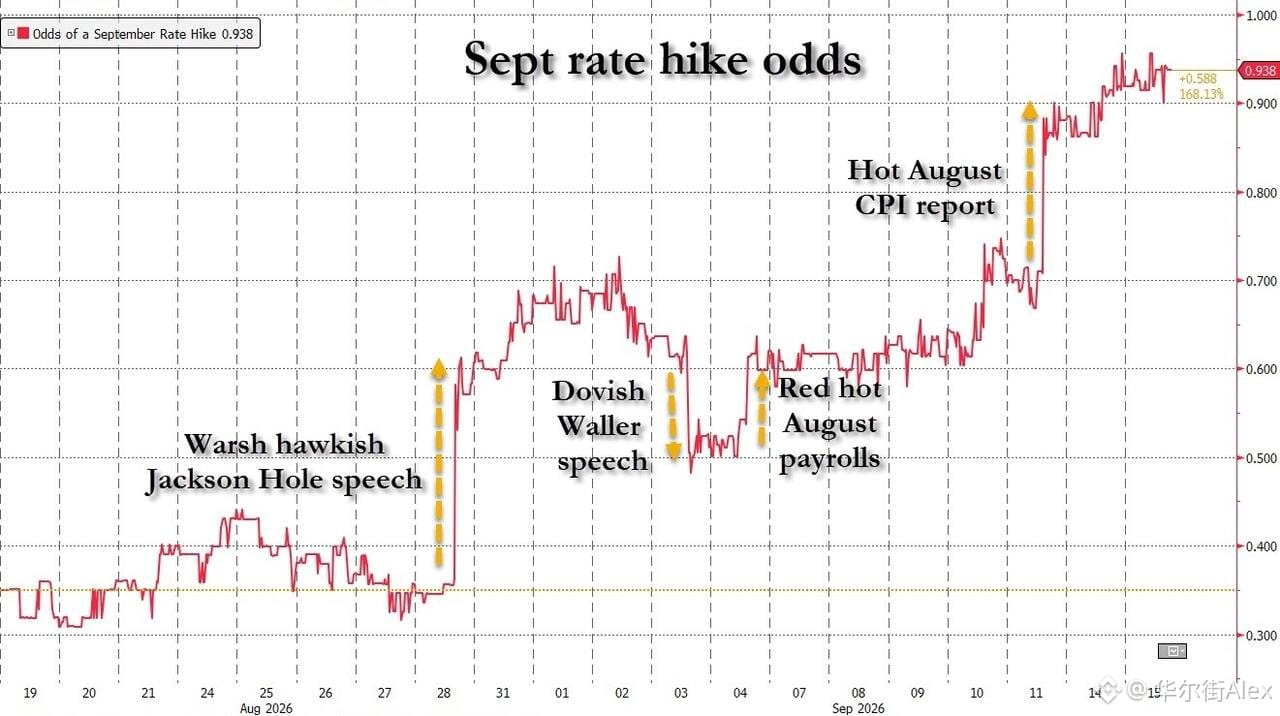
Right now, the market has essentially priced in a 25-basis-point rate hike. Interest rate swap contracts show the probability of this hike is close to 94%, and the target range may be raised to 3.75%—4.00%. In other words, if they don’t hike tonight, it would be a major dovish surprise—and could trigger more complicated market reactions.
Why has the Fed suddenly turned so hawkish?
There are three core reasons:
First, the yield on the 10-year U.S. Treasury has broken above 5%, hitting a multi-year high. The bond market is voting.
Second, energy prices have continued to climb, and inflation pressure has started to heat up again.
Third, the U.S. August core CPI came in above expectations on a month-over-month basis, giving the Fed justification to tighten further.
So tonight’s most important thing isn’t the hike itself, but three details:
Dot plot
Markets will look at whether the dot plot implies one more hike in 2026 or two. If it shows multiple hikes remain within the year, the U.S. dollar and Treasury yields could keep strengthening, weighing on risk assets.
Dissenting votes
If the hike gets a high level of consensus, it suggests the Fed is more willing to maintain policy credibility from within. But if there are clearly dovish dissenting votes, the market may interpret it as a less solid path for future hikes.
Waller’s press conference
This is the true “market ignition point” tonight. If he emphasizes stubborn inflation, a strong economy, and that financial conditions are not tight enough, markets may price in a higher terminal rate. Conversely, if he deliberately downplays the subsequent hike path, risk assets may get some breathing room.
Here’s a counterintuitive point: “not hiking” tonight may not be bullish for stocks.
Because if the Fed doesn’t hike, the market may wonder: has inflation already gotten out of control to the point that the Fed doesn’t dare act? That would lift long-term inflation expectations, further push up 10-year and 30-year Treasury yields, and ultimately hurt valuations of stocks and crypto assets.
On the other hand, if the Fed hikes 25 basis points but doesn’t release signals of consecutive hikes, the market may think, “the shoe has dropped,” and risk assets could rebound in the short term.
For the crypto market, tonight’s focus is on two variables:
One is the U.S. dollar index and Treasury yields.
If the dollar and Treasury yields keep surging, Bitcoin and altcoins will likely face pressure.
Two is how U.S. equities—especially the Nasdaq—respond.
If the market interprets the rate hike as “manageable tightening,” risk appetite may recover, and the crypto market would likely follow with a repair.
My view is that the most likely combination tonight is “a 25-basis-point hike + a restrained statement + Waller not providing too much forward guidance.” That is, the Fed will first safeguard its anti-inflation credibility, but may not be eager to commit immediately to a sequence of hikes.
For short-term traders tonight, don’t just watch the rate outcome. The dot plot and Waller’s wording will truly determine the direction.
For medium-term investors, you should focus on a bigger question: if the U.S. moves into an era with a higher interest-rate “center of gravity,” the valuation logic that has relied on low rates over the past few years may need to be repriced.
Tonight, don’t just watch whether the hammer falls.
More importantly, watch how many times the Fed plans to lift the hammer after it falls.
At 2:00 a.m. Beijing time on Thursday, the Federal Reserve will release its latest interest rate decision, economic projections, and the dot plot; at 2:30 a.m., Chair Waller will hold a press conference. Real volatility often doesn’t begin with the question of “whether they’ll hike,” but with the market’s understanding of “how many more times they’ll hike next.”
Right now, the market has essentially priced in a 25-basis-point rate hike. Interest rate swap contracts show the probability of this hike is close to 94%, and the target range may be raised to 3.75%—4.00%. In other words, if they don’t hike tonight, it would be a major dovish surprise—and could trigger more complicated market reactions.
Why has the Fed suddenly turned so hawkish?
There are three core reasons:
First, the yield on the 10-year U.S. Treasury has broken above 5%, hitting a multi-year high. The bond market is voting.
Second, energy prices have continued to climb, and inflation pressure has started to heat up again.
Third, the U.S. August core CPI came in above expectations on a month-over-month basis, giving the Fed justification to tighten further.
So tonight’s most important thing isn’t the hike itself, but three details:
Dot plot
Markets will look at whether the dot plot implies one more hike in 2026 or two. If it shows multiple hikes remain within the year, the U.S. dollar and Treasury yields could keep strengthening, weighing on risk assets.
Dissenting votes
If the hike gets a high level of consensus, it suggests the Fed is more willing to maintain policy credibility from within. But if there are clearly dovish dissenting votes, the market may interpret it as a less solid path for future hikes.
Waller’s press conference
This is the true “market ignition point” tonight. If he emphasizes stubborn inflation, a strong economy, and that financial conditions are not tight enough, markets may price in a higher terminal rate. Conversely, if he deliberately downplays the subsequent hike path, risk assets may get some breathing room.
Here’s a counterintuitive point: “not hiking” tonight may not be bullish for stocks.
Because if the Fed doesn’t hike, the market may wonder: has inflation already gotten out of control to the point that the Fed doesn’t dare act? That would lift long-term inflation expectations, further push up 10-year and 30-year Treasury yields, and ultimately hurt valuations of stocks and crypto assets.
On the other hand, if the Fed hikes 25 basis points but doesn’t release signals of consecutive hikes, the market may think, “the shoe has dropped,” and risk assets could rebound in the short term.
For the crypto market, tonight’s focus is on two variables:
One is the U.S. dollar index and Treasury yields.
If the dollar and Treasury yields keep surging, Bitcoin and altcoins will likely face pressure.
Two is how U.S. equities—especially the Nasdaq—respond.
If the market interprets the rate hike as “manageable tightening,” risk appetite may recover, and the crypto market would likely follow with a repair.
My view is that the most likely combination tonight is “a 25-basis-point hike + a restrained statement + Waller not providing too much forward guidance.” That is, the Fed will first safeguard its anti-inflation credibility, but may not be eager to commit immediately to a sequence of hikes.
For short-term traders tonight, don’t just watch the rate outcome. The dot plot and Waller’s wording will truly determine the direction.
For medium-term investors, you should focus on a bigger question: if the U.S. moves into an era with a higher interest-rate “center of gravity,” the valuation logic that has relied on low rates over the past few years may need to be repriced.
Tonight, don’t just watch whether the hammer falls.
More importantly, watch how many times the Fed plans to lift the hammer after it falls.