
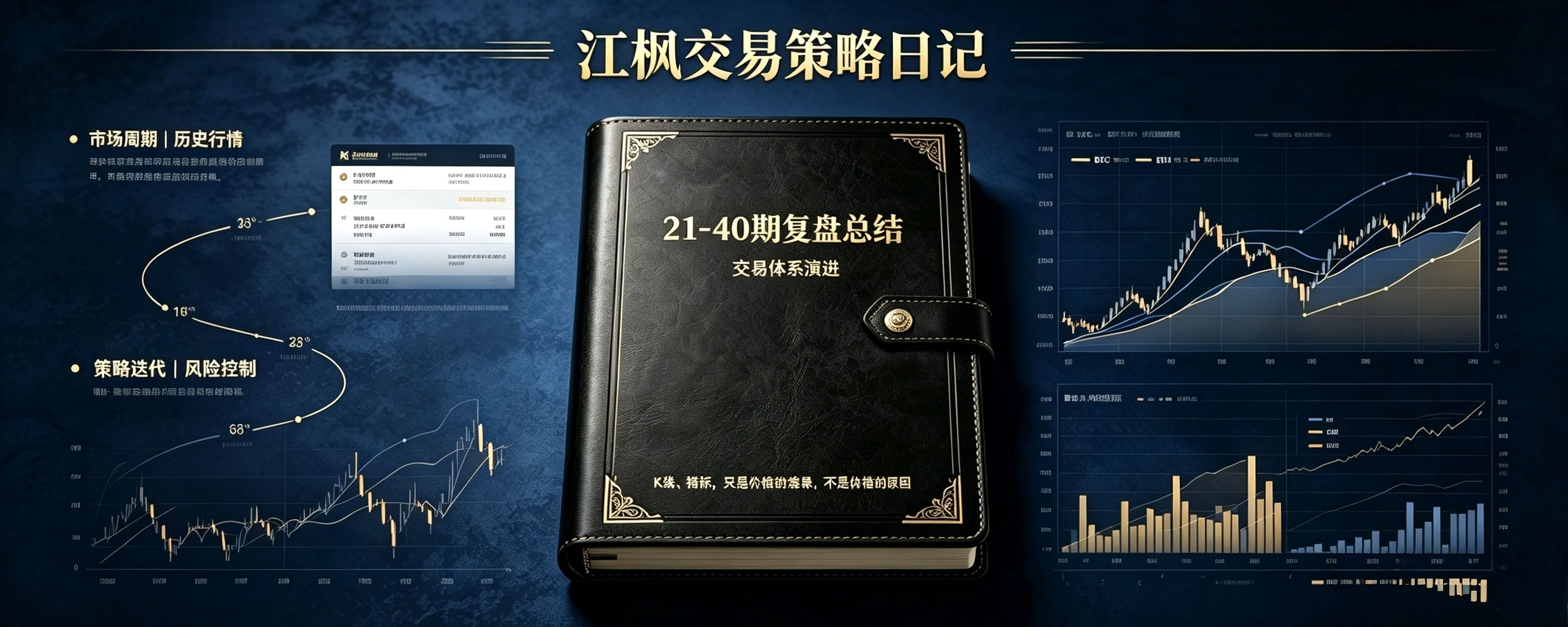

Starting from July 13 this year, I set a very simple rule for myself: publish and keep a record of my trading strategies.
Whether right or wrong, whether in the end it’s take-profit or stop-loss, and even without any entry strategy, everything is still recorded.
Today, the 40th issue has been written. Forty issues: not very long, but not short either.
If it’s just reading one market analysis every day, you might think there’s nothing much to it. But when I put all these 40 issues of records together and review them again, that’s when I truly realized—trading is completely different from what we imagine.
There are times when my judgment is correct, and times when I keep eating stop-losses in a row. There are times when I got the direction right but didn’t get to enter, and times when after entering I held on so hard that I started doubting life itself.
But that’s exactly why I keep insisting on writing trade logs. I’m not trying to prove I’m right every time. I want to see where exactly I’m wrong.
It’s not scary to be wrong. What’s truly terrifying is being wrong and then not knowing why you were wrong.
I. First, take a look at the first 20 episodes; I used to be how “smooth” I was.
The data from Episodes 1–20 is actually very impressive.
BTC’s 20-strategy total: 10 didn’t trigger, 10 were actually traded. 9 were profitable, 1 was losing—win rate 90%.
ETH has the same 20-strategy structure: 10 didn’t trigger, 10 were actually traded. 9 were profitable, 1 was losing—win rate 90%.
BTC+ETH total 40-trade strategy:
Out of 20 times, you didn’t enter 20 times; you truly participated in 20 trades—18 were profitable, 2 were losing. Overall win rate: 90%.
Having those 90% numbers there certainly looks good. But the most interesting part of trading is right here.
When you keep getting things right, it’s easy to feel like you’ve already found the market’s pattern. But the market won’t guarantee that the 19th time is also right just because you got the first 18 times right.
The real test usually doesn’t show up in a lucky streak; it shows up when you keep making the same mistakes. And my test started from Episode 21 onwards.
II. Episode 21: the first time I truly reminded myself—“being right” and “making money” are not the same thing.
In Episode 21, the short zone provided by BTC was 63300–65000. Then price rebounded as high as around 65482, and afterwards it started falling.
Looking at the subsequent price action, the direction wasn’t completely wrong. But the problem was that after entering, I started fighting the position. In the end, although price also moved into the target area, from the perspective of real trading, this order had already gone through stop-loss risk.
So in the end I recorded it as: BTC stop-loss, ETH stop-loss.
This time made me re-understand one problem: trading isn’t about where price ends up at the end. It’s about what your account experiences after you enter.
If after entering you already seriously deviate from the plan, even if the price later comes back, you can’t use “it later proved I was right” as an excuse for yourself—otherwise the recap loses its meaning.
III. Episodes 22–27: you keep eating profits in a row, but what truly alerted me wasn’t the profit. In the next few episodes, the market started giving opportunities.
Episode 22:
BTC took profit at about 2000 points total; ETH reduced positions and protected to break-even.
Episode 23:
BTC completed the 63300 target; after ETH reduced the position, it protected to break-even once the 1860 target was reached.
Episode 24:
After taking profits in batches, both BTC and ETH protected the gains.
Episode 25:
BTC took profits in batches again; ETH didn’t give an opportunity to enter.
Episode 26:
Neither BTC nor ETH triggered.
Episode 27:
BTC completed the second target at 62600; after ETH reduced positions, it protected to break-even.
This stretch of market action made me experience again: not entering doesn’t mean the strategy failed. If the market doesn’t give the price, then you don’t do it.
Sometimes, the hardest trade isn’t “how to make money,” but to watch price rise and fall there and still be able to resist chasing. For traders, “not doing it” is also a result.
IV. Episodes 28–30: some money looks right there in front of you, yet you just can’t earn it
Episodes 28 and 29: neither the BTC nor the ETH strategy triggered.
Episode 30: this is the first time I tried setting up a BTC long entry around 61300–60800, but the market only dipped as low as 62482.
It was off by a certain distance. So this trade never happened from start to finish.
If you look at it in hindsight, you might think: look, it later just shot up.”
But for trading, this sentence has no meaning. If you don’t enter, then you don’t enter. Without triggering conditions, there’s no position. And that’s the biggest value of the public records—
I can’t go back and tell everyone, “Actually I saw it coming,” just because later the price dropped or rose to a certain level. If you don’t enter, then you don’t enter.
V. Episodes 31–32: four consecutive stop-losses— the market starts teaching me a lesson
The truly uncomfortable phase is here
Episode 31:
BTC stop-loss. ETH stop-loss.
Episode 32: BTC stopped out again. ETH stopped out again.
Four consecutive stop-losses.
If you only look at the first 20 episodes’ 90% win rate, it’s easy to start doubting whether it was just luck before. But I actually think these two episodes are extremely valuable. Because the most important thing in trading has never been permanently not using stop-losses.
It’s whether, when your judgments keep being wrong, you can still follow the original rules. Stop-loss itself is not failure.
What’s truly dangerous is when, after the stop-loss, you’re unwilling to accept it—then you start adding to the position, start chasing trades, start revenge trading. In the end you turn a normal, manageable loss into one you can’t bear.
So for Episodes 31 and 32, I’d rather record these losses exactly as they happened.
Because when you look back later, these stop-loss strategies may be more valuable than those “beautiful” take-profits.
VI. Episodes 33–35: the market once again proves that waiting is sometimes more important than prediction
Episode 33: neither BTC nor ETH triggered.
Episode 34: BTC and ETH completed the targets again, and after reducing positions, they protected back to break-even.
Episode 35 is a particularly representative one in this phase.
BTC short: around 79300–80800; add shorts around 81500–82600. Then price fell to around 76947, completing the second target around 77000.
BTC’s 76000 long position didn’t get an entry opportunity.
ETH short: around 2485–2535; add shorts around 2600–2680. Ultimately it fell back to around 2384 to complete the first target.
Then ETH around 2400 also gave a chance: the highest rebound reached around 2490, completing about 90 points.
This episode actually shows several completely different outcomes in trading: short take-profit. Long order not entered. Another long order take-profit.
So in a trading plan, it’s not necessary that all strategies will occur.
What’s truly important is that if it happens, execute according to plan; if it doesn’t happen, accept that it simply didn’t happen.
VII. Episodes 36–38: some profits, some stop-losses—the market still won’t accommodate anyone
Episode 36: neither the BTC nor the ETH strategy provided an ideal entry.
Episode 37: BTC stopped out again.
As for ETH, it went the opposite way: it dropped to around 2430, and after reducing the position size, it was protected back to break-even.
Episode 38: BTC didn’t trigger. ETH entered around 2535–2565, then dipped as low as around 2430 to complete the second target 2435.
These episodes make it clearer and clearer: trading isn’t about finding 100% correct predictions—because such a thing doesn’t exist. What can truly last is a method that, even if your judgment is wrong, won’t kill you; and when your judgment is correct, it can leave as much profit as possible.
VIII. Episodes 39–40: not entering in a row is also part of trading
Episode 39: BTC didn’t trigger. ETH didn’t trigger.
Episode 40: the BTC 79850 short didn’t trigger. ETH also didn’t trigger. Later, on September 11, after a rebound to around 79859, it quickly fell back.
IX. Recap of Episode 40—what did I ultimately hand in as the “report card”?
Putting Episodes 1–40 together for statistics, here’s how it works according to my actual trade logic:
As long as after entering you achieve the goal, you reduce position size, and the remaining position is further protected back to break-even, it’s also counted as take-profit. Because in essence, this kind of trade has already realized profits—not a single order that stays unprofitable from start to finish.
The final data is as follows:
Episodes 1–40: total 81 strategies. 38 didn’t trigger entries, 43 actual entries, 34 take-profits, 9 stop-losses. Overall win rate: 79.07%
Win-rate calculation: 34 ÷ (34+9) = 79.07%
And separately for Episodes 21–40: 41 strategy instances
Of these: 18 trades didn’t enter, 16 were take-profits, 7 were stop-losses. Actually entered: 23 trades.
Win rate: 16 ÷ (16+7) = 69.57%. From the first 20 episodes’ 90% to the next 20 episodes’ 69.57%.
This number doesn’t look as impressive as the earlier 90%. But I actually think the data from the last 20 episodes is more meaningful than the first 20.
Because it went through consecutive stop-losses, also went through times when the judgment was correct but didn’t lead to an entry, and also went through reducing positions, protecting to break-even, taking profits, and the real trading pressure in the process.
A 79.07% win rate doesn’t mean I’ve found the trading holy grail. Win rate is only win rate.
What truly determines whether a trade can survive long-term is also the risk-reward ratio, position sizing, stop-loss range, take-profit range—and most importantly—execution.
Especially for me, I’m very clear: sometimes the directional judgment may not be the problem, but in the execution you run into counter-trades, premature break-even, missed re-entry opportunities, or even emotions generated after the stop-loss.
These things won’t directly show up in a single win-rate table. So for me, in this recap of 40 episodes, what’s truly important isn’t the 79.07% being “so high.” It’s why there were 9 stop-losses, why some times I was clearly right but still didn’t make money, and why sometimes even when I already had profit, I still managed to make myself feel awful?”
These issues are what should truly be solved in the next phase.
Why do I keep insisting on leaving all records behind? Anyone who trades should understand a feeling: when you’re making money, you always think you really understand the market.
When you’re losing money, you feel like the market is specifically working against you. But once you truly put dozens of trades together, you’ll realize the market has never been targeting anyone. It just keeps giving you questions. If you get today’s answer right, it gives you profit. If you get tomorrow wrong, it takes your stop-loss. The day after tomorrow it won’t give you a chance, and you can only stand outside and watch.
And the trade log is where I leave all those “exam results.”
No deleting posts. No hindsight talk. Not because it later went up and then saying I was bullish all along. And not because it later fell and then saying I was bearish all along. Whatever I wrote at the time is what the result ends up being.
This might be the most important meaning of why I keep writing the (Jiangfeng Trading Strategy Diary).
Episode 40 ended. Not the endpoint—just one stage. Episodes 1–20: 90% win rate. Episodes 21–40: 69.57% win rate.
Episodes 1–40: 81 strategies, 43 actual entries, 34 take-profits, 9 stop-losses. Overall win rate: 79.07%.
The numbers will keep changing.
Episode 41, Episode 42, Episode 50, Episode 100…
There may be more take-profits in the future, and there will definitely be more stop-losses as well.
But I hope I can always keep one thing: when I profit, I record it. When I lose, I record it too. When I’m wrong, I admit it. When I’m right, I recap it. Because what’s truly scary about trading is never just one losing trade.
But after losing, you learn nothing. I write these not to tell others how “great” I am. On the contrary, I want to leave behind every moment of hesitation, greed, fear, wishful thinking, and persistence of an ordinary trader in the market—and the process where the market educates you again and again.
Episode 40 is just the beginning. The road ahead is still very long.
All the strategies above can be reviewed (Jiangfeng Trading Strategy Diary) and checked episode by episode.
