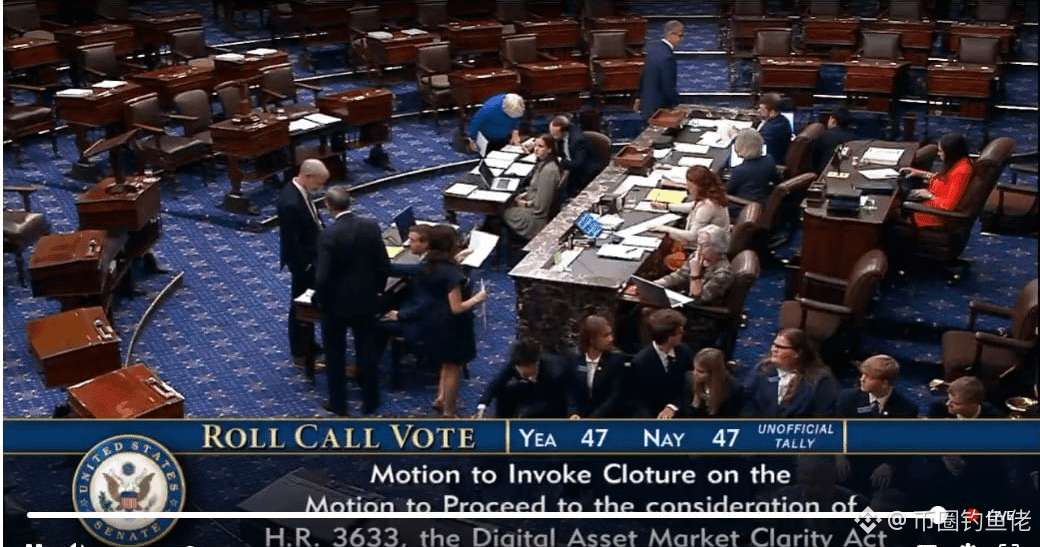
CLARITY Act】At 4:50 a.m. on September 16, the Senate’s procedural vote failed 49:50, falling short of 60 votes, leaving little hope in the short term of moving into full chamber consideration. This is the one thing the crypto crowd most wants to prove: that its bill is being kept off the voting table.
49 to 50 sounds like a single-vote difference, but in reality it’s a shortfall of 11 votes. This procedural vote requires 60 votes, #Clarity and it didn’t even manage to reach the threshold for a formal debate.
This is the cruelest part of the outcome—not that the bill was rejected, but that the Senate wouldn’t put it on the table.
All 49 “yes” votes came from Republicans; not a single Democratic or independent lawmaker supported moving it forward. So this isn’t “almost reaching cross-party consensus.”
They made 126 changes, yet there still isn’t a single cross-party vote. The number of edits isn’t the same as trust. Democrats still believe the bill hasn’t closed the loopholes that allow the president’s family and senior officials to profit from crypto businesses.
This isn’t fundamentally a regulatory-technology problem. By the time it got to the end, every line touched real interests. Officials’ crypto assets run into political ethics. Stablecoin rewards run into bank deposits. DeFi developer protections run into anti–money laundering rules and law-enforcement authority.
CLARITY’s failure isn’t a failure of crypto. What it exposes is: the U.S. may verbally support crypto innovation, but the moment political interests, banking interests, and regulatory power are involved, cross-party consensus remains extremely fragile.
$BTC
The few percentage points that have dropped will likely be covered up by the next set of macroeconomic data soon. But for the whole industry, what’s been lost is a long-term rule written into law...
49 to 50 sounds like a single-vote difference, but in reality it’s a shortfall of 11 votes. This procedural vote requires 60 votes, #Clarity and it didn’t even manage to reach the threshold for a formal debate.
This is the cruelest part of the outcome—not that the bill was rejected, but that the Senate wouldn’t put it on the table.
All 49 “yes” votes came from Republicans; not a single Democratic or independent lawmaker supported moving it forward. So this isn’t “almost reaching cross-party consensus.”
They made 126 changes, yet there still isn’t a single cross-party vote. The number of edits isn’t the same as trust. Democrats still believe the bill hasn’t closed the loopholes that allow the president’s family and senior officials to profit from crypto businesses.
This isn’t fundamentally a regulatory-technology problem. By the time it got to the end, every line touched real interests. Officials’ crypto assets run into political ethics. Stablecoin rewards run into bank deposits. DeFi developer protections run into anti–money laundering rules and law-enforcement authority.
CLARITY’s failure isn’t a failure of crypto. What it exposes is: the U.S. may verbally support crypto innovation, but the moment political interests, banking interests, and regulatory power are involved, cross-party consensus remains extremely fragile.
$BTC
The few percentage points that have dropped will likely be covered up by the next set of macroeconomic data soon. But for the whole industry, what’s been lost is a long-term rule written into law...