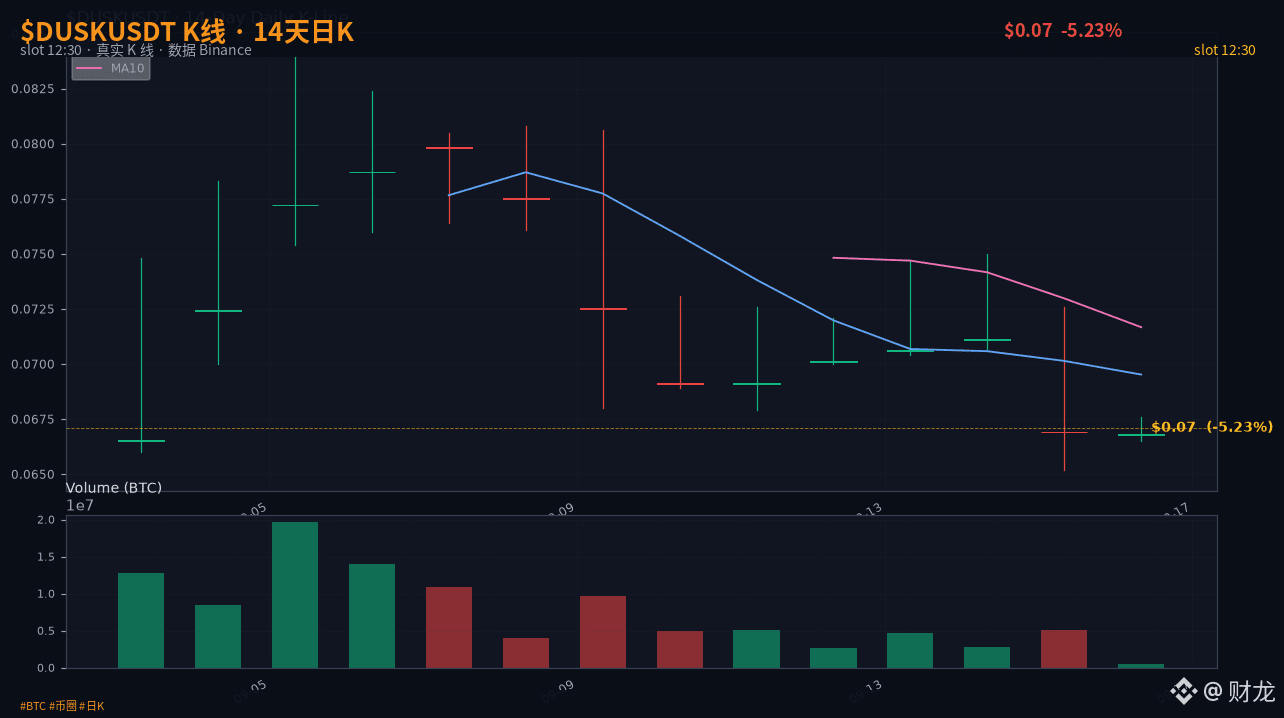

In $DUSK 24 hours, it dropped 5.367%, grinding down from $0.0708 to $0.0670; the intraday low was $0.0652, and the 24-hour trading volume was 352,000 USDT. The candlestick looks ugly, but the line that @Dusk quietly laid this week is even more worth dissecting than this one.
On September 15, Dusk officially published an RWA interoperability special (dusk.network/news/rwa-interoperability). On September 11, it also posted a use case for trading-venues-secondary-markets. Put together, the two point to an unresolved gap under EU regulation: how do cross-chain RWA assets move from the “native issuance chain” to the “secondary market circulation chain”—and what happens to investors’ rights, ownership proofs, and regulatory attribution as they cross?
Under the MiCA framework, if the issuer issues under MiCA on chain A, then the asset moves to chain B for secondary-market trading—who holds the rights and responsibilities?
The kind of settlement+trading-all-in-one license like 21X solves the single-chain problem, and NPEX’s license handles the off-chain side. But for the cross-chain step, a license can only cover part of it. The public-chain privacy layer (Dusk’s choice of selective disclosure) must cover the other half of the seam. #dusk #EU-licensed
In practice: a Dutch asset manager issues a fund under MiCA on chain A, and the assets move to chain B for secondary-market trading. For the cross-chain step, who pays the compliance costs? Who takes responsibility for KYC/AML for retail investors on chain B? Can NPEX’s license cover the secondary market after the cross-chain move?
Under the current version, the portion that the license can’t cover must be handled by the public-chain privacy layer (Dusk’s selective disclosure on this chain)—as the other half of the seam. #Cross-chainRWAseam
On September 15, Dusk officially published an RWA interoperability special (dusk.network/news/rwa-interoperability). On September 11, it also posted a use case for trading-venues-secondary-markets. Put together, the two point to an unresolved gap under EU regulation: how do cross-chain RWA assets move from the “native issuance chain” to the “secondary market circulation chain”—and what happens to investors’ rights, ownership proofs, and regulatory attribution as they cross?
Under the MiCA framework, if the issuer issues under MiCA on chain A, then the asset moves to chain B for secondary-market trading—who holds the rights and responsibilities?
The kind of settlement+trading-all-in-one license like 21X solves the single-chain problem, and NPEX’s license handles the off-chain side. But for the cross-chain step, a license can only cover part of it. The public-chain privacy layer (Dusk’s choice of selective disclosure) must cover the other half of the seam. #dusk #EU-licensed
In practice: a Dutch asset manager issues a fund under MiCA on chain A, and the assets move to chain B for secondary-market trading. For the cross-chain step, who pays the compliance costs? Who takes responsibility for KYC/AML for retail investors on chain B? Can NPEX’s license cover the secondary market after the cross-chain move?
Under the current version, the portion that the license can’t cover must be handled by the public-chain privacy layer (Dusk’s selective disclosure on this chain)—as the other half of the seam. #Cross-chainRWAseam