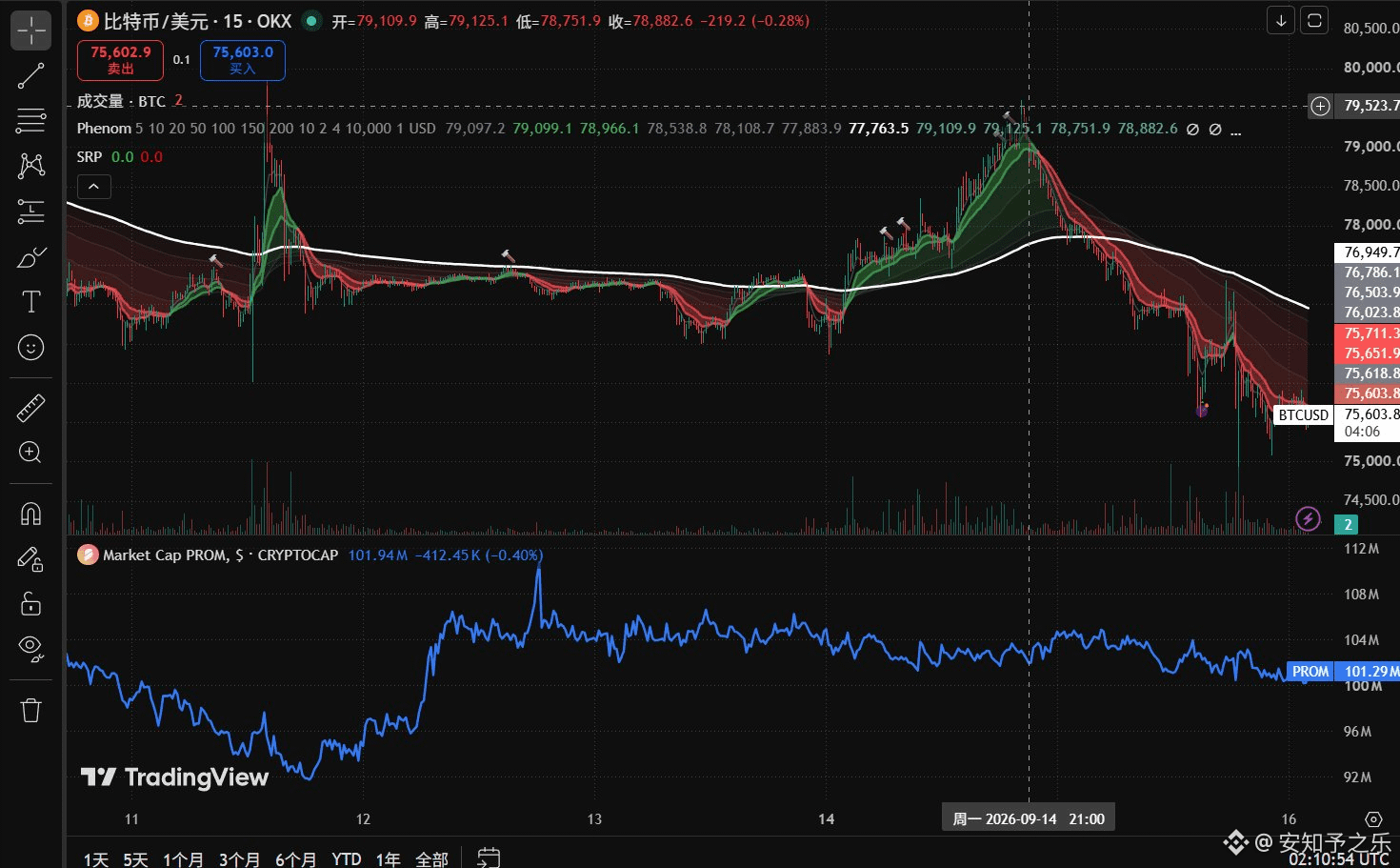
I just took a look at the order book—the #BTC has returned to around $75.8K.
Although the intraday swings don’t look particularly extreme, at this price level there’s active buying from funds, which can provide the market with some psychological support. The shorts that originally planned to sell into the move may now have a bit more to worry about too.
That said, the main focus is still the macro environment. Right now, sentiment in Wall Street and the U.S. Treasury market is rather tense. The 10-year Treasury yield remains elevated, and market expectations for the Fed’s next monetary policy have been swinging back and forth. Recently, sensitivity across crypto markets has been turned up to the max—it’s not just one specific policy headline driving it.
BTC is increasingly acting like an emotional amplifier. When macro expectations shift, risk assets react first; when the dollar and rate-expectation outlooks fluctuate, BTC’s price action tends to amplify further. Once a policy headline drops, short-term funds switch quickly between long and short.
Next, I’m watching two key price levels: $76K. If it can hold steady, short-term market sentiment may continue to recover, and overhead selling pressure may have a chance to be digested gradually. If it breaks back below $75K, then we’ll need to see how strong the buy-side follow-through is around the $74K area. Losing that level doesn’t necessarily mean the trend is fully broken, but it does indicate the market is still stuck in its ranging structure.
My thinking is pretty simple: don’t blindly chase on the way up, and don’t panic-sell on the way down. Until a key level confirms a breakout, don’t add to your position arbitrarily beyond your core holdings.
That’s what makes the market so interesting: when a bill doesn’t pass, one group feels bearish and sighs, while another group continues to build positions in BTC. A small dip makes the shorts start feeling optimistic; the moment the price bounces back, someone immediately starts shouting “reversal.”
At the end of the day, it all comes down to one thing: manage your own position size. Even if the market pulls back, your holdings can help you sleep soundly.
Although the intraday swings don’t look particularly extreme, at this price level there’s active buying from funds, which can provide the market with some psychological support. The shorts that originally planned to sell into the move may now have a bit more to worry about too.
That said, the main focus is still the macro environment. Right now, sentiment in Wall Street and the U.S. Treasury market is rather tense. The 10-year Treasury yield remains elevated, and market expectations for the Fed’s next monetary policy have been swinging back and forth. Recently, sensitivity across crypto markets has been turned up to the max—it’s not just one specific policy headline driving it.
BTC is increasingly acting like an emotional amplifier. When macro expectations shift, risk assets react first; when the dollar and rate-expectation outlooks fluctuate, BTC’s price action tends to amplify further. Once a policy headline drops, short-term funds switch quickly between long and short.
Next, I’m watching two key price levels: $76K. If it can hold steady, short-term market sentiment may continue to recover, and overhead selling pressure may have a chance to be digested gradually. If it breaks back below $75K, then we’ll need to see how strong the buy-side follow-through is around the $74K area. Losing that level doesn’t necessarily mean the trend is fully broken, but it does indicate the market is still stuck in its ranging structure.
My thinking is pretty simple: don’t blindly chase on the way up, and don’t panic-sell on the way down. Until a key level confirms a breakout, don’t add to your position arbitrarily beyond your core holdings.
That’s what makes the market so interesting: when a bill doesn’t pass, one group feels bearish and sighs, while another group continues to build positions in BTC. A small dip makes the shorts start feeling optimistic; the moment the price bounces back, someone immediately starts shouting “reversal.”
At the end of the day, it all comes down to one thing: manage your own position size. Even if the market pulls back, your holdings can help you sleep soundly.