Wall Street research & investment observations‧September 16
What did we find?
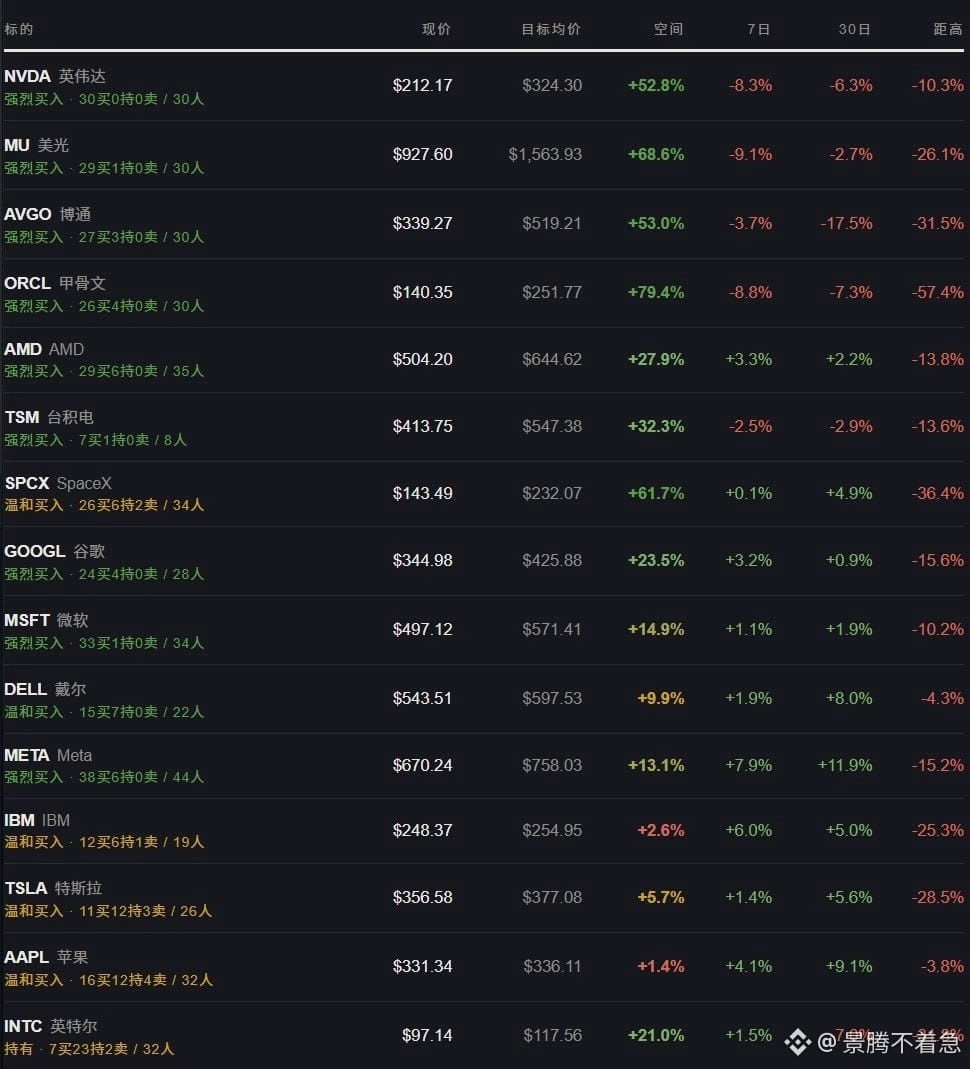
Today’s coverage pool structure is rare: very high consensus with very few rating actions. Out of 15 underlying names, 10 have had zero sell-side orders; the implied upside ranges from Microsoft +14.9% to Oracle +79.4%. However, within 48 hours, only 11 names saw any rating actions—no upgrades and no downgrades. Everything is either a “reaffirmation” or a “first coverage.” The sell-side stays put collectively at the high end.
Market action diverges from consensus: the semiconductor hardware chain continued to weaken—Oracle was down 8.8% over 7 days and 57.4% below its 52-week high; Micron fell 9.1% over 7 days; Nvidia dropped 8.3% over 7 days; Broadcom declined 17.5% over 30 days. Strength came from Meta (up 7.9% over 7 days, up 11.9% over 30 days), IBM (up 6.0% over 7 days), and Apple (up 4.1% over 7 days). Funds are moving from “compute” to “cash flow.”
With no add-ons from the sell-side and buyers taking profits along the hardware chain, the biggest opportunity lies in heavily beaten-down names with deep pullbacks—not in the strong stocks that are only 4% away from their 52-week highs. The one window item worth noting: Morgan Stanley’s first coverage of Oracle assigns a “Hold,” taking the field against the other 26 buy-side institutions.
Apple and AMD are the two extremes of the day: for Apple, high-level disagreement; for AMD, institutions openly admit the valuation is too high.
---
Today’s research: drilled down and then selected
Drill-down|Core allocations / Best value
$MU Micron — Implied +68.6%, the highest among chip stocks in the implied-upside table. Out of 30 institutions, only 1 holds and none sell. Long-term customer agreements set a price floor. Current price is $927.60, 26.1% below the 52-week high; another 9.1% drop over the past 7 days is, in fact, the entry window. Upside comes from killing valuation—not from upgrade expectations—making it the best value.
$AVGO Broadcom — Implied +53.0%. Among 30 institutions, 27 buy, 3 hold, and none sell. Dual-engine leaders in customized AI chips and networking; customer base expanded to three large AI enterprises. Down 17.5% over 30 days and 31.5% below the 52-week high. The pullback has already covered most of the risk at the highs; both quality and price are excellent.
$ORCL Oracle — Implied +79.4%, the top in the entire pool. 30 institutions: 26 buy. Orders piled up turning into revenue; equity financing removes the overhang of suspended funds. Current price is $140.35, 57.4% below the 52-week high—an extreme case of being mispriced down. The variable is Morgan Stanley’s first coverage giving a “Hold”; consider taking a small position in batches and waiting for the short thesis to be falsified.
Up with the best | High-quality core, but not that cheap
NVDA Nvidia — 30 institutions all buy; zero holders and zero sellers. Consensus is #1 in the whole pool. But with a current price of $212.17, 10.3% below the 52-week high, and down 8.3% over 7 days, the implied +52.8% depends on volume delivery from the next-generation products—so it’s not cheap.
GOOGL Google — 28 institutions: 24 buy, 4 hold, and none sell. Cloud business is boosted by enterprise-level AI; selling TPU externally opens a new revenue stream. 52-week high is down 15.6%, and the 30-day trend is flat. Implied +23.5% is mid-to-upper, but lacks catalysts.
MSFT Microsoft — 34 institutions: 33 buy, 1 hold. Consensus is extremely stable. But the 7-day and 30-day returns are nearly flat; 10.2% below the 52-week high. Implied upside is only +14.9%, the lowest in the whole pool. The AI assistant inflection point is waiting for data to validate.
META — 44 institutions: 38 buy, 6 hold, and none sell. Consensus is the thickest. Momentum is the strongest in the whole pool: up 7.9% over 7 days and up 11.9% over 30 days. But the current price of $670.24 is approaching the target average price of $758.03, narrowing the implied upside to +13.1%.
AMD — 35 institutions: 29 buy, 6 hold, and none sell. Helios racks have won orders from multiple AI labs; the ROCm ecosystem is mature. However, it is still +236.5% above the 52-week low and implied +27.9%—a great company, but not a great price.
NPC|Average and drifting, lacking an independent trend
TSM TSMC — 8 institutions: 7 buy, 1 hold, none sell. Process and packaging leadership is firmly established, implied +32.3%. But coverage has only 8 samples—too thin. Over 7 days it’s down 2.5%, over 30 days down 2.9%, tracking overall semiconductor sentiment.
DELL Dell — 22 institutions: 15 buy, 7 hold, none sell. AI server order backlogs provide visible revenue; 30-day +8.0%. However, it is 4.3% below the 52-week high with implied +9.9%, which is already priced in.
IBM — 19 institutions: 12 buy, 6 hold, and 1 sell. Consensus is bland. Up 6.0% over 7 days and up 5.0% over 30 days are solid, but implied upside is only +2.6%. The stock has already reached the target average price—there’s no catalyst for repricing.
SPCX SpaceX — 34 institutions: 26 buy, 6 hold, 2 sell. Implied +61.7% looks tempting. But the bearish thesis centers on financing dependence and intensifying competition; as a newer stock, there is also underwriting chatter and release/supply pressure after lock-up.
Pull|High risk—steer clear
AAPL Apple — 32 institutions: 16 buy, 12 hold, 4 sell. Sell ratings are the most across the pool. Two target prices—$263.66 (Jefferies) and $300 (Phillip Securities)—are both below the current price of $331.34. Implied upside is only +1.4%, and 52-week high is down 3.8%. Worst value.
INTC Intel — Consensus is only “Hold” (7 buy, 23 hold, 2 sell). It’s the only stock in the coverage pool that lacks a buy-side consensus. Down 31.8% from the 52-week high and down 7.0% over 30 days; outsourcing/foundry share expectations are already built into the valuation.
TSLA Tesla — 26 institutions: 11 buy, 12 hold, 3 sell. Holds exceed buys. Implied upside is only +5.7%, and it’s 28.5% below the 52-week high; but over 30 days it’s only +5.6%. Upside depends largely on the commercialization of autonomous driving; insufficient disclosures are hard to verify.
---
The attached figure shows a rating overview. Target prices represent a 12-month optimistic scenario and do not constitute investment advice.
#btc #aapl #trading #tsla #stocks
What did we find?
Today’s coverage pool structure is rare: very high consensus with very few rating actions. Out of 15 underlying names, 10 have had zero sell-side orders; the implied upside ranges from Microsoft +14.9% to Oracle +79.4%. However, within 48 hours, only 11 names saw any rating actions—no upgrades and no downgrades. Everything is either a “reaffirmation” or a “first coverage.” The sell-side stays put collectively at the high end.
Market action diverges from consensus: the semiconductor hardware chain continued to weaken—Oracle was down 8.8% over 7 days and 57.4% below its 52-week high; Micron fell 9.1% over 7 days; Nvidia dropped 8.3% over 7 days; Broadcom declined 17.5% over 30 days. Strength came from Meta (up 7.9% over 7 days, up 11.9% over 30 days), IBM (up 6.0% over 7 days), and Apple (up 4.1% over 7 days). Funds are moving from “compute” to “cash flow.”
With no add-ons from the sell-side and buyers taking profits along the hardware chain, the biggest opportunity lies in heavily beaten-down names with deep pullbacks—not in the strong stocks that are only 4% away from their 52-week highs. The one window item worth noting: Morgan Stanley’s first coverage of Oracle assigns a “Hold,” taking the field against the other 26 buy-side institutions.
Apple and AMD are the two extremes of the day: for Apple, high-level disagreement; for AMD, institutions openly admit the valuation is too high.
---
Today’s research: drilled down and then selected
Drill-down|Core allocations / Best value
$MU Micron — Implied +68.6%, the highest among chip stocks in the implied-upside table. Out of 30 institutions, only 1 holds and none sell. Long-term customer agreements set a price floor. Current price is $927.60, 26.1% below the 52-week high; another 9.1% drop over the past 7 days is, in fact, the entry window. Upside comes from killing valuation—not from upgrade expectations—making it the best value.
$AVGO Broadcom — Implied +53.0%. Among 30 institutions, 27 buy, 3 hold, and none sell. Dual-engine leaders in customized AI chips and networking; customer base expanded to three large AI enterprises. Down 17.5% over 30 days and 31.5% below the 52-week high. The pullback has already covered most of the risk at the highs; both quality and price are excellent.
$ORCL Oracle — Implied +79.4%, the top in the entire pool. 30 institutions: 26 buy. Orders piled up turning into revenue; equity financing removes the overhang of suspended funds. Current price is $140.35, 57.4% below the 52-week high—an extreme case of being mispriced down. The variable is Morgan Stanley’s first coverage giving a “Hold”; consider taking a small position in batches and waiting for the short thesis to be falsified.
Up with the best | High-quality core, but not that cheap
NVDA Nvidia — 30 institutions all buy; zero holders and zero sellers. Consensus is #1 in the whole pool. But with a current price of $212.17, 10.3% below the 52-week high, and down 8.3% over 7 days, the implied +52.8% depends on volume delivery from the next-generation products—so it’s not cheap.
GOOGL Google — 28 institutions: 24 buy, 4 hold, and none sell. Cloud business is boosted by enterprise-level AI; selling TPU externally opens a new revenue stream. 52-week high is down 15.6%, and the 30-day trend is flat. Implied +23.5% is mid-to-upper, but lacks catalysts.
MSFT Microsoft — 34 institutions: 33 buy, 1 hold. Consensus is extremely stable. But the 7-day and 30-day returns are nearly flat; 10.2% below the 52-week high. Implied upside is only +14.9%, the lowest in the whole pool. The AI assistant inflection point is waiting for data to validate.
META — 44 institutions: 38 buy, 6 hold, and none sell. Consensus is the thickest. Momentum is the strongest in the whole pool: up 7.9% over 7 days and up 11.9% over 30 days. But the current price of $670.24 is approaching the target average price of $758.03, narrowing the implied upside to +13.1%.
AMD — 35 institutions: 29 buy, 6 hold, and none sell. Helios racks have won orders from multiple AI labs; the ROCm ecosystem is mature. However, it is still +236.5% above the 52-week low and implied +27.9%—a great company, but not a great price.
NPC|Average and drifting, lacking an independent trend
TSM TSMC — 8 institutions: 7 buy, 1 hold, none sell. Process and packaging leadership is firmly established, implied +32.3%. But coverage has only 8 samples—too thin. Over 7 days it’s down 2.5%, over 30 days down 2.9%, tracking overall semiconductor sentiment.
DELL Dell — 22 institutions: 15 buy, 7 hold, none sell. AI server order backlogs provide visible revenue; 30-day +8.0%. However, it is 4.3% below the 52-week high with implied +9.9%, which is already priced in.
IBM — 19 institutions: 12 buy, 6 hold, and 1 sell. Consensus is bland. Up 6.0% over 7 days and up 5.0% over 30 days are solid, but implied upside is only +2.6%. The stock has already reached the target average price—there’s no catalyst for repricing.
SPCX SpaceX — 34 institutions: 26 buy, 6 hold, 2 sell. Implied +61.7% looks tempting. But the bearish thesis centers on financing dependence and intensifying competition; as a newer stock, there is also underwriting chatter and release/supply pressure after lock-up.
Pull|High risk—steer clear
AAPL Apple — 32 institutions: 16 buy, 12 hold, 4 sell. Sell ratings are the most across the pool. Two target prices—$263.66 (Jefferies) and $300 (Phillip Securities)—are both below the current price of $331.34. Implied upside is only +1.4%, and 52-week high is down 3.8%. Worst value.
INTC Intel — Consensus is only “Hold” (7 buy, 23 hold, 2 sell). It’s the only stock in the coverage pool that lacks a buy-side consensus. Down 31.8% from the 52-week high and down 7.0% over 30 days; outsourcing/foundry share expectations are already built into the valuation.
TSLA Tesla — 26 institutions: 11 buy, 12 hold, 3 sell. Holds exceed buys. Implied upside is only +5.7%, and it’s 28.5% below the 52-week high; but over 30 days it’s only +5.6%. Upside depends largely on the commercialization of autonomous driving; insufficient disclosures are hard to verify.
---
The attached figure shows a rating overview. Target prices represent a 12-month optimistic scenario and do not constitute investment advice.
#btc #aapl #trading #tsla #stocks