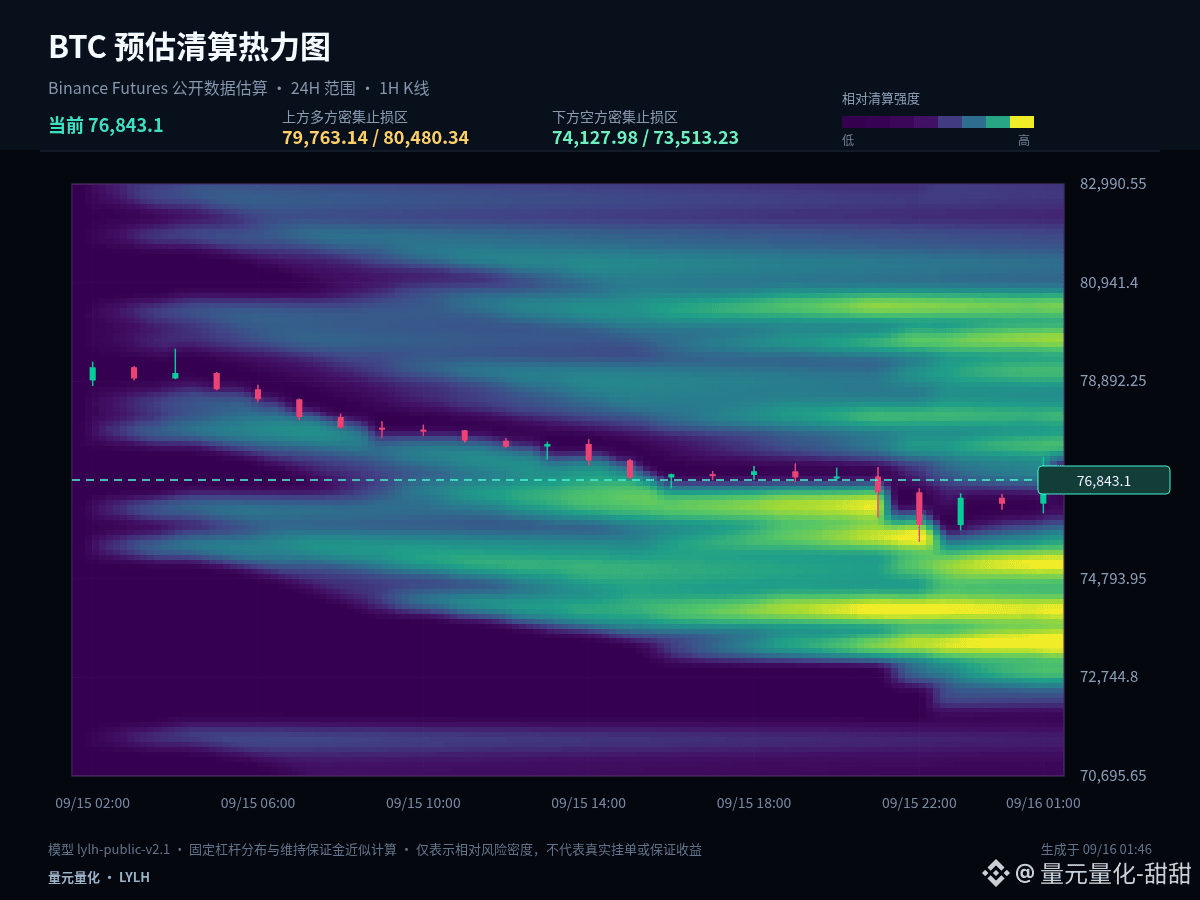
$BTC #BTC This time, I break down things from a position perspective. In the same chart, the key points differ depending on whether you already hold a position or are currently flat. Current price: 76,874.01. In the past 1 hour: +0.64%, and in the past 24 hours: -2.50%.
Based on cycle alignment: the 24-hour change is -2.50%, while the 1-hour has returned to +0.64%. Short-term is repairing, but the larger timeframe has not yet fully turned stronger. At this stage, treat it as a bounce. Only if price regains and holds above the core resistance and completes an effective retest, will there be conditions to upgrade the assessment to a trend reversal.
For those already in a position, first observe whether continuous rejection appears around 79,600, and use 77,602.5 as the protective structure. For those with no position, don’t chase near resistance; instead, wait for the consolidation and acceptance after the retest of the midline, or for a second confirmation after breaking resistance.
My scenario analysis is not betting on just one direction. If price breaks above 79,600 and can hold, it means the upside space has been reopened. If it breaks below 75,605 and cannot reclaim it on the bounce, it means the structure weakens further. If it stays trading between those levels, continue monitoring the closing behavior on both sides of 77,602.5.
For those already holding: the focus is to manage based on whether support fails, not to get carried away by every fluctuation. For those flat: prioritize waiting for a breakout-and-retest, or support confirmation. Spot can be scaled in batches; for derivatives, shorten the decision chain—first determine the stop-loss level, then decide whether to participate.
The key with contracts is not to predict every single K-line. It’s to ensure that entries, trimming, and exits all have a basis. Do less without confirmation; when a key level fails, redo the plan. Control risk per trade first, and only then talk about further upside/downside space.
#StrategyMarketCapPassesFord
Based on cycle alignment: the 24-hour change is -2.50%, while the 1-hour has returned to +0.64%. Short-term is repairing, but the larger timeframe has not yet fully turned stronger. At this stage, treat it as a bounce. Only if price regains and holds above the core resistance and completes an effective retest, will there be conditions to upgrade the assessment to a trend reversal.
For those already in a position, first observe whether continuous rejection appears around 79,600, and use 77,602.5 as the protective structure. For those with no position, don’t chase near resistance; instead, wait for the consolidation and acceptance after the retest of the midline, or for a second confirmation after breaking resistance.
My scenario analysis is not betting on just one direction. If price breaks above 79,600 and can hold, it means the upside space has been reopened. If it breaks below 75,605 and cannot reclaim it on the bounce, it means the structure weakens further. If it stays trading between those levels, continue monitoring the closing behavior on both sides of 77,602.5.
For those already holding: the focus is to manage based on whether support fails, not to get carried away by every fluctuation. For those flat: prioritize waiting for a breakout-and-retest, or support confirmation. Spot can be scaled in batches; for derivatives, shorten the decision chain—first determine the stop-loss level, then decide whether to participate.
The key with contracts is not to predict every single K-line. It’s to ensure that entries, trimming, and exits all have a basis. Do less without confirmation; when a key level fails, redo the plan. Control risk per trade first, and only then talk about further upside/downside space.
#StrategyMarketCapPassesFord