

$ARC Mainnet will officially go live tomorrow.
Over the past few months, this project’s presence in the crypto space has been rather divisive. On one side, Circle has made a high-profile announcement, stuffing the validator list with names like BlackRock, DTCC, Visa, Mastercard, ICE, and StanChart—sounds like traditional finance is collectively “on-chain.” On the other side, the community has already started to issue tokens on their own, build terminals, and play with Memes; stories have also started circulating about its market cap jumping from tens of thousands to one or two million. 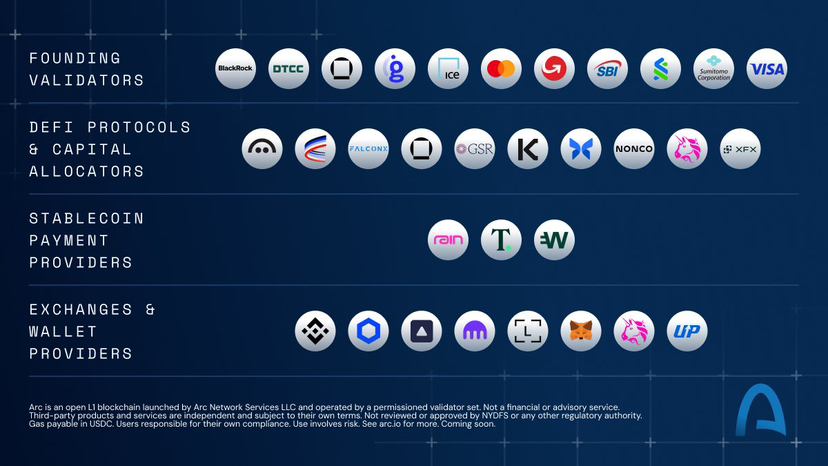
First, lay out the fundamentals clearly.
Arc is Circle’s EVM-compatible Layer1, with a very clear positioning: to be the internet’s “economic operating system.” The core design has three fairly solid points:
First, Gas is directly paid with USDC, with fees denominated in USD, making it more predictable for both institutions and ordinary users;
Second, it pursues sub-second deterministic finality and uses the Malachite BFT consensus;
Third, validators use permissioning; in the initial stage, regulated financial institutions ensure security, which is different from most openly verifiable public chains.
Circle is also actively pushing a product suite, including a composable application framework, AI-assisted development tools, and tokenized RWA management, among others. Institutions such as BlackRock, BNY, DTCC, and StanChart are already exploring directions like settlement and custody of tokenized assets, stablecoin integration, FX, and buybacks. In the long run, this is a chain intended to serve real financial liquidity—not just a chain for pure speculation.
But what truly excites many crypto natives is the other side.
Before the mainnet goes live, there have already been real on-chain trading activities. Several Launchpads have opened early; Tolly, Argus, and Warp are currently among the most discussed. Tolly’s model is more aggressive: all new tokens are immediately directed into a permanently locked USDC liquidity pool, without the traditional “graduation” phase of a bonding curve. Transaction fees also come with designs for buyback-and-burn and holder rewards. Argus combines the launchpad and the trading terminal quite closely. Warp, on the other hand, emphasizes cross-chain intent and a seamless CCTP experience. For the Meme side, COOL directly ties into the symbol “USDC is cool,” which grew out of Circle-related culture; the community-driven feel is quite strong. Most market caps are still in the low millions of USD, placing them in a typical early stage.
This reminds me of the startup playbooks of many chains. When infrastructure is still being built, the ones that first pull in users and attention are often launchpads and community tokens that resonate culturally. They generate trading volume and buzz first, then force wallets, bridges, and DeFi tools to catch up. In the early days of Solana, Base, and even certain L2 launches, something similar happened. Arc currently has that same vibe.
Of course, the risks must be clearly stated.
In institution-led chains, compliance and risk control priorities are typically higher, and the pure degen party space may not be as open as in a chain that fully enables that. Most early projects suffer from issues like no audits, thin liquidity, concentrated holdings, and anonymous teams; the vast majority ultimately end up at zero. The official ARC token had a private placement, and there is still a lock-up period; in the short term it isn’t the main trading target. Bridging currently relies mainly on Circle’s CCTP, and public tooling and wallet support are still being rapidly filled in—there’s still friction in operations.
My own observation framework is relatively simple, and I’ll share it with everyone:
First, look at real trading volume—not just market-cap callouts;
Second, whether fees flow back to the platform token or token holders, and whether the mechanism is sustainable;
Third, whether the community continuously produces content, or if it’s just pure emotion-driven signal calling.
Fourth, how tightly it’s bound to the official narrative or cultural symbols.
In the next few days, I’ll focus on two kinds of things:
First, it’s a Launchpad platform token that can truly drive day-trading volume and user retention;
Second, it’s tightly bound to USDC/Circle culture and has ongoing community activities—a Meme.
Mainnet launch is the watershed. Before that, only a few people laid out positions early; after that, when real traffic truly comes in. Opportunity windows usually don’t last long, and so do the traps.
Afterward, if mainnet data comes out and one direction clearly starts performing, I’ll update my observations.
Are you more focused on RWA and payments after institutional adoption, or early projects at the community level? Or have you already been watching a specific target? Say so in the comments—let’s exchange ideas together.
(Data as of the time of posting; the market changes quickly—please verify the contract and on-chain information yourself. All content is for discussion only and does not constitute investment advice.)#美联储加息是否已成定局 #USDC链上交易量突破100万亿美元