
#韩国延迟加密税请愿破5万签名
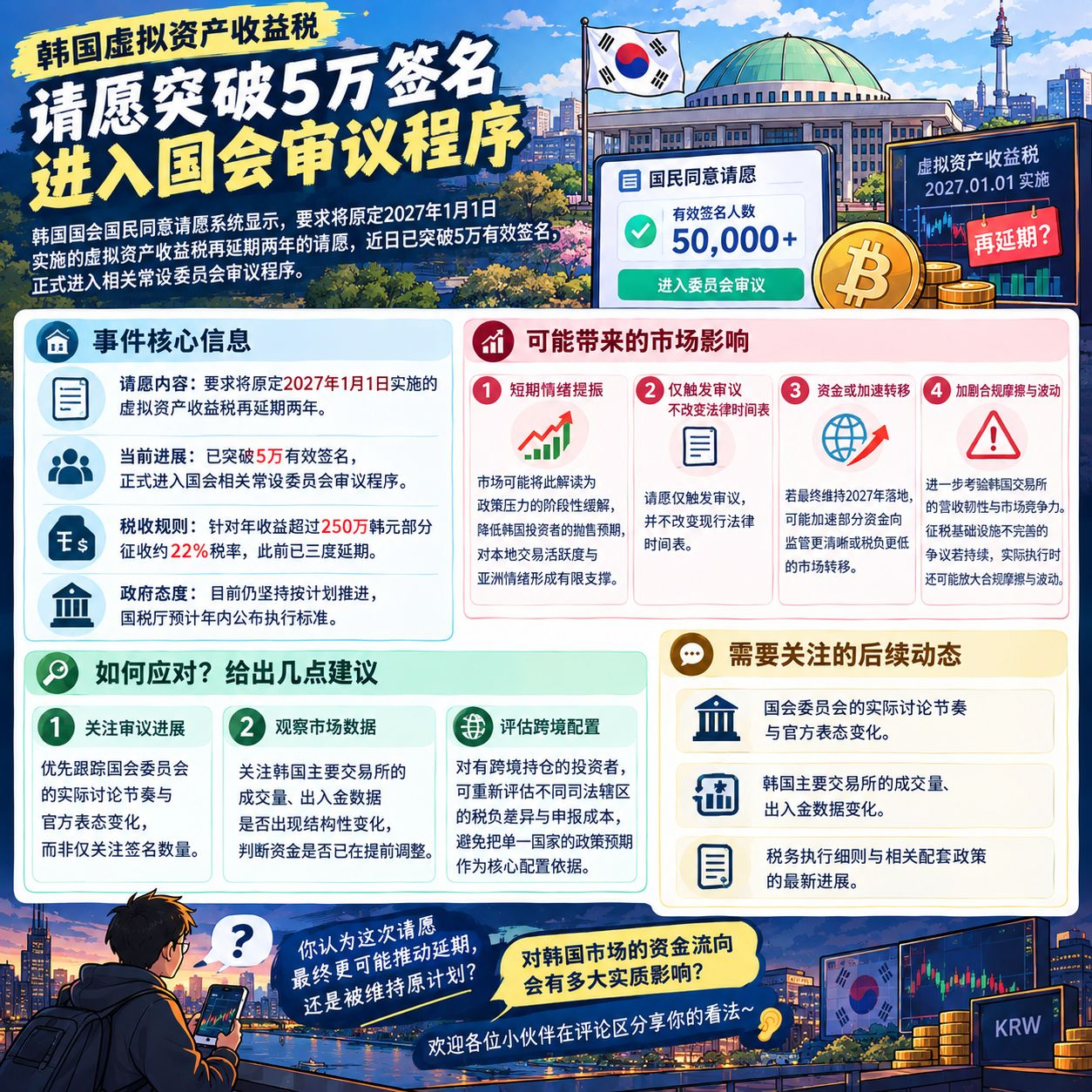
In South Korea, the National Assembly’s citizens petition platform has shown that a petition requesting another two-year extension of the tax on virtual-asset gains originally scheduled to take effect on January 1, 2027 has recently surpassed 50,000 valid signatures and has officially entered the review process of the relevant standing committee. The tax applies a rate of about 22% on the portion of annual gains exceeding 2.5 million Korean won. It has been postponed three times previously. The government is still insisting on moving forward according to the original plan, and the National Tax Service is expected to publish implementation standards within the year.
In terms of impact, in the short term, the market may interpret this as a temporary easing of policy pressure, which could reduce Korean investors’ expectations of selling and provide limited support to local trading activity and broader sentiment across Asia. However, the petition only triggers the review process and does not change the current legal timetable. If the 2027 rollout is ultimately maintained, it may accelerate the movement of some funds toward markets where regulation is clearer or the tax burden is lower, further testing the resilience of revenue at Korean exchanges and their competitiveness. If controversy over inadequate taxation infrastructure persists, actual implementation could also amplify compliance frictions and volatility.
Regarding this event, it is recommended to prioritize tracking the real pace of committee discussions in the National Assembly and changes in official statements, rather than focusing solely on the number of signatures. At the same time, monitor whether major Korean exchanges see structural changes in trading volume and deposit/withdrawal data to determine whether capital has already begun adjusting in advance. For investors with cross-border holdings, consider reevaluating tax-burden differences and filing costs across different jurisdictions, and avoid using a single country’s policy expectations as the core basis for asset allocation.
Do you think this petition is more likely to ultimately push for an extension, or will the original schedule be maintained? How much real impact do you expect it to have on capital flows in the Korean market? Feel free to share your views in the comments section~👂
In South Korea, the National Assembly’s citizens petition platform has shown that a petition requesting another two-year extension of the tax on virtual-asset gains originally scheduled to take effect on January 1, 2027 has recently surpassed 50,000 valid signatures and has officially entered the review process of the relevant standing committee. The tax applies a rate of about 22% on the portion of annual gains exceeding 2.5 million Korean won. It has been postponed three times previously. The government is still insisting on moving forward according to the original plan, and the National Tax Service is expected to publish implementation standards within the year.
In terms of impact, in the short term, the market may interpret this as a temporary easing of policy pressure, which could reduce Korean investors’ expectations of selling and provide limited support to local trading activity and broader sentiment across Asia. However, the petition only triggers the review process and does not change the current legal timetable. If the 2027 rollout is ultimately maintained, it may accelerate the movement of some funds toward markets where regulation is clearer or the tax burden is lower, further testing the resilience of revenue at Korean exchanges and their competitiveness. If controversy over inadequate taxation infrastructure persists, actual implementation could also amplify compliance frictions and volatility.
Regarding this event, it is recommended to prioritize tracking the real pace of committee discussions in the National Assembly and changes in official statements, rather than focusing solely on the number of signatures. At the same time, monitor whether major Korean exchanges see structural changes in trading volume and deposit/withdrawal data to determine whether capital has already begun adjusting in advance. For investors with cross-border holdings, consider reevaluating tax-burden differences and filing costs across different jurisdictions, and avoid using a single country’s policy expectations as the core basis for asset allocation.
Do you think this petition is more likely to ultimately push for an extension, or will the original schedule be maintained? How much real impact do you expect it to have on capital flows in the Korean market? Feel free to share your views in the comments section~👂