

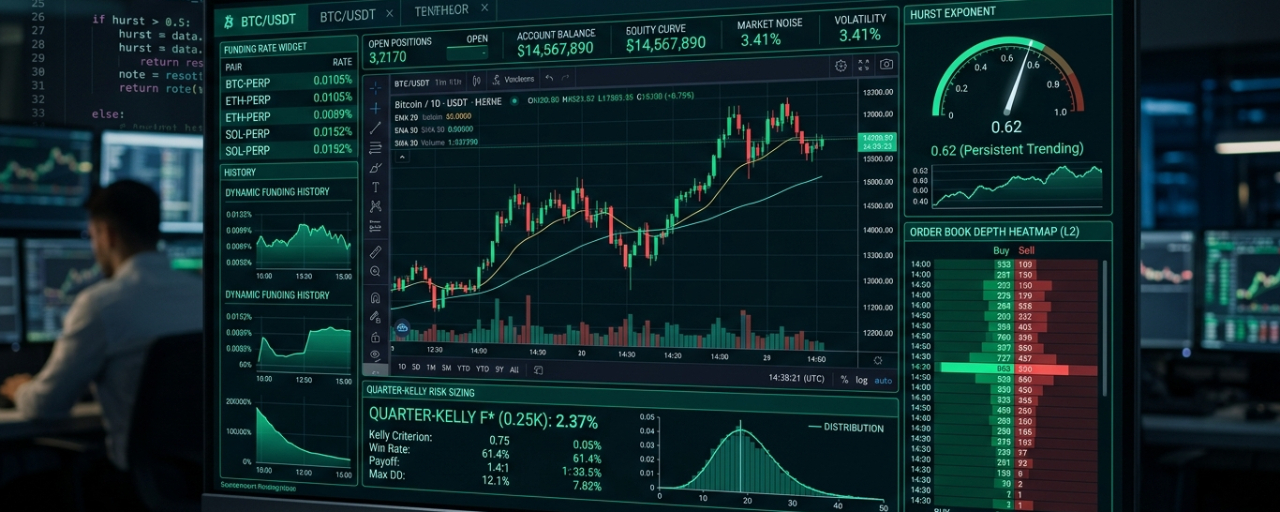

«Forget about triangle-based chart analysis. In the crypto market, microstructure and the probability distribution rule».
For the past six months, I’ve been developing an autonomous trading system in Python (ML ensemble + order book analysis). During this time, I understood the main reason why 95% of traders lose their deposits on futures.
It’s NOT that they didn’t get the price direction right.
The issue is that they enter the market when the trade’s mathematical expectation is negative.
Here are 3 tough gate filters (Gate Filters) that my algorithm checks before placing even one order:
1. The Funding Rate Trap
When the crowd greedily jumps into longs, the funding rate shoots up above +0.03%. For a retail trader, it looks like a sign of «market strength». For an algorithm, it’s a «longs overcrowded» signal and a high probability of a downside squeeze to collect liquidity. My bot automatically penalizes confidence in longs when funding is high and fully blocks entry if the rate is extreme.
2. The Hurst Exponent (Hurst Exponent)
The market is in a trend only 20–30% of the time. The other 70% is random wandering (white noise and chopping). The algorithm calculates the Hurst indicator HH on the last 100 hourly candles:
If H>0.55H>0.55 — the market is directional (let profits run).
If H<0.45H<0.45 — the market returns to the average (quick take-profit).
If H≈0.50H≈0.50 — it’s «casino». Entering is strictly forbidden.
3. The Quarter-Kelly rule instead of wild 20x–50x leverage
The biggest illusion for a beginner is: «I’ll take 20x leverage and quickly grow the deposit». By the Kelly criterion formula, the optimal risk fraction for crypto assets with their volatility is fractional Kelly (Quarter-Kelly, 0.25). This means a working leverage no higher than 2x–3x and risk no more than 1.5–2% of the deposit per trade. With this sizing, a series of 5 consecutive stop-losses feels like a minor scratch rather than a fatal wipeout.
💬 A question for traders:
What maximum leverage are you using right now when trading Binance futures? Do you use a mathematical risk calculation (Kelly/ATR), or do you open positions by intuition?
Write your numbers in the comments — we’ll discuss what sizing is safe right now given the current BTC$ volatility!
Hit like 👍 and subscribe if you’re interested in honest Build in Public and a quantum approach to algorithmic trading without the info-gypsy stuff.
#Bitcoin #BTC #Futures #TradingStrategy #RiskManagement #BinanceSquare $BTC $ETH $SOL


