#比特币现货etf净流入1.6亿美元
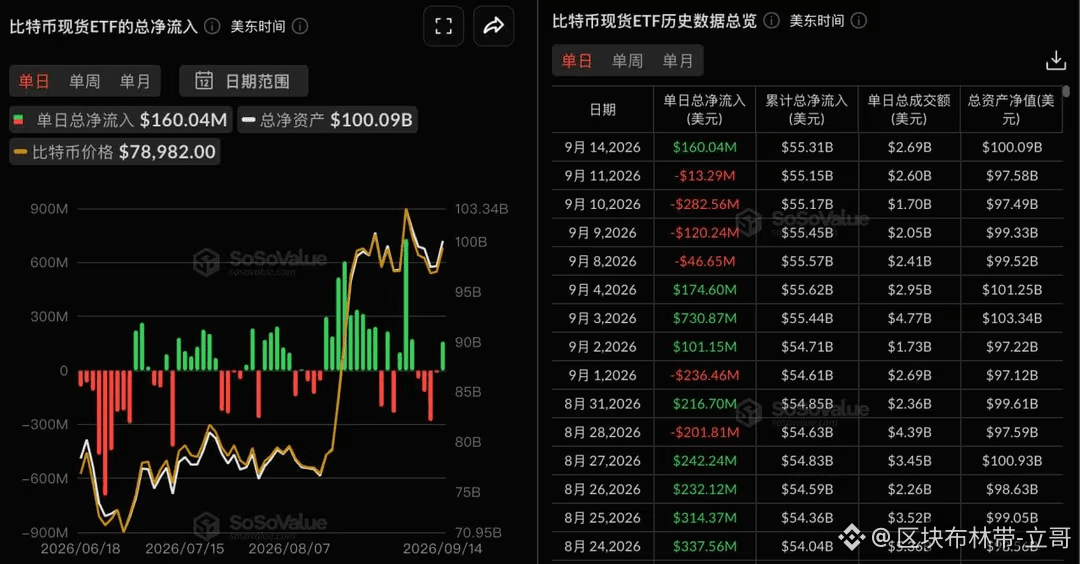
Yesterday, Bitcoin spot ETFs saw another inflow of money. Total net inflows were $160 million.
BlackRock’s IBIT alone accounted for $134 million. Fidelity’s FBTC added $53.33 million. Only ARKB was seeing outflows, at $41.95 million.
Bitcoin spot ETFs’ total assets have now reached $100.092 billion, representing 6.3% of Bitcoin’s total market value. Historical cumulative net inflows are $55.315 billion.
So what does this mean? Institutions are still buying— and they’re buying with big money, not the kind of money retail investors use to chase rallies and then panic-sell.
BlackRock’s IBIT has historically net inflowed $64.1 billion. That figure is even larger than many countries’ foreign exchange reserves.
But here’s the interesting part: money is flowing into ETFs, and ETFs are buying— yet many people’s positions are still trapped. Why? Because institutions buy based on trends, while you’re holding leveraged positions. When institutions fall, they can wait or add. When you fall, you’re forced to liquidate. That’s the difference.
If you currently have a position that’s underwater and you don’t know what to do, don’t try to figure it out randomly. Come find me—I’ll help you understand whether your current position can still be salvaged and what to wait for in the next trade.
Yesterday, Bitcoin spot ETFs saw another inflow of money. Total net inflows were $160 million.
BlackRock’s IBIT alone accounted for $134 million. Fidelity’s FBTC added $53.33 million. Only ARKB was seeing outflows, at $41.95 million.
Bitcoin spot ETFs’ total assets have now reached $100.092 billion, representing 6.3% of Bitcoin’s total market value. Historical cumulative net inflows are $55.315 billion.
So what does this mean? Institutions are still buying— and they’re buying with big money, not the kind of money retail investors use to chase rallies and then panic-sell.
BlackRock’s IBIT has historically net inflowed $64.1 billion. That figure is even larger than many countries’ foreign exchange reserves.
But here’s the interesting part: money is flowing into ETFs, and ETFs are buying— yet many people’s positions are still trapped. Why? Because institutions buy based on trends, while you’re holding leveraged positions. When institutions fall, they can wait or add. When you fall, you’re forced to liquidate. That’s the difference.
If you currently have a position that’s underwater and you don’t know what to do, don’t try to figure it out randomly. Come find me—I’ll help you understand whether your current position can still be salvaged and what to wait for in the next trade.