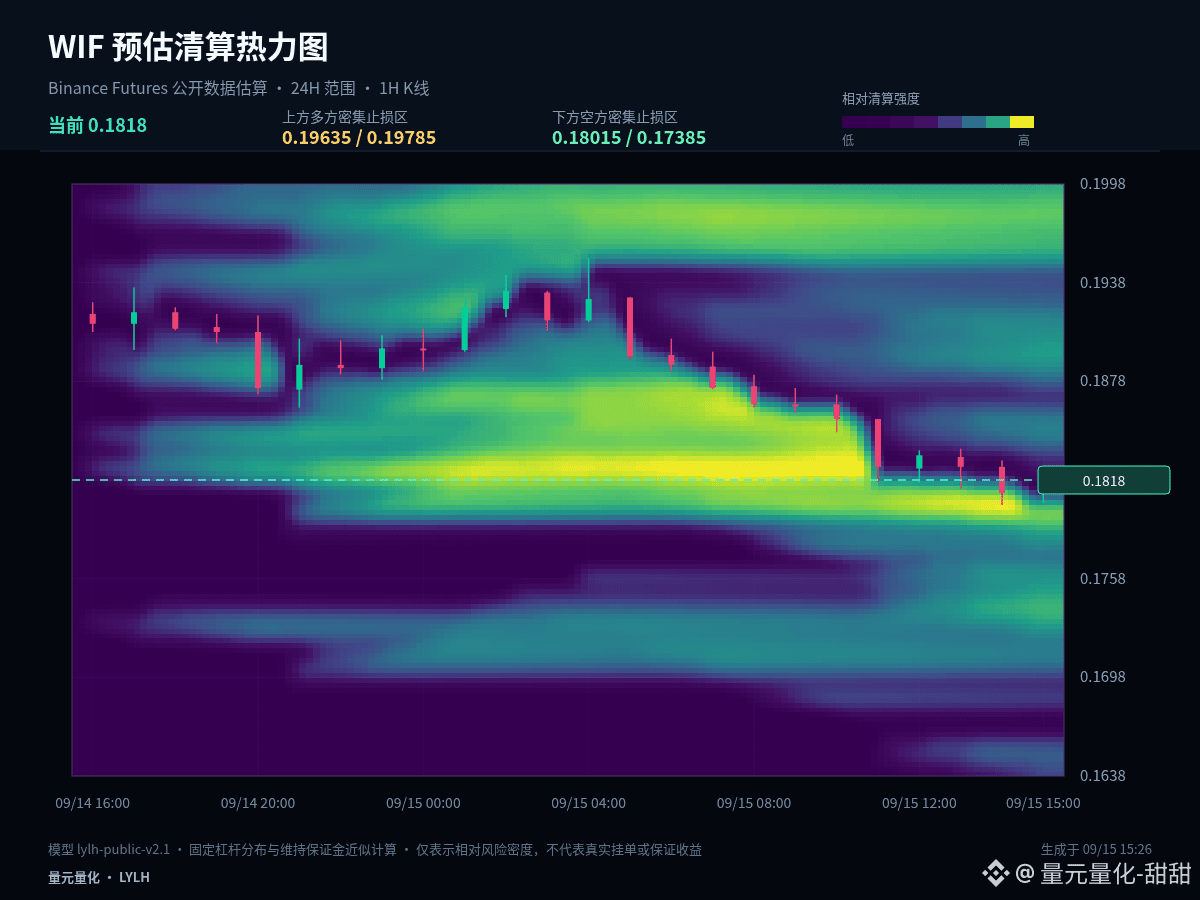
$WIF #WIF Right now it looks more like range trading with turnover. There’s no need to explain every 1-hour candlestick as a brand-new trend. Current price: 0.182, 1 hour +0.44%, 24 hours -5.36%.
The current price is near the lower bound of the last 24-hour range: 1 hour +0.44%, 24 hours -5.36%. The key in analyzing the lower area isn’t trying to bottom-pick early, but observing whether it can quickly reclaim after breaking down. Reclaiming means sell pressure is being absorbed; staying under the lower bound for an extended period indicates the weakness hasn’t ended.
Upper range: 0.1955, lower range: 0.1806, midline: 0.18805. Near the upper bound, watch the breakout quality; near the lower bound, watch for support/holding power. Around the midline, reduce frequent trading—because it isn’t far enough from either side, and both direction and risk-reward ratio are unclear.
The signals truly worth acting on are: after a break, price is willing to remain in the new range; or after dipping to the boundary, it quickly reclaims. Without such confirmation, continue to treat it as consolidation, and don’t change the overall plan due to temporary intraday fluctuations.
For those already holding positions, focus on whether support has failed to manage the trade—rather than being carried around by every fluctuation. For those with no position, prioritize waiting for a breakout with a retest, or confirmation of support. Spot can be scaled in batches; for futures, shorten the decision chain: first determine the stop-loss level, then decide whether to participate.
A trading plan must include invalidation conditions. If your judgment is correct, you can take profit in stages; if your judgment is wrong, you must also allow yourself to exit. Don’t use adding to disguise the fact that the original logic has changed. The market will update, and your view should adjust with the price evidence.
#SECChairUrgesCongressToAdvanceClarityAct
The current price is near the lower bound of the last 24-hour range: 1 hour +0.44%, 24 hours -5.36%. The key in analyzing the lower area isn’t trying to bottom-pick early, but observing whether it can quickly reclaim after breaking down. Reclaiming means sell pressure is being absorbed; staying under the lower bound for an extended period indicates the weakness hasn’t ended.
Upper range: 0.1955, lower range: 0.1806, midline: 0.18805. Near the upper bound, watch the breakout quality; near the lower bound, watch for support/holding power. Around the midline, reduce frequent trading—because it isn’t far enough from either side, and both direction and risk-reward ratio are unclear.
The signals truly worth acting on are: after a break, price is willing to remain in the new range; or after dipping to the boundary, it quickly reclaims. Without such confirmation, continue to treat it as consolidation, and don’t change the overall plan due to temporary intraday fluctuations.
For those already holding positions, focus on whether support has failed to manage the trade—rather than being carried around by every fluctuation. For those with no position, prioritize waiting for a breakout with a retest, or confirmation of support. Spot can be scaled in batches; for futures, shorten the decision chain: first determine the stop-loss level, then decide whether to participate.
A trading plan must include invalidation conditions. If your judgment is correct, you can take profit in stages; if your judgment is wrong, you must also allow yourself to exit. Don’t use adding to disguise the fact that the original logic has changed. The market will update, and your view should adjust with the price evidence.
#SECChairUrgesCongressToAdvanceClarityAct