It’s the same “long/short ratio,” but Binance gives you two numbers: 2.77 and 1.23—which one do you trust?
I just scanned Binance’s department of security 851 USDT perpetual contracts’ funding rates, and while I was at it, I also looked at the long/short ratios. The easiest to misread are these two metrics.
First, the funding rate. Don’t just look at the absolute value in the 8-hour line—annualize it (×3×365): ETH is currently -0.00699%/8h, which annualizes to -7.65%. A negative funding rate means shorts are paying longs; BTC is +0.00672%/8h, annualized to +7.36%. The number in the third decimal place—when annualized—is basically around 7 percentage points. That’s the real holding cost.
What’s even more worth a quick look across the whole market: among 851 USDT perpetuals, 116 have negative funding rates (13.6%), 483 are positive, and the rest are zero. The annualized median is +5.48%, but the mean is -4.22%—because a few extreme values drag the average down: ASTR (-1178%), CVC (-1108%), and HIVE (-742%). Describing “market sentiment” using the mean is like letting a few illiquid small coins represent the entire market.
Extreme funding rates are also rarely a good opportunity: there are 23 contracts with annualized absolute value ≥100% (15 negative, 8 positive). These are mostly concentrated in low-liquidity small caps and new coins. High funding rates mean someone is urgently paying to exit or抢 positions—liquidity depth for these instruments is the same order of magnitude as the cost you’ll pay when entering and exiting.
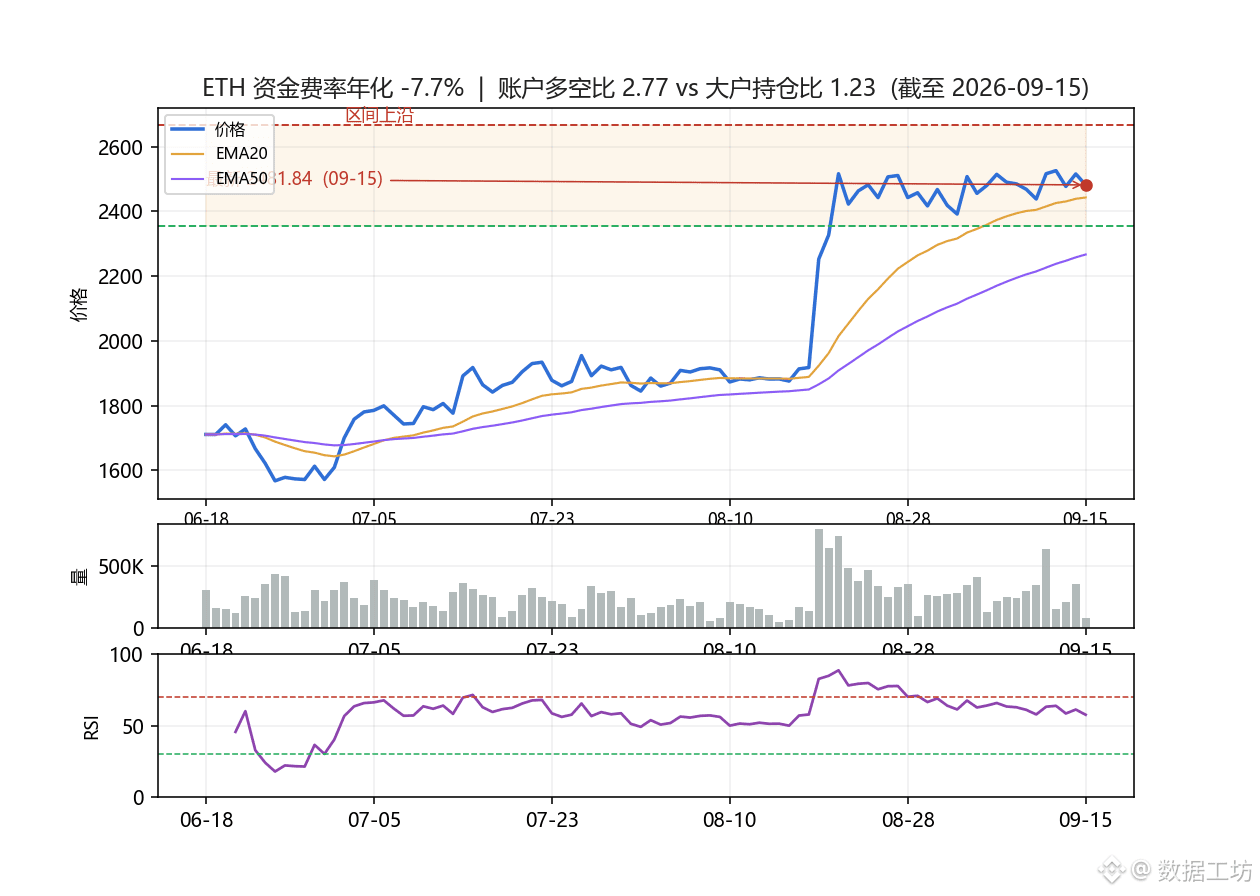
Back to those two long/short ratios: for ETH, the account long/short ratio is 2.77, and for large holders it’s 1.23; for BTC, the account ratio is 1.38, while large holders’ ratio is 2.20. One number reflects heads, the other reflects positions—so the conclusion flips completely. Any claim like “the long/short ratio shows the market is bullish” should first clarify the metric being used.
My take: I’d rather interpret negative funding rates as “shorts are crowded, longs are retreating,” not as a bearish signal. ETH’s account ratio is currently skewed long, while the positioning ratio is neutral. I’ll look at changes in position size and where price/returns fall within the range before deciding on positioning—no single indicator alone.
(I’ve turned this whole-market scan of funding rates + positioning + long/short ratios into a daily report that runs automatically every day; I only get alerted when something is abnormal.)
When you look at funding rates, are you looking at the 8-hour line, or should you annualize first? Let’s discuss in the comments.
#ETH #资金费率 #量化 #持仓量 #数据控
I just scanned Binance’s department of security 851 USDT perpetual contracts’ funding rates, and while I was at it, I also looked at the long/short ratios. The easiest to misread are these two metrics.
First, the funding rate. Don’t just look at the absolute value in the 8-hour line—annualize it (×3×365): ETH is currently -0.00699%/8h, which annualizes to -7.65%. A negative funding rate means shorts are paying longs; BTC is +0.00672%/8h, annualized to +7.36%. The number in the third decimal place—when annualized—is basically around 7 percentage points. That’s the real holding cost.
What’s even more worth a quick look across the whole market: among 851 USDT perpetuals, 116 have negative funding rates (13.6%), 483 are positive, and the rest are zero. The annualized median is +5.48%, but the mean is -4.22%—because a few extreme values drag the average down: ASTR (-1178%), CVC (-1108%), and HIVE (-742%). Describing “market sentiment” using the mean is like letting a few illiquid small coins represent the entire market.
Extreme funding rates are also rarely a good opportunity: there are 23 contracts with annualized absolute value ≥100% (15 negative, 8 positive). These are mostly concentrated in low-liquidity small caps and new coins. High funding rates mean someone is urgently paying to exit or抢 positions—liquidity depth for these instruments is the same order of magnitude as the cost you’ll pay when entering and exiting.
Back to those two long/short ratios: for ETH, the account long/short ratio is 2.77, and for large holders it’s 1.23; for BTC, the account ratio is 1.38, while large holders’ ratio is 2.20. One number reflects heads, the other reflects positions—so the conclusion flips completely. Any claim like “the long/short ratio shows the market is bullish” should first clarify the metric being used.
My take: I’d rather interpret negative funding rates as “shorts are crowded, longs are retreating,” not as a bearish signal. ETH’s account ratio is currently skewed long, while the positioning ratio is neutral. I’ll look at changes in position size and where price/returns fall within the range before deciding on positioning—no single indicator alone.
(I’ve turned this whole-market scan of funding rates + positioning + long/short ratios into a daily report that runs automatically every day; I only get alerted when something is abnormal.)
When you look at funding rates, are you looking at the 8-hour line, or should you annualize first? Let’s discuss in the comments.
#ETH #资金费率 #量化 #持仓量 #数据控