
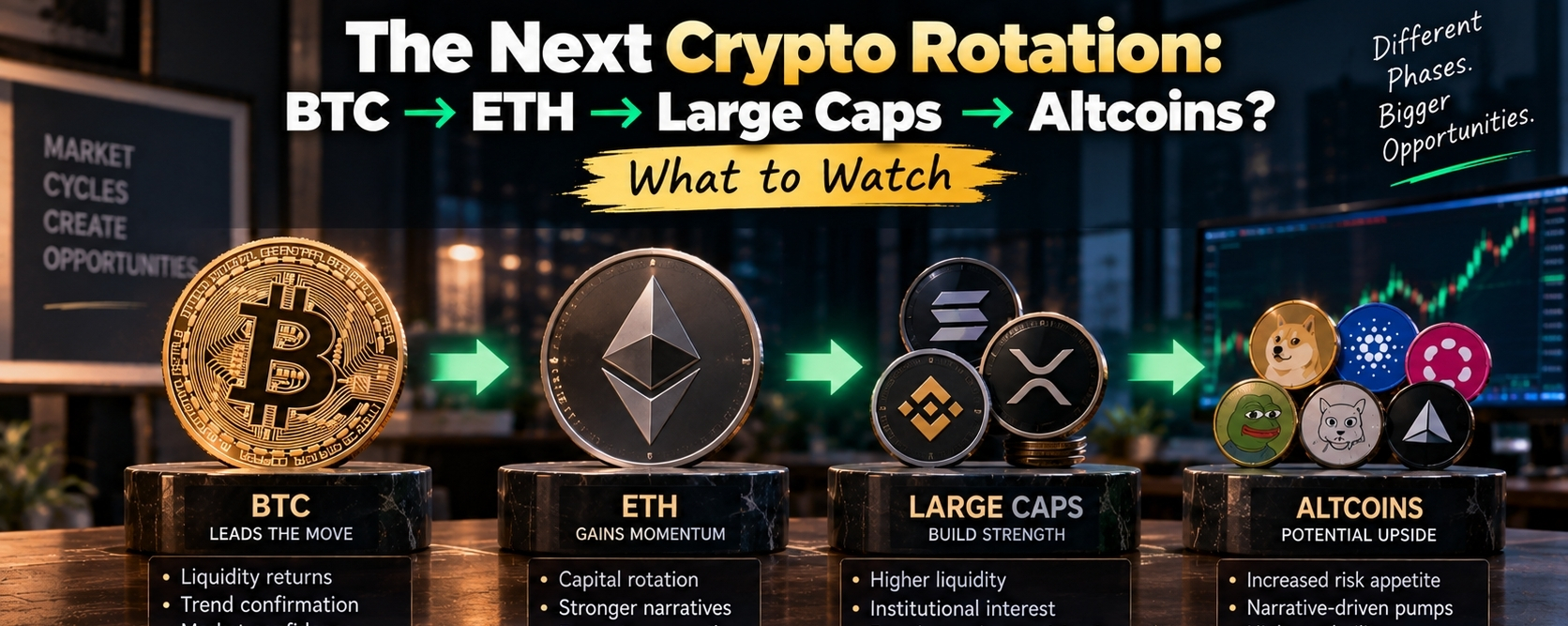


Crypto money rarely moves everywhere at the same time.
During strong market cycles, capital often moves in stages.
Bitcoin gets attention first.
Then Ethereum starts outperforming.
Then traders move toward major coins such as SOL and XRP.
And if risk appetite becomes strong enough, money can eventually reach smaller altcoins.
The big question right now is:
Are we getting close to that rotation again?
Stage One: Bitcoin Leads
Bitcoin normally sits at the beginning of the rotation.
It has the deepest liquidity, the strongest institutional presence and the most established ETF market among cryptocurrencies.
That matters even more in uncertain conditions.
Bitcoin recently recovered from lows around $60,000 and pushed back toward the upper-$70K region. Renewed ETF demand and improving sentiment contributed to that recovery.
But BTC is now facing an important challenge around $80K.
If Bitcoin breaks higher too aggressively, capital may simply continue chasing BTC.
That isn't necessarily good for altseason.
For a broader rotation, something different can be more helpful:
Bitcoin stays strong but begins consolidating.
That gives traders confidence in the overall market while encouraging them to search elsewhere for higher returns.
Stage Two: Watch Ethereum
Ethereum may provide the first major clue that rotation is beginning.
ETH recently produced a roughly 37% rally over ten days before entering consolidation. Reuters technical analysis described the resulting structure as a potential bull flag.
But ETH's dollar price isn't the only chart worth watching.
ETH/BTC is arguably even more important.
If ETH consistently starts outperforming Bitcoin, it can signal that investors are becoming comfortable moving farther along the crypto risk curve.
That doesn't guarantee altseason.
But historically, stronger ETH relative performance has been an important piece of the rotation puzzle.
Stage Three: Large Caps Wake Up
If Ethereum begins outperforming, attention can move toward other established crypto assets.
This is where names such as SOL and XRP become particularly interesting.
The logic is simple.
Investors who made money in BTC may take some profits and move into ETH.
If ETH performs well, some of that capital can then search for greater upside in other liquid large-cap cryptocurrencies.
Large caps effectively become the bridge between Bitcoin and the more speculative parts of the market.
This stage is important because it tells us whether investors are becoming comfortable taking additional risk.
Stage Four: Altcoins
This is the stage everyone calls “altseason.”
But traders often call it too early.
Seeing five or ten altcoins suddenly jump 20% doesn't mean the entire market has entered an altcoin season.
A genuine broad rotation requires sustained relative strength across a much larger part of the market.
That's why Bitcoin dominance becomes so important.
If BTC remains strong while its share of the overall crypto market starts falling, it can suggest capital is spreading into other cryptocurrencies rather than leaving crypto completely.
If Bitcoin dominance keeps climbing, however, money is still concentrated around BTC.
Bitcoin Dominance Is the Chart to Watch
This may be one of the most useful indicators for understanding the rotation.
Recent September data has been mixed.
Bitcoin dominance has remained around the high-50% region, and some measures of altcoin performance still remain far from levels normally associated with a broad altseason.
At the same time, ETH has shown periods of improving relative strength.
So we may be seeing early rotation attempts rather than a confirmed altcoin season.
That's a major difference.
Bitcoin Doesn't Need to Crash for Altcoins to Rally
There's another misconception worth clearing up.
A Bitcoin crash isn't what altcoins need.
A sharp BTC selloff can actually be terrible for altcoins because fear spreads throughout the entire crypto market.
The healthier scenario is often Bitcoin remaining strong while volatility decreases.
Imagine BTC breaks an important resistance area, establishes support and then trades sideways.
Traders stop worrying about an immediate Bitcoin collapse.
They start looking around.
ETH becomes interesting.
Then SOL, XRP and other large caps.
Eventually smaller projects start receiving attention.
That's the type of environment where rotation can develop.
Macro Still Controls the Game
There is one major obstacle to this scenario right now:
The macro environment.
Markets are preparing for the Federal Reserve decision while inflation and bond yields remain important concerns.
Higher interest rates generally make investors more cautious about speculative assets.
And smaller altcoins sit near the highest-risk end of the crypto market.
That's why macro conditions matter even more for altseason than they do for Bitcoin.
Institutional demand can help BTC survive difficult conditions.
Small altcoins usually don't have the same support.
What Would Strengthen the Rotation Case?
I would want to see several things happening together.
Bitcoin remains structurally strong.
BTC stops absorbing nearly all the market's attention.
ETH begins outperforming BTC consistently.
Large-cap coins start participating.
Bitcoin dominance begins trending lower rather than simply experiencing a one-day drop.
And eventually, strength spreads across the broader altcoin market.
When several of those signals appear together, the rotation argument becomes much stronger.
What Could Kill the Rotation?
The biggest danger would be another major risk-off event.
A hawkish Fed, persistent inflation, rising Treasury yields or a sharp Bitcoin rejection could send investors back toward safety.
In crypto, that often means capital either moves back toward BTC or leaves the market entirely.
Smaller altcoins could suffer the most in that environment.
That's why simply buying every altcoin because “altseason is coming” can be a dangerous assumption.
The market needs to confirm the rotation first.
The Bigger Picture
Right now, the possible roadmap looks like this:
BTC → ETH → Large Caps → Broader Altcoins
But we're not at the final stage yet.
Bitcoin is still fighting for control around a major resistance region, while Ethereum is beginning to show some interesting relative strength.
That makes the next phase particularly important.
If BTC remains strong and ETH starts taking leadership, SOL, XRP and other large caps could become the next area to watch.
If that strength eventually spreads while Bitcoin dominance declines, then the altseason conversation becomes much more serious.
Until then, don't chase the word “altseason.”
Watch the rotation.
Because the movement of capital usually tells the story before the hype does.
For market discussion and education only.