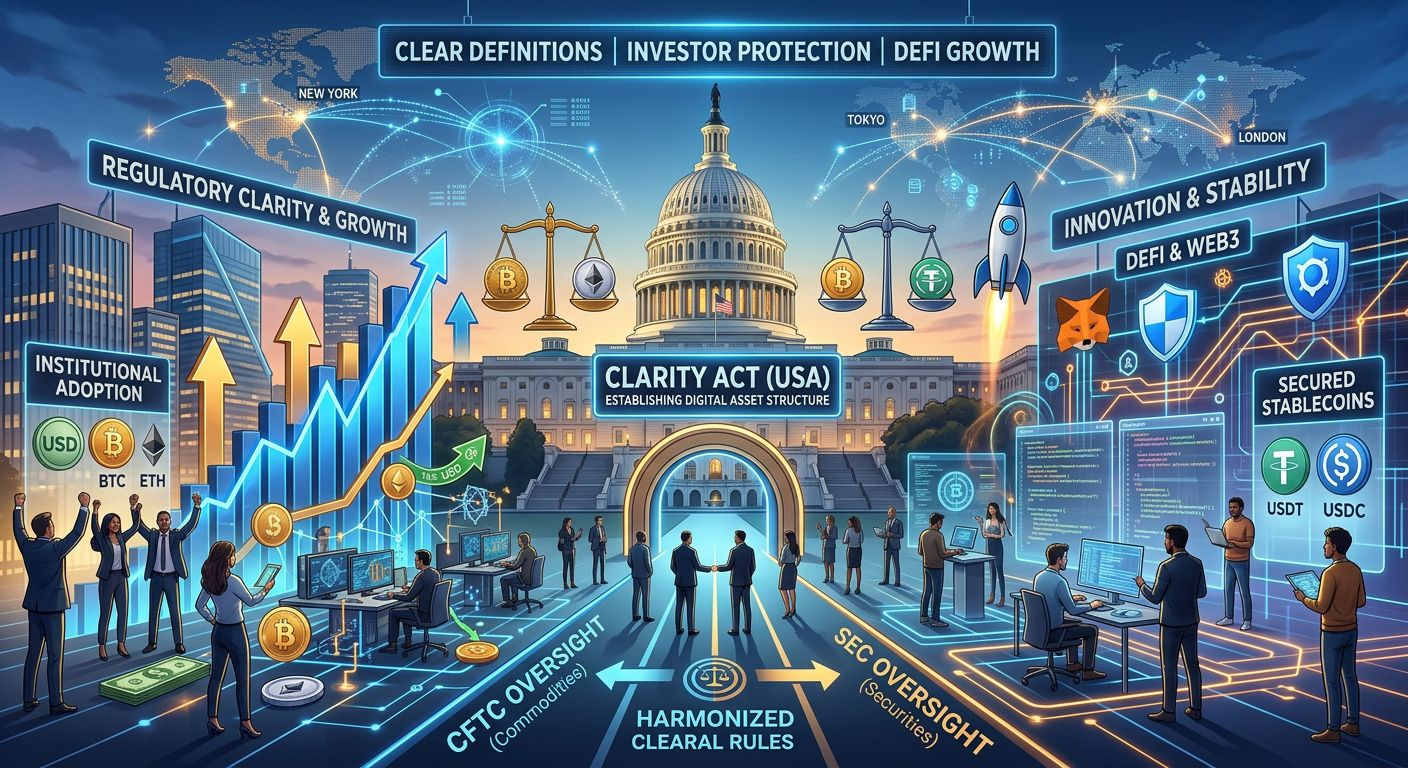
The CLARITY Act (Digital Asset Market Structure Bill) represents a pivotal legislative effort in the United States to establish a clear, comprehensive regulatory framework for the digital asset ecosystem after years of legal ambiguity.
Key Provisions & Major Decisions
Following extensive negotiations, the revised bill incorporates several critical compromises and structural changes:
Jurisdictional Division (CFTC vs. SEC):
The bill clearly demarcates authority between the Commodity Futures Trading Commission (CFTC) and the Securities and Exchange Commission (SEC). Primary oversight of digital commodity spot markets is granted to the CFTC—a agency generally viewed as more suited for commodity-based market dynamics.
Developer and Validator Protections:
Integrating key language from the Blockchain Regulatory Certainty Act (BRCA), the bill explicitly exempts software developers, miners, and network validators from money-transmitter licensing requirements, provided they do not hold custody of user funds (non-custodial).
Stablecoin Circuit Breakers:
To protect community banks from sudden deposit flights into yield-bearing stablecoins, the U.S. Treasury is granted temporary authority to impose yield caps or 18-month "circuit breakers" on stablecoin reward programs during periods of financial strain.
Strict Ethics & Conflict-of-Interest Rules:
The draft includes permanent prohibitions preventing federal officials, judges, and their spouses from issuing or sponsoring digital assets. Significant crypto holdings by covered officials must be divested or placed into a blind trust.
Future Outlook for the Crypto Market
The implementation of the CLARITY Act is set to reshape the global crypto landscape in several distinct ways:
Accelerated Institutional Capital Inflow:
Regulatory uncertainty has long been the primary barrier for major institutional investors. Clear statutory definitions distinguishing commodities from securities provide traditional financial institutions with the legal certainty needed to deploy capital at scale.
Growth of Non-Custodial DeFi Infrastructure:
By shielding non-custodial software developers from transmitter liabilities, the Act creates a safer environment for decentralized finance (DeFi) innovation, encouraging open-source development within U.S. jurisdiction.
Shift in the Stablecoin Landscape:
Restrictions on yield-bearing features may limit high-yield crypto-native stablecoins, favoring compliant, reserve-backed stablecoins integrated directly into traditional banking rails.
End to "Regulation by Enforcement":
Establishing explicit statutory guidelines reduces reliance on retroactive SEC enforcement actions, providing crypto startups with a predictable compliance roadmap.