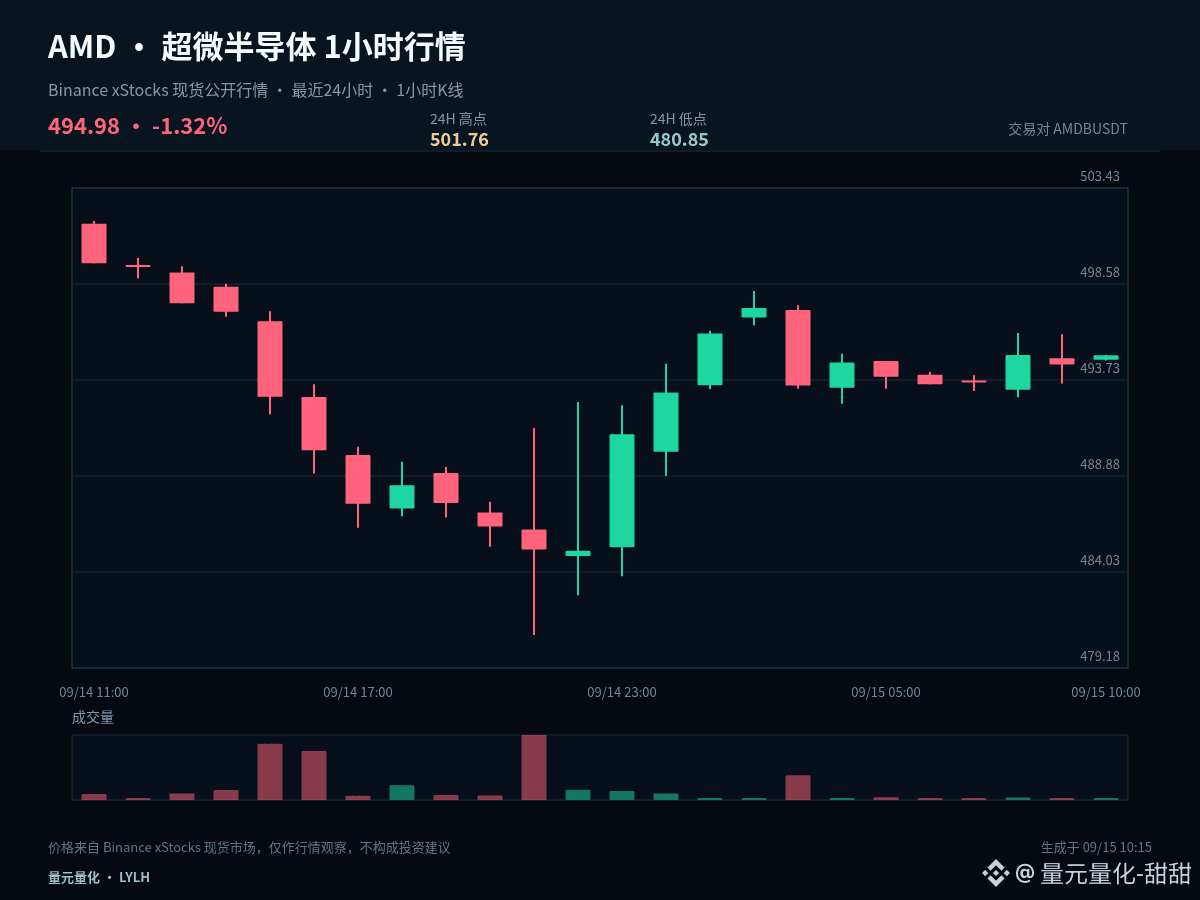
$AMDB #AMD After the momentum picked up, only then did it become worth preparing to enter; first, the position needs to be evaluated. The current 1-hour move is +0.10%, and the 24-hour move is -1.42%. The space that has already played out cannot simply be assumed to repeat in the next leg.
$AMDB #AMD has not yet formed a clear one-way trend, and the rhythm of the 1-hour and 24-hour timeframes is still in conflict. At this stage, attention should be on the boundaries of the range rather than the color of each candlestick.
A rhythm that is more favorable to bulls is for price to return near 491.305, with selling pressure easing, and then to make another attempt at 501.76. If price accelerates upward without a pullback, the risk-reward of chasing becomes worse.
In execution, set clear conditions: after breaking above 501.76, confirmation is needed rather than chasing a sudden spike; after testing 480.85 on the downside, watch whether it can quickly recover rather than blindly buying the dip; in the middle of the range, if there is not enough edge, waiting is also part of the strategy.
Position management should distinguish between medium-term and short-term holdings. Existing medium-term positions should first assess whether the structure has been damaged, without being repeatedly influenced by a single 1-hour candlestick; short-term positions, on the other hand, should be executed around support, resistance, and close confirmation. Those with no position do not need to chase in the middle of the range; waiting for a clearer location is usually more advantageous.
Missing a move does not directly cause a loss; what causes trouble is chasing without a plan near the end of the swing. The key for short-term positions is not to predict every candlestick, but to ensure that entry, reduction, and exit all have a basis. If there is no confirmation, do less; if a key level fails, redo the plan. First control the risk per trade, then talk about the room ahead.
#AvalancheIntegratesIntoUAEPassDigitalVault
$AMDB #AMD has not yet formed a clear one-way trend, and the rhythm of the 1-hour and 24-hour timeframes is still in conflict. At this stage, attention should be on the boundaries of the range rather than the color of each candlestick.
A rhythm that is more favorable to bulls is for price to return near 491.305, with selling pressure easing, and then to make another attempt at 501.76. If price accelerates upward without a pullback, the risk-reward of chasing becomes worse.
In execution, set clear conditions: after breaking above 501.76, confirmation is needed rather than chasing a sudden spike; after testing 480.85 on the downside, watch whether it can quickly recover rather than blindly buying the dip; in the middle of the range, if there is not enough edge, waiting is also part of the strategy.
Position management should distinguish between medium-term and short-term holdings. Existing medium-term positions should first assess whether the structure has been damaged, without being repeatedly influenced by a single 1-hour candlestick; short-term positions, on the other hand, should be executed around support, resistance, and close confirmation. Those with no position do not need to chase in the middle of the range; waiting for a clearer location is usually more advantageous.
Missing a move does not directly cause a loss; what causes trouble is chasing without a plan near the end of the swing. The key for short-term positions is not to predict every candlestick, but to ensure that entry, reduction, and exit all have a basis. If there is no confirmation, do less; if a key level fails, redo the plan. First control the risk per trade, then talk about the room ahead.
#AvalancheIntegratesIntoUAEPassDigitalVault