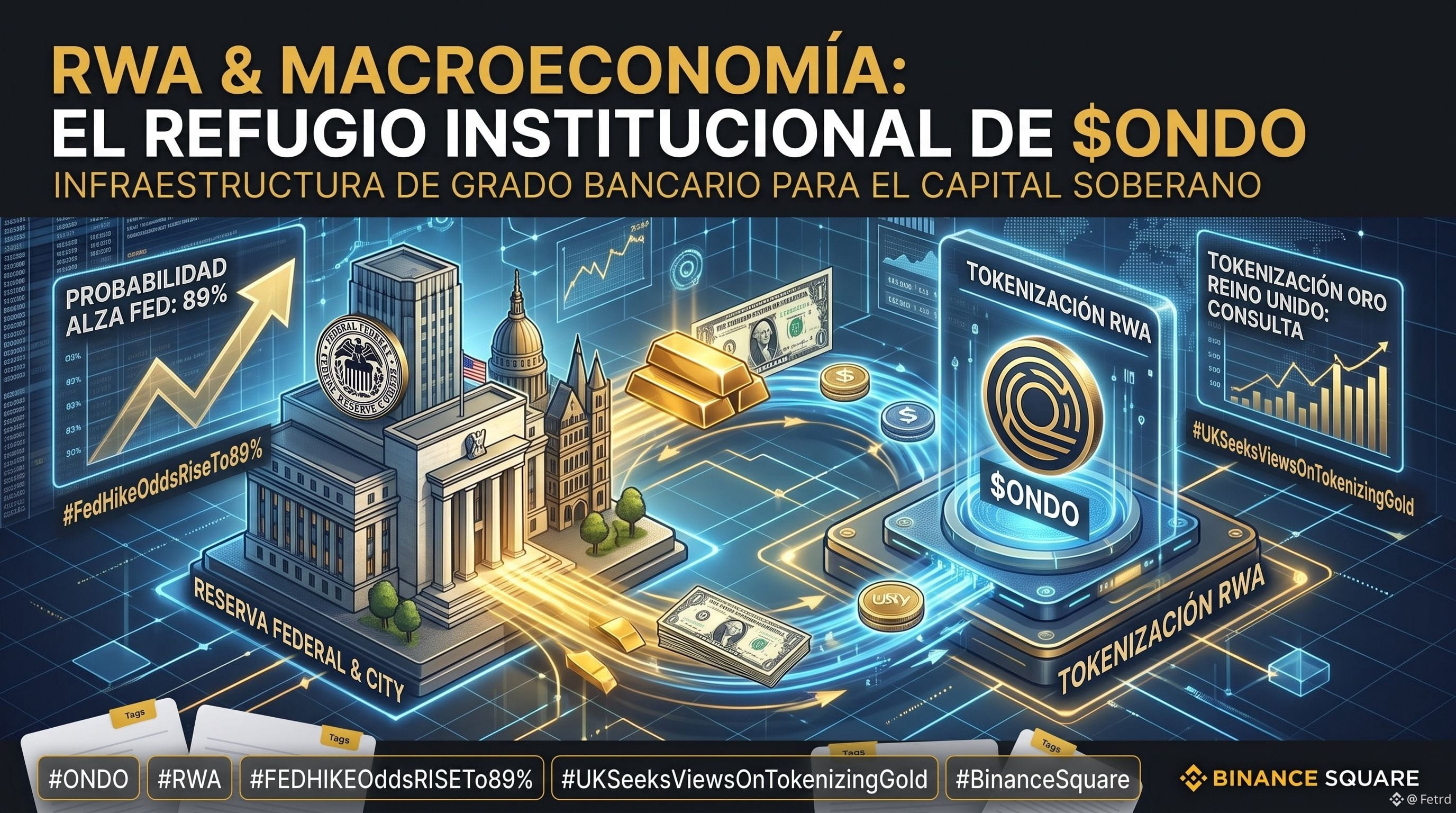
High Rates in the Fed? Why the Macro Scenario Drives $ONDO and the RWA
While the speculative market shakes at the growing likelihood of a new monetary adjustment by the Federal Reserve, institutional capital isn’t leaving the chain—it’s rotating in a surgical way toward real yield infrastructure.
Quantitative tightening usually hits risk assets, but for tokenization of real-world assets (RWA), this context acts as a direct catalyst for three structural reasons:
On-Chain Sovereign Yield: With rate-hike probabilities surging (#FedHikeOddsRiseTo89%), the opportunity cost of money rises. Protocols like $ONDO capitalize on this scenario by routing U.S. Treasury debt (via products such as USDY), allowing corporate treasuries to earn risk-free returns without abandoning decentralized liquidity.
Adoption of Hard Assets: The UK government’s formal consultation to evaluate gold tokenization (#UKSeeksViewsOnTokenizingGold) confirms that G7 economies don’t see RWA as a passing trend, but as the mandatory architecture for modernizing their capital and commodities markets.
Regulatory Purge: Demands for higher capital requirements and regulatory compliance from crypto providers are weeding out fragile players. Only issuers with transparent fiduciary structures and audited reserves will survive this macro cycle.
Institutional money doesn’t chase volatile narratives without cash flow. It looks for backed instruments, 24/7 settlement efficiency, and real profitability.
In a restrictive monetary cycle, the question isn’t whether DeFi will outperform the traditional market, but which protocols will act as the definitive regulatory bridge to absorb that sovereign liquidity.
Do you think RWA and tokenized debt will take center stage throughout the cycle as long as the Fed’s high-rate regime persists?
#ONDO #RWA #FedHikeOddsRiseTo89% #UKSeeksViewsOnTokenizingGold
While the speculative market shakes at the growing likelihood of a new monetary adjustment by the Federal Reserve, institutional capital isn’t leaving the chain—it’s rotating in a surgical way toward real yield infrastructure.
Quantitative tightening usually hits risk assets, but for tokenization of real-world assets (RWA), this context acts as a direct catalyst for three structural reasons:
On-Chain Sovereign Yield: With rate-hike probabilities surging (#FedHikeOddsRiseTo89%), the opportunity cost of money rises. Protocols like $ONDO capitalize on this scenario by routing U.S. Treasury debt (via products such as USDY), allowing corporate treasuries to earn risk-free returns without abandoning decentralized liquidity.
Adoption of Hard Assets: The UK government’s formal consultation to evaluate gold tokenization (#UKSeeksViewsOnTokenizingGold) confirms that G7 economies don’t see RWA as a passing trend, but as the mandatory architecture for modernizing their capital and commodities markets.
Regulatory Purge: Demands for higher capital requirements and regulatory compliance from crypto providers are weeding out fragile players. Only issuers with transparent fiduciary structures and audited reserves will survive this macro cycle.
Institutional money doesn’t chase volatile narratives without cash flow. It looks for backed instruments, 24/7 settlement efficiency, and real profitability.
In a restrictive monetary cycle, the question isn’t whether DeFi will outperform the traditional market, but which protocols will act as the definitive regulatory bridge to absorb that sovereign liquidity.
Do you think RWA and tokenized debt will take center stage throughout the cycle as long as the Fed’s high-rate regime persists?
#ONDO #RWA #FedHikeOddsRiseTo89% #UKSeeksViewsOnTokenizingGold