
#英国就代币化黄金征询意见
I think many people are underestimating this message.
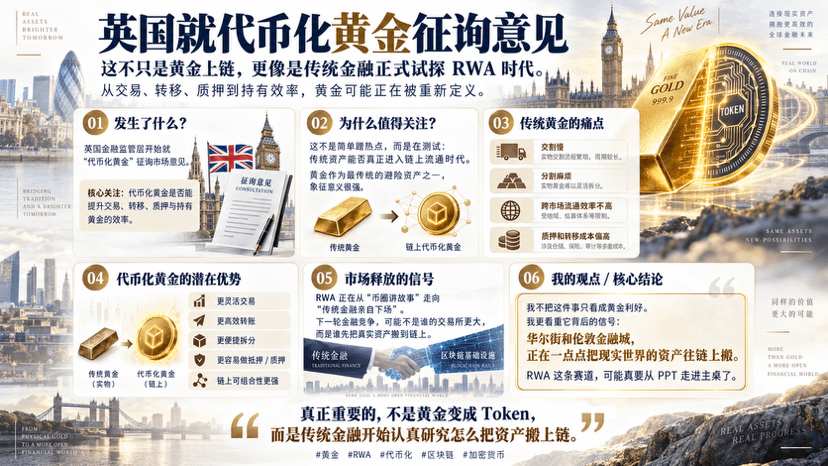
The UK FCA has started researching tokenized gold. This is not as simple as “moving gold onto the blockchain”; rather, it is probing something bigger: can traditional financial assets truly enter the era of on-chain circulation?
Gold $XAU has been around for thousands of years, so it’s pretty traditional, right? But the problem is also obvious: slow settlement, cumbersome division, and inefficient cross-market liquidity.
Once gold is turned into a Token backed by real physical reserves, trading, transfers, collateralization, and splitting can all become much more flexible.
What I care about most is not whether gold prices will rise because of this news, but the signal behind it:
RWA is moving from “crypto storytelling” to traditional finance itself stepping in to reshape the infrastructure.
In the past, when people talked about RWA, many thought it was just wrapping stocks, bonds, and gold in a Token shell.
Now even a long-established financial center like the UK is seriously studying the rules, which shows they have realized that the next round of financial competition may not be about “whose exchange is bigger,” but about who first brings real assets onto the blockchain.
And gold is very special.
It is already one of the world’s largest safe-haven assets. If tokenized gold can in the future be used more broadly for trading, collateral, and even institutional settlement, then the on-chain world will gain not just a new asset class, but an asset with a genuine foundation of traditional financial credit.
So I don’t see this as simply “bullish for gold.”
I would rather understand it like this:
Wall Street and the City of London are gradually moving real-world assets onto the blockchain.
The RWA sector may truly be moving from slides into the main table.
#黄金 #RWA #区块链 #加密货币
I think many people are underestimating this message.
The UK FCA has started researching tokenized gold. This is not as simple as “moving gold onto the blockchain”; rather, it is probing something bigger: can traditional financial assets truly enter the era of on-chain circulation?
Gold $XAU has been around for thousands of years, so it’s pretty traditional, right? But the problem is also obvious: slow settlement, cumbersome division, and inefficient cross-market liquidity.
Once gold is turned into a Token backed by real physical reserves, trading, transfers, collateralization, and splitting can all become much more flexible.
What I care about most is not whether gold prices will rise because of this news, but the signal behind it:
RWA is moving from “crypto storytelling” to traditional finance itself stepping in to reshape the infrastructure.
In the past, when people talked about RWA, many thought it was just wrapping stocks, bonds, and gold in a Token shell.
Now even a long-established financial center like the UK is seriously studying the rules, which shows they have realized that the next round of financial competition may not be about “whose exchange is bigger,” but about who first brings real assets onto the blockchain.
And gold is very special.
It is already one of the world’s largest safe-haven assets. If tokenized gold can in the future be used more broadly for trading, collateral, and even institutional settlement, then the on-chain world will gain not just a new asset class, but an asset with a genuine foundation of traditional financial credit.
So I don’t see this as simply “bullish for gold.”
I would rather understand it like this:
Wall Street and the City of London are gradually moving real-world assets onto the blockchain.
The RWA sector may truly be moving from slides into the main table.
#黄金 #RWA #区块链 #加密货币