Brazil Raises Capital Threshold for Virtual Asset Licenses
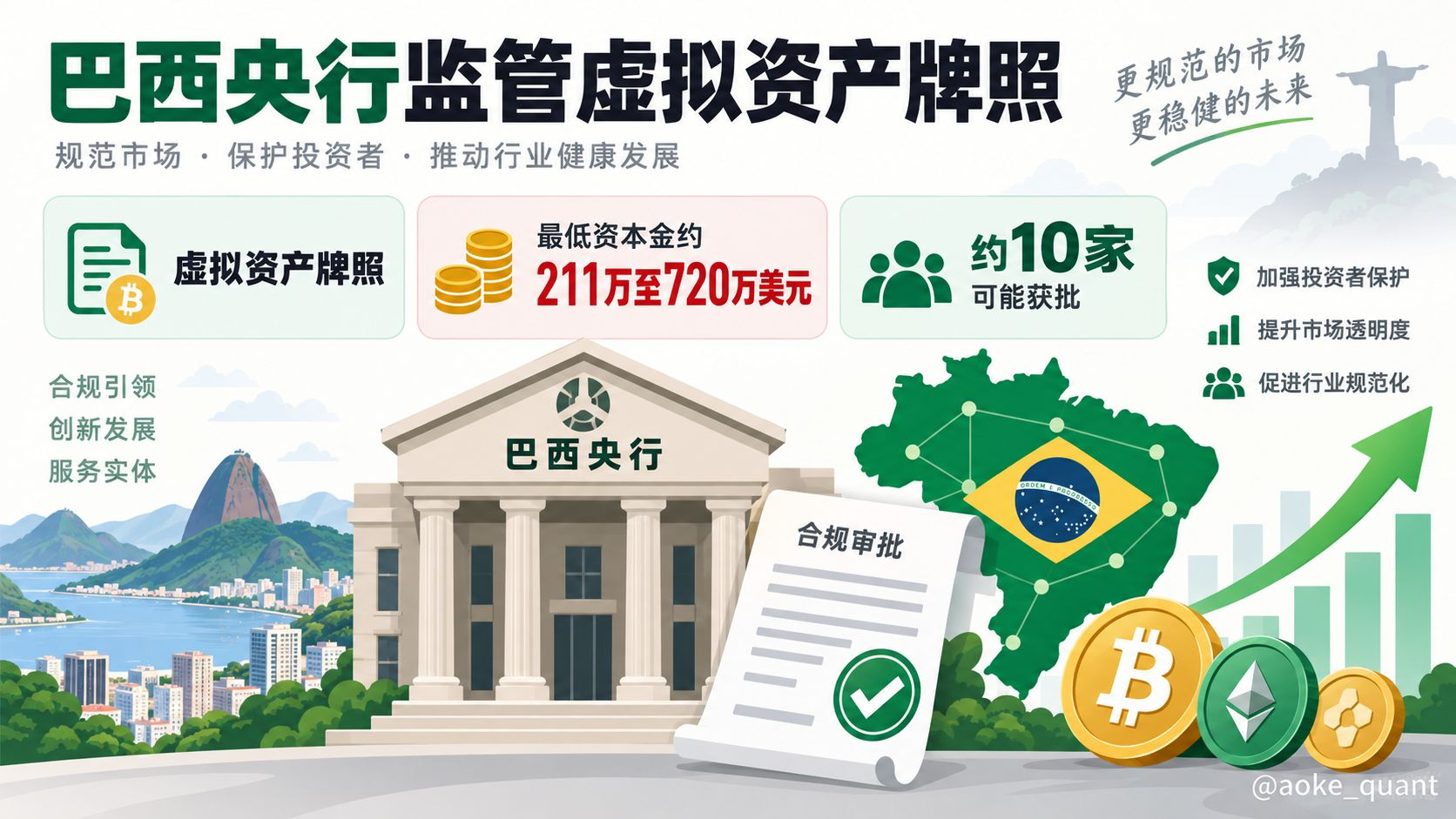
Brazil’s crypto regulation has entered a more clearly defined phase of prudent market access. According to information already disclosed, on September 14 the Central Bank of Brazil finalized the final rules for virtual asset service providers. The minimum licensing capital is divided by business type and risk level, ranging from about 10.8 million to 37.2 million Brazilian reais (approximately USD 2.11 million to USD 7.20 million). Compared with the earlier consultation draft’s range of roughly USD 1 million to USD 3 million reais, the new standard is clearly higher. It also adds requirements for governance, internal controls, anti–money laundering, audits, and ongoing reporting.
The key point is that this is not merely a change in a single capital figure, but an overall elevation of the market access framework. Industry estimates suggest there are currently about 150 to 300 relevant companies in Brazil. Of these, about 20 to 25 may apply with the necessary conditions or willingness, and ultimately only around 10 may obtain licenses. The report also mentions that some smaller platforms have already ended or reorganized their retail business. This means the regulatory threshold may shift from being purely a cost item to becoming a structural market variable, directly affecting which institutions can continue serving local users.
Logically, when the central bank raises capital requirements, it usually reflects higher expectations regarding the safety of clients’ assets, operational resilience, and anti–money laundering responsibilities. Capital is only the first layer of screening. Subsequent governance, internal control, audit, and ongoing reporting requirements will further increase compliance spending. For asset-light, small-team platforms, the real pressure may not come only from one-time capital top-ups, but also from the need for long-term compliance personnel, system development, and external audit costs.
The impact on the crypto market may unfold in three layers. First, the number of local service providers may shrink, causing retail entry points to become more concentrated; users may flow more toward platforms with stronger capital and more complete compliance capabilities. Second, the importance of licensed institutions’ cooperation with banks, payment firms, and custody service providers will increase. Fiat on/off-ramp and custody standards may become competitive focal points. Third, as Brazil is a major market in Latin America, its regulatory moves may be used as reference by other emerging markets—especially given the rapid development of stablecoins, cross-border payments, and local transaction services.
What needs to be distinguished is that existing information confirms a substantial increase in capital requirements and industry estimates for the number of approvals, but it does not allow conclusions that specific companies will exit, nor can it directly be used to infer the direction of short-term market prices. The editorial view is that the signal released by Brazil’s rules is not simply a negation of crypto business; rather, it moves the industry from low-threshold expansion into a framework of licensing, adequate capital, and ongoing supervision. In the long run, this may reduce certain compliance risks. In the short run, however, the adjustment and consolidation pressures on small and medium-sized platforms will be more pronounced.
#巴西央行提高VASP资本要求 #BTC #ETH #BNB
Brazil’s crypto regulation has entered a more clearly defined phase of prudent market access. According to information already disclosed, on September 14 the Central Bank of Brazil finalized the final rules for virtual asset service providers. The minimum licensing capital is divided by business type and risk level, ranging from about 10.8 million to 37.2 million Brazilian reais (approximately USD 2.11 million to USD 7.20 million). Compared with the earlier consultation draft’s range of roughly USD 1 million to USD 3 million reais, the new standard is clearly higher. It also adds requirements for governance, internal controls, anti–money laundering, audits, and ongoing reporting.
The key point is that this is not merely a change in a single capital figure, but an overall elevation of the market access framework. Industry estimates suggest there are currently about 150 to 300 relevant companies in Brazil. Of these, about 20 to 25 may apply with the necessary conditions or willingness, and ultimately only around 10 may obtain licenses. The report also mentions that some smaller platforms have already ended or reorganized their retail business. This means the regulatory threshold may shift from being purely a cost item to becoming a structural market variable, directly affecting which institutions can continue serving local users.
Logically, when the central bank raises capital requirements, it usually reflects higher expectations regarding the safety of clients’ assets, operational resilience, and anti–money laundering responsibilities. Capital is only the first layer of screening. Subsequent governance, internal control, audit, and ongoing reporting requirements will further increase compliance spending. For asset-light, small-team platforms, the real pressure may not come only from one-time capital top-ups, but also from the need for long-term compliance personnel, system development, and external audit costs.
The impact on the crypto market may unfold in three layers. First, the number of local service providers may shrink, causing retail entry points to become more concentrated; users may flow more toward platforms with stronger capital and more complete compliance capabilities. Second, the importance of licensed institutions’ cooperation with banks, payment firms, and custody service providers will increase. Fiat on/off-ramp and custody standards may become competitive focal points. Third, as Brazil is a major market in Latin America, its regulatory moves may be used as reference by other emerging markets—especially given the rapid development of stablecoins, cross-border payments, and local transaction services.
What needs to be distinguished is that existing information confirms a substantial increase in capital requirements and industry estimates for the number of approvals, but it does not allow conclusions that specific companies will exit, nor can it directly be used to infer the direction of short-term market prices. The editorial view is that the signal released by Brazil’s rules is not simply a negation of crypto business; rather, it moves the industry from low-threshold expansion into a framework of licensing, adequate capital, and ongoing supervision. In the long run, this may reduce certain compliance risks. In the short run, however, the adjustment and consolidation pressures on small and medium-sized platforms will be more pronounced.
#巴西央行提高VASP资本要求 #BTC #ETH #BNB