


Don’t just focus on the unit price. A key common trait of the early “big movers” in the past is that they “distributed a lot.”
From RAVE, RIVER, COAI to AKE, BTW, M: Some token airdrops really aren’t worse than the “golden dogs,” but low circulation is an amplifier, not a ticket.
When many people see that a certain Binance Alpha token was once worth thousands of dollars per share, their first reaction is to look for the next “golden dog.”
But what you should look at first isn’t the token unit price—it’s how many tokens were actually distributed per share.
If each share has 10,000 tokens and the price rises to 0.01 US dollars, that’s 100 US dollars.
If each share only has 50 tokens, even if the price rises to 1 US dollar, you only end up with 50 US dollars.
So, the value of an airdrop shouldn’t be judged only by its unit price. Instead, you should look at:
Tokens per share × Price.
I compiled the top 20 samples of Binance Alpha’s all-time highest value, with the observation window running from each token’s airdrop or activity start date to September 10, 2026.
Here, “all-time highest value” refers to the number of tokens per share multiplied by the all-time highest price after the airdrop—this is a theoretical value, and it doesn’t mean the entire allocation can be sold at the peak price.
To make this conclusion more intuitive, below I put these 20 samples together for comparison.
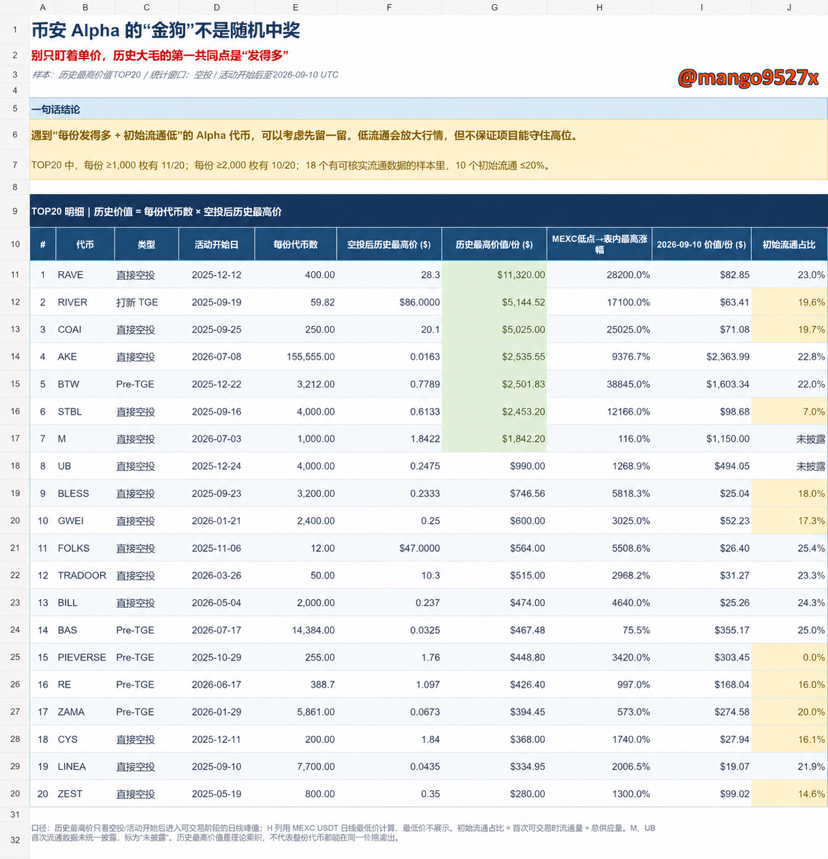
From the table, the first thing you can tell isn’t which tokens have the highest unit price, but that for many tokens, the number of tokens distributed per share is itself already quite substantial.
First commonality: many tokens are distributed per share
In the 20 samples:
There are 11 tokens with 1,000 tokens per share;
There are 10 tokens with 2,000 tokens per share;
The median number of tokens per share is 1,500.
The theoretical peak value for RAVE, RIVER, and COAI is all above $5,000.
The theoretical peak value for AKE, BTW, and STBL is also above $2,000.
This points to a very practical issue:
As long as the quantity is large enough, the coin price doesn’t need to rise to an especially exaggerated level—an entire airdrop allocation can still quickly become very valuable.
This is also why you can’t just look at whether coin prices are high or low. Many low-unit-price tokens—once you multiply by the quantity—actually have very considerable real value.
Second commonality: initial circulation is generally quite low
Low circulation is another important reason these tokens can quickly surge.
Of the 20 samples, 18 have relatively clear initial circulation data that can be found.
Among them:
10 initial circulating supply ratios are no more than 20%;
9 are strictly below 20%;
M and UB have no unified and verifiable initial circulation data, so you can’t force an estimate.
Low initial circulation, in simple terms, means there are relatively fewer tokens that the market can truly buy at the very beginning.
When an airdrop, listing, trending attention, and capital all appear at the same time, buy orders cluster together, making the price easier to push up quickly.
But low circulation doesn’t mean all remaining tokens are held entirely by market makers. The team, investors, foundations, ecosystem incentives, and market-making arrangements can all affect the actual circulating structure.
It’s difficult for outsiders to accurately judge who actually holds the tokens based solely on one circulation ratio.
So, more accurately, it’s:
Low circulation can amplify price volatility, but it can’t alone prove that a project will definitely rise, nor can it prove that the project definitely has a controlling stake.
Some tokens don’t surge immediately; they start after a period of time.
Among these 20 samples, only 9 reached their peak within 30 days after the activity started.
Also, for 9 samples, the historical high doesn’t appear until after 90 days.
STBL hits its peak about 8 days after the activity starts, and COAI about 21 days after.
But BTW only reaches its peak about 240 days later; ZAMA about 205 days later; CYS about 247 days later.
So if the token didn’t rise on the day of the airdrop, that doesn’t mean this project has no opportunity.
Some tokens need to wait until the listing, the narrative matures, product progress happens, or market sentiment returns—before they truly start.
From the low to the high, the increase could be extremely staggering
Based on MEXC USDT daily data, for some tokens, the move from the low point after the airdrop to the highest price in the table shows a very large increase:
RAVE: approximately 28,200%;
COAI: approximately 25,025%;
BTW: approximately 38,845%;
STBL: approximately 12,166%;
AKE: approximately 9,377%.
But these numbers can only show how large the volatility is; they can’t be directly understood as returns that ordinary people can replicate.
The lowest price might just be an extreme price on a single day, and the highest price might also last only a very short time.
If the trading volume is small and the order book is thin, even if the software shows the price jumped by several hundred times, you may not be able to actually buy or sell at that price.
Low circulation amplifies; fundamentals determine sustainability
You can’t look at Alpha projects in only one way.
Some tokens mainly rely on quantity, low circulation, and market sentiment to surge—so they rise fast and retrace fast as well.
Some projects also truly do have products, users, a financing background, or real industry demand. They may not be the strongest on day one, but there is still a chance later as product progress brings renewed attention and capital.
So you need to separate two questions:
Low circulation determines whether the price has the possibility to surge quickly.
Product and real demand determine whether it can stay at high levels for longer.
Ultimately, what’s really worth paying attention to isn’t just “whether there’s a story,” but whether there is a continuing demand to use this token.
How to filter Alpha “golden dogs” in the future
Focus first on this combination below:
Larger amount per share + initial circulating supply not exceeding 20% + able to absorb both volume and order book.
I think what Alpha is most worth paying attention to isn’t simply tokens with a “low price,” but rather:
Tokens with a large distribution, low initial circulation, and real money in the market paying attention.
When I encounter this kind of setup, I’ll consider holding off a bit first, but I won’t treat the theoretical peak value as guaranteed returns.
Finally, I also wish everyone can make it through this bear market and keep both your principal and patience. The real outcomes usually belong to those still sitting at the table.