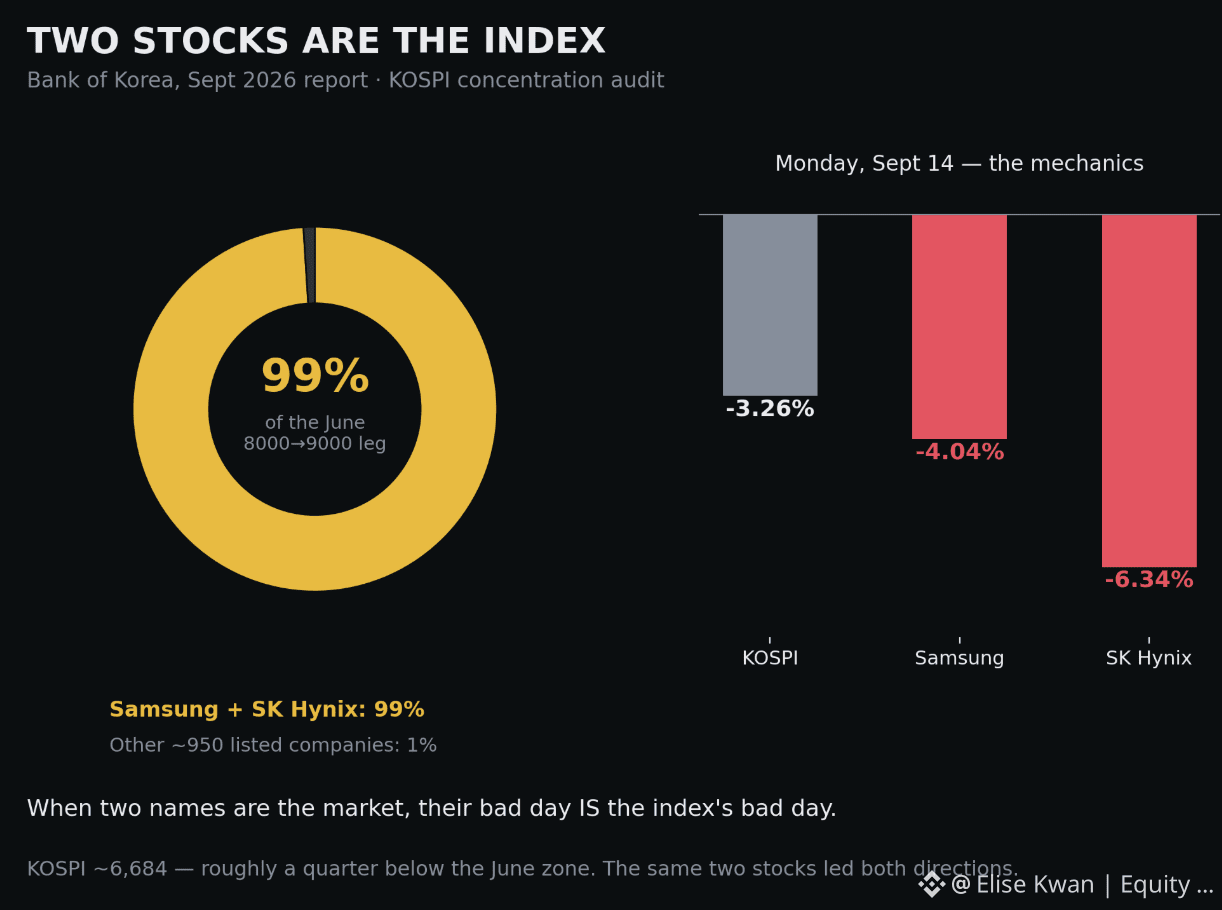
Korea, Monday close: KOSPI -3.26% to ~6,684. SKHY -6.34%. Samsung -4.04%.
The context arrived from the least likely source — the central bank. The Bank of Korea's September policy report audited this year's index volatility and published the number: during the KOSPI's June leg from 8,000 toward 9,000, Samsung and SK Hynix contributed 99% of the rise. Two names. Roughly 950 other listed companies split the remaining one percent.
That statistic reclassifies the entire Korean market. It isn't an index rallying and correcting — it's a leveraged memory-cycle trade wearing an index costume, and the costume has now come off in both directions: the same two stocks that were 99% of the way up have led the index roughly a quarter below its June zone.
Which makes days like Monday pure mechanics. When two stocks are the market, a 4-6% move in them IS a 3% index day. Nothing else needs to happen, and nothing else did.
The read-through runs straight to the US names: the memory supercycle thesis — sub-10-day inventories, record tightness projected for 2027 — and the concentration risk are now the same trade, in Seoul and in MU SNDK alike. The fundamentals may well be right. But a trade this crowded moves at crowd speed, both ways.
Position for the thesis if you believe it. Size for the exit everyone else will attempt through the same door. #positioning #flows
The context arrived from the least likely source — the central bank. The Bank of Korea's September policy report audited this year's index volatility and published the number: during the KOSPI's June leg from 8,000 toward 9,000, Samsung and SK Hynix contributed 99% of the rise. Two names. Roughly 950 other listed companies split the remaining one percent.
That statistic reclassifies the entire Korean market. It isn't an index rallying and correcting — it's a leveraged memory-cycle trade wearing an index costume, and the costume has now come off in both directions: the same two stocks that were 99% of the way up have led the index roughly a quarter below its June zone.
Which makes days like Monday pure mechanics. When two stocks are the market, a 4-6% move in them IS a 3% index day. Nothing else needs to happen, and nothing else did.
The read-through runs straight to the US names: the memory supercycle thesis — sub-10-day inventories, record tightness projected for 2027 — and the concentration risk are now the same trade, in Seoul and in MU SNDK alike. The fundamentals may well be right. But a trade this crowded moves at crowd speed, both ways.
Position for the thesis if you believe it. Size for the exit everyone else will attempt through the same door. #positioning #flows