

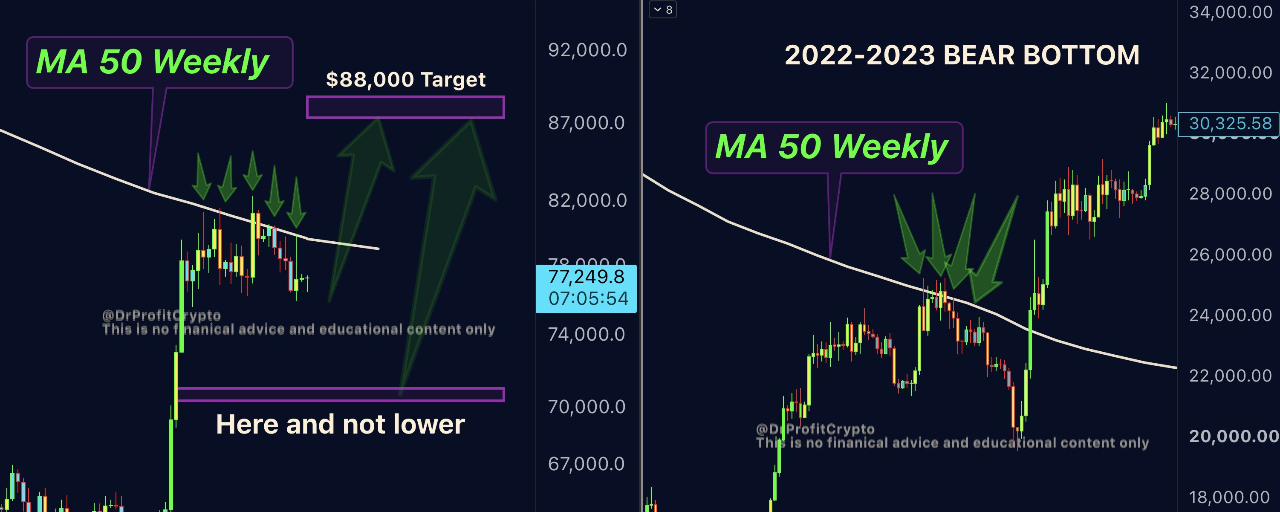

One point I think many people are understanding a bit too much about Bitcoin’s current developments: the MA50 Weekly is acting as resistance, but that doesn’t mean $BTC it can’t be broken through.

Looking back at the early-year 2023 recovery period, you’ll see something quite interesting.
Bitcoin has also tested the MA50 Weekly multiple times before, being rejected each time, then returning to test again before finally breaking out for real. Therefore, BTC being capped at the MA50 right now is not enough to conclude that the recovery trend has ended.
Simply put: a resistance zone that’s doing its job today doesn’t mean it will control the market forever.
So what am I looking at for Bitcoin right now?
In the framework I’ve been following since last week:
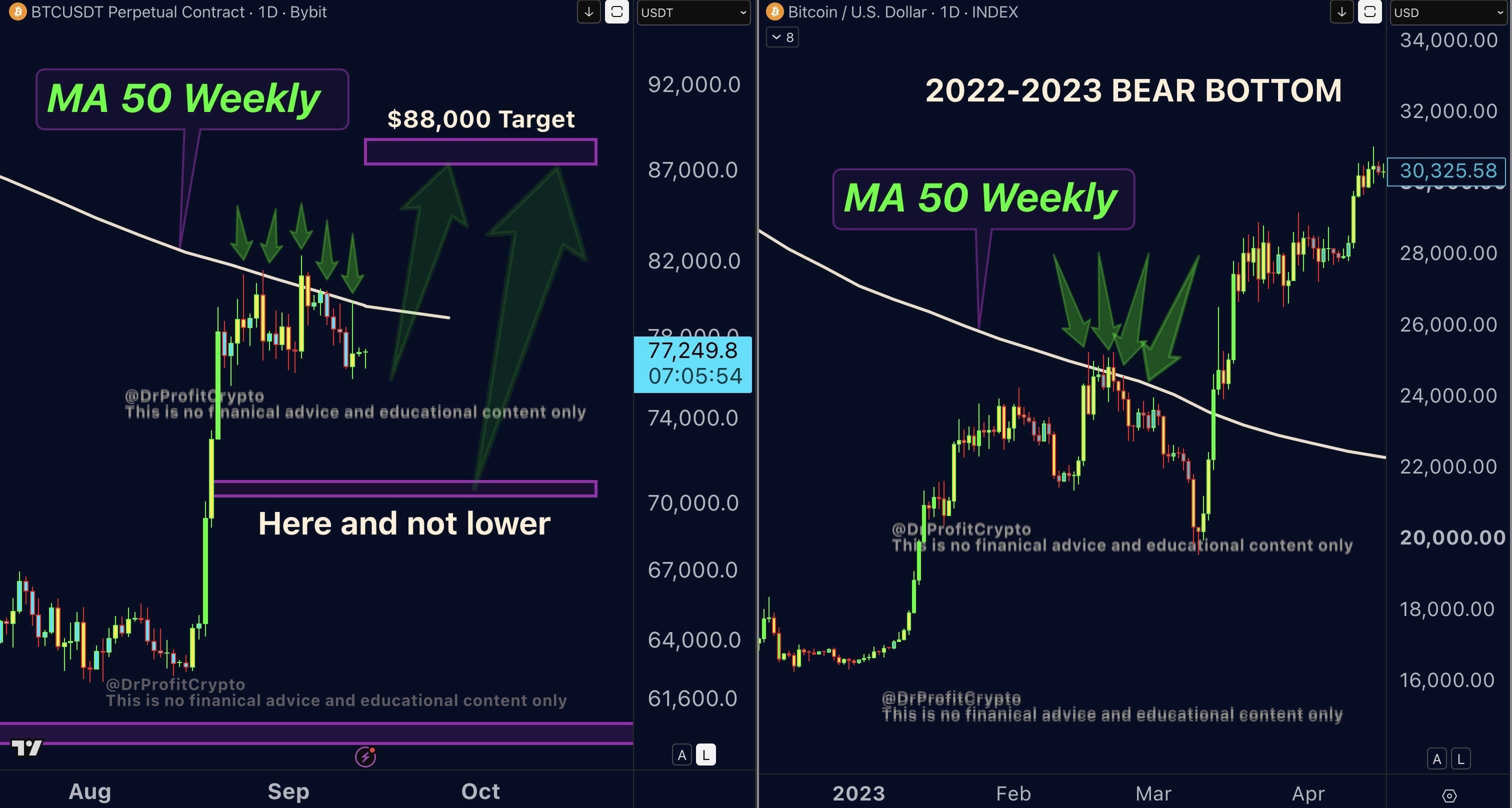
$78.5K has already been reclaimed by BTC as a resistance zone, but I still haven’t confirmed it’s strong enough to act as support.
$71K is still the most important support zone in the correction scenario.
Meanwhile, $82.5K–$83K is the zone I’m especially interested in. If BTC reclaims the MA50 Weekly and continues breaking out above this area, the bullish structure will become much more convincing.
Then, $88K is the next big target I’m watching.
But there’s one point to distinguish:
Expecting resistance to be broken doesn’t mean that every test has to break out immediately.
BTC may very well need more time—possibly an additional correction move—before it goes on.
Will BTC come back to $71K?
That’s the real hard question.
Two scenarios are still on the table:
One: BTC continues moving up, reclaims the MA50 Weekly, and breaks out above $83K without giving the market an opportunity to enter lower.
Second, BTC makes a deeper pullback around $71K, holds that support zone, and only then turns back toward $88K.
Personally, I don’t try to predict every small move.
If the market gives an opportunity around $71K, I still want to have a long position there. For spot, I’ll keep holding rather than trying to trade every fluctuation.
The goal I care about is the bigger structure, not nailing each individual candle.
CLARITY Act: bullish, but don’t misinterpret what’s happening on 15/9
Another thing to note is the CLARITY Act.
September 15 relates to a procedural hurdle that needs 60 votes to advance the bill during the review process—not the day when “the vote is done and the law is officially passed.”
So if it reaches 60 votes and the process continues, I see this as a positive signal. If it hasn’t reached that, it could simply mean more negotiations are needed.
From a longer-term perspective, I’m still leaning toward the scenario where the CLARITY Act ultimately passes and is signed into law this year.
More importantly, we’re seeing an entire infrastructure system for digital finance being built.
Nasdaq has announced a $100M investment agreement into Payward, Kraken’s parent company, as both sides push forward tokenized stocks.
Circle also expects to launch Arc’s public mainnet on 16/9, with major names such as BlackRock, DTCC, Visa, and Mastercard joining as founding validators.
For me, this is the thesis worth paying attention to.
Circle, Coinbase, and Ethereum may represent different pieces of the puzzle, but they all fit into a bigger story: the development of digital finance infrastructure.
And if this thesis is correct, the upside is much bigger than just trading the market’s first reaction to a headline.
What about the Fed?
FOMC will end on 16/9.
The market is currently pricing about a 85.5% chance of a 25bps hike, 14.5% for no change, and nearly 0% for a rate cut scenario.
Personally, I’m leaning more toward the option of the Fed keeping rates unchanged.
But for Bitcoin, I don’t think this is the time to try to guess the next headline. Most expectations have already been priced in by the market.
What I care about more is BTC’s actual reaction after the event.
MA50 Weekly → $82.5K–$83K → $88K.
That’s still the roadmap I’m tracking.
I’m still bullish on Bitcoin, but I wouldn’t call the breakout confirmed while resistance is still there.
If BTC needs one more move around $71K before going on, I still have a plan for that scenario.
What if the market decides to go straight up?
So that’s also fine.
You don’t necessarily need to catch the lowest entry. More important is not losing the thesis because of a few short-term swings.