
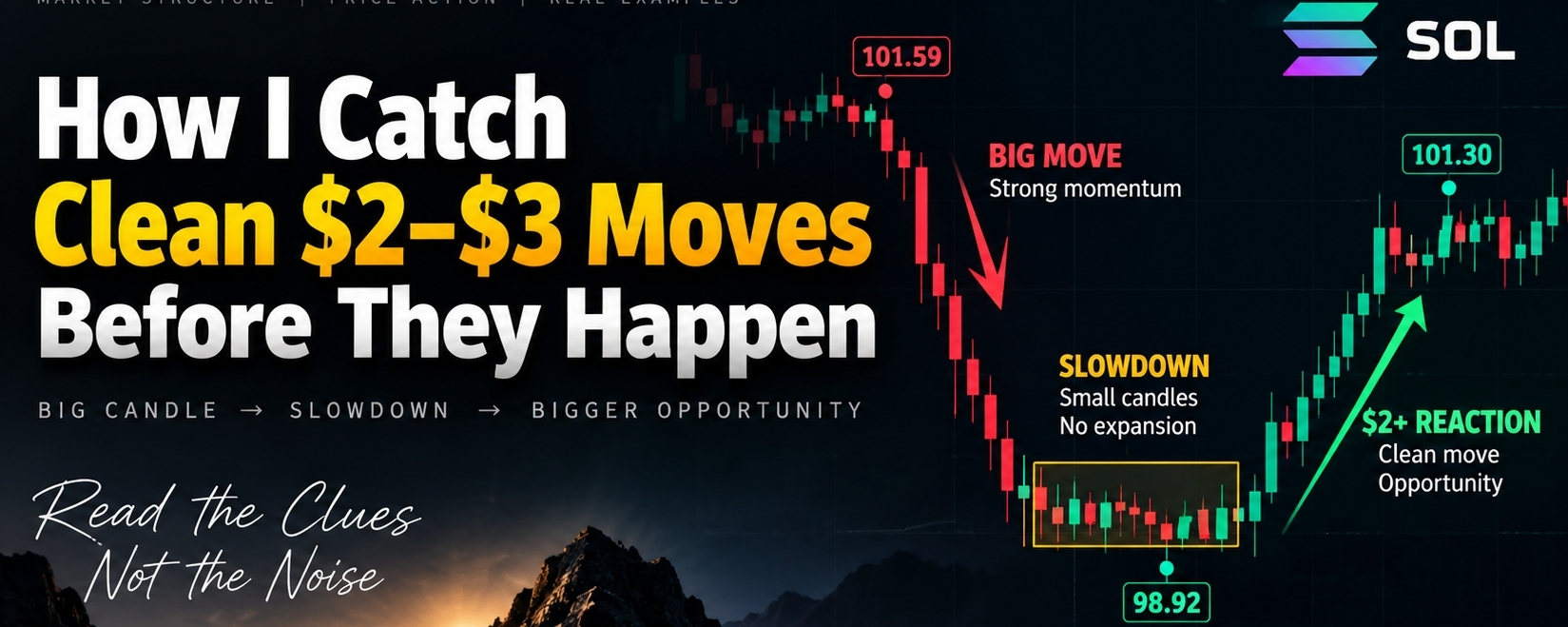

$SOL One thing I’ve been learning from watching SOL is that catching a clean $2–$3 move is not always about predicting the direction.
Sometimes the biggest clue is what happens after a big move.
For example, SOL made a strong downside move from around 101.59 and came down toward the 99 area with big candles.
At first, everything looked bearish.
The market was going down, so naturally the brain starts thinking:
“It’s going lower. It’s going lower.”
But then something changed.
Around 99.30–99.50, the market became extremely slow.
Instead of continuing with strong downside candles, it started moving only around $0.10–$0.20 at a time:
99.35 → 99.45 → 99.24 → 99.10
This is where the real clue appeared.
The market was still moving down, but the expansion was disappearing.
That distinction is extremely important.
Big displacement → sudden slowdown
When a market makes a large move and then suddenly becomes very slow, I don't automatically assume that the same move will continue.
I start asking:
“Is the current move actually still working?”
Because if sellers were truly in control, I would expect continued expansion.
Instead, we saw:
101.59 → 99.8/99.9
Big move.
Then:
99.xx → extremely slow → stuck
That slowdown was telling us something.
Eventually the market reached around 98.92 and stayed there for roughly two hours.
No meaningful downside expansion.
Then the market started moving back upward.
And from:
98.92 → 100.80 → 101.30+
That became a clean $2+ reaction.
This is how I think about the $2–$3 move
I don't want to trade every small movement.
I want to find the moments where the market gives me a clean structural clue.
For example:
Big displacement
↓
Movement starts shrinking
↓
Market becomes slow
↓
Price spends time at the location
↓
No further expansion in the original direction
↓
Reaction starts
That is where I start looking for the next $2–$3 opportunity.
And there is another important lesson here.
The overall market can still be bearish.
That doesn't mean every move has to be down.
A bearish market can still give you a $2–$3 upside reaction from a lower zone.
Likewise, a bullish market can still give you a sharp downside reaction.
So I try to separate:
Overall direction
from
the reaction available at the current location.
The biggest mistake I made
The funny part is that I actually mapped the possibility around 98–99 before the move happened. 🤣
I had the feeling:
“If this gets stuck around 98–99, it can come back toward 100.80 or even higher.”
But I didn't fully trust myself because the market still felt bearish.
That was the noise.
The structure was saying one thing.
My brain was saying:
“But it's going down!”
And that's exactly where I need to improve.
Not by trying to predict every move.
But by trusting a clear structural clue when it appears.
My main takeaway
When a market comes down with a big candle, then suddenly becomes very slow and stuck, I don't automatically chase the continuation.
I watch for whether the move has finished for now.
Because sometimes:
Big move → stop → slow → reaction
is the beginning of the next juicy $2–$3 move.
And that's what makes trading interesting.
You don't need to catch everything.
You just need to recognize the clean moves when the market actually gives them.
Map the move.
Wait for the clue.
Ignore the noise.
Catch the juicy $2–$3. 🔥