

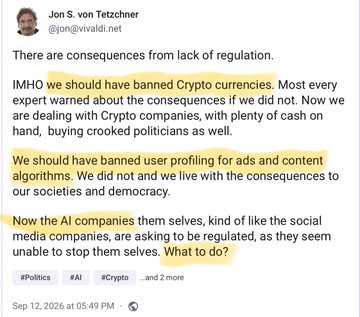
Businessman fears that the lack of regulation in the crypto industry could lead to negative consequences for the whole world. Von Tezner advised introducing a similar ban on "user profiling for showing ads and on content-forming algorithms." The entrepreneur drew a parallel between digital assets and browser algorithms, calling them uncontrolled technologies used to manipulate public opinion and undermine democracy.
Von Tetzner has long been critical of cryptocurrencies. Earlier, he argued that digital assets are unlikely to become a widely used means of payment due to their high volatility. The browser creator criticized Bitcoin mining for its excessive electricity consumption and doubted that cryptocurrencies could have any real-life use.
In January 2022, Vivaldi’s founder promised that his company would not follow the example of competitors and would not add functions related to cryptocurrencies to the new browser. According to von Tetzner, "if you strip away the hype around cryptocurrencies, nothing is there except a financial pyramid posing as a currency." Adding a built-in crypto wallet to Vivaldi, the businessman explained, is like pushing users toward gambling and fraud.
In August 2025, von Tetzner said that Vivaldi would not fall in line with the mass trend of turning browsers into AI assistants and would not integrate chatbots based on large language models (LLMs), systems for automatically generating brief summaries, and other similar generative artificial intelligence features. By the end of the year, the businessman cited an internal survey by his company, according to which an overwhelming majority of Vivaldi users are against integrating AI into the browser.
In 2022, Opera developers added support for eight blockchains to the browser: Bitcoin, Ethereum, Polygon, Solana, Ronin, StarkEx, Nervos, and IXO based on Cosmos. Later, Opera announced a partnership with the Alteon LaunchPad platform for the release of non-fungible tokens (NFTs).