
Cryptology_7
2.6k Posts
Cryptology_7
🧠 Quantitative Trader | Binance Sqaure Post Creator | Crypto Insights | Your Go-To Path to Profit
High-Frequency Trader
3.4 Years
785 Following
18.1K+ Followers
6.1K+ Liked
Posts
All
Quotes
Live
PINNED

PINNED





Shaheen 69
·
--
🎁 A Little ETH, A Lot of Love ❤️
This red packet is my small way of saying THANK YOU to my amazing community. 🙏 Keep supporting me, keep showing your love, and let’s continue this journey together. Your trust means everything! ❤️
Stay with me — more love, bigger red packets & better rewards are coming! 🚀💎
$ETH
This red packet is my small way of saying THANK YOU to my amazing community. 🙏 Keep supporting me, keep showing your love, and let’s continue this journey together. Your trust means everything! ❤️
Stay with me — more love, bigger red packets & better rewards are coming! 🚀💎
$ETH


Ahli Hidaya
·
--
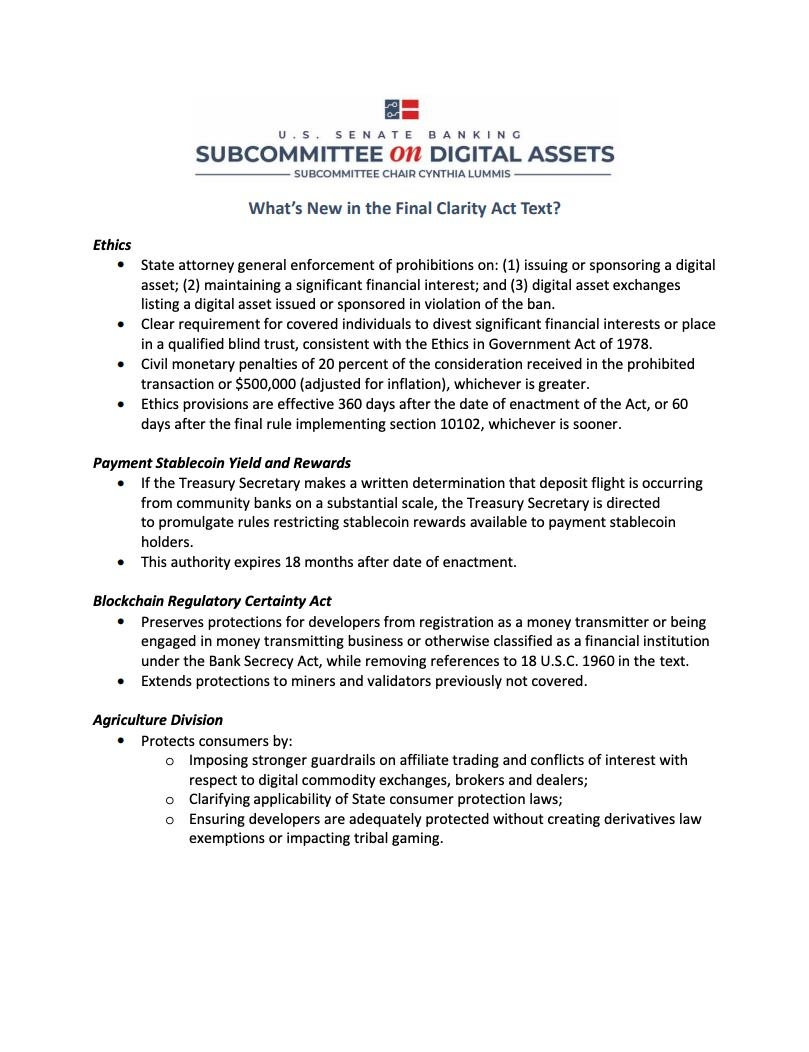
Bullish🚨 BREAKING: Senate Republicans Drop Final Offer on the Clarity Act!
Senate Republicans have officially released the new Clarity Act text, featuring a revised ethics proposal signed off by Trump. This is being called their final offer to Democrats ahead of Tuesday’s crucial cloture vote.
Here is a breakdown of what's inside the final text:
Ethics & Enforcement: State AG enforcement against illegal digital asset issuance or banned exchange listings. Strict divestment requirements for covered individuals or placement in a qualified blind trust under the Ethics in Government Act of 1978. Civil penalties hit 20% of the transaction consideration or $500,000 (adjusted for inflation), whichever is greater. Provisions take effect 360 days post-enactment or 60 days after final rule implementation, whichever is sooner.
Payment Stablecoin Yield & Rewards: If the Treasury Secretary determines community bank deposit flight is happening on a substantial scale, they are directed to promulgate rules restricting stablecoin rewards (authority expires 18 months post-enactment).
Blockchain Regulatory Certainty Act: Preserves developer protections from being classified as money transmitters/financial institutions under the Bank Secrecy Act while removing references to 18 U.S.C. 1960. Extends protections to previously uncovered miners and validators.
Agriculture Division: Stronger guardrails on affiliate trading and conflicts of interest for digital commodity exchanges/brokers/dealers, clarifies state consumer protection laws, and protects developers without impacting tribal gaming.
With Tuesday's cloture vote fast approaching, the pressure is now on Democrats. Will this final offer push the Clarity Act across the finish line?
What are your thoughts on these new terms? Let’s discuss in the comments below! 👇
#ClarityAct #CryptoRegulation #USCrypto #Senate #CryptoNews #BinanceSquare$BTC $BNB $USDC #dyor
Senate Republicans have officially released the new Clarity Act text, featuring a revised ethics proposal signed off by Trump. This is being called their final offer to Democrats ahead of Tuesday’s crucial cloture vote.
Here is a breakdown of what's inside the final text:
Ethics & Enforcement: State AG enforcement against illegal digital asset issuance or banned exchange listings. Strict divestment requirements for covered individuals or placement in a qualified blind trust under the Ethics in Government Act of 1978. Civil penalties hit 20% of the transaction consideration or $500,000 (adjusted for inflation), whichever is greater. Provisions take effect 360 days post-enactment or 60 days after final rule implementation, whichever is sooner.
Payment Stablecoin Yield & Rewards: If the Treasury Secretary determines community bank deposit flight is happening on a substantial scale, they are directed to promulgate rules restricting stablecoin rewards (authority expires 18 months post-enactment).
Blockchain Regulatory Certainty Act: Preserves developer protections from being classified as money transmitters/financial institutions under the Bank Secrecy Act while removing references to 18 U.S.C. 1960. Extends protections to previously uncovered miners and validators.
Agriculture Division: Stronger guardrails on affiliate trading and conflicts of interest for digital commodity exchanges/brokers/dealers, clarifies state consumer protection laws, and protects developers without impacting tribal gaming.
With Tuesday's cloture vote fast approaching, the pressure is now on Democrats. Will this final offer push the Clarity Act across the finish line?
What are your thoughts on these new terms? Let’s discuss in the comments below! 👇
#ClarityAct #CryptoRegulation #USCrypto #Senate #CryptoNews #BinanceSquare$BTC $BNB $USDC #dyor

苏菲亚 Sophia
·
--
🦋🦋🦋A bold butterfly life—let’s all make it to shore and be reborn!
Butterfly Launchpad official meme coin officially sets sail
Official launch | community co-building | full-scale on-the-ground promotion
A massive on-the-ground promotion team, forging ahead together
100% AAPLB stock dividend—dividends start with just 10,000 coins
Dividend apples—AAPLB coin shares, share the rewards
Build a world-class community
Join hands with fellow travelers, head toward a bright new future
Butterfly Launchpad—making the world a better place!
Version 2 (condensed poster short lines, suitable for covers)
🔥 Butterfly life | let’s all make it to shore and be reborn
✅ Official launch ✅ community co-building ✅ on-the-ground promotion
🍎 AAPLB coin-share dividends, start with 10,000
A strong on-the-ground team, co-building a great community
A bold butterfly life—let’s all make it to shore and be reborn!
🦋🦋#蝴蝶人生🦋 #Flap🦋 #meme #全网爆仓6.74亿美元 #英伟达洽谈至多100亿美元投资Anthropic
Butterfly Launchpad official meme coin officially sets sail
Official launch | community co-building | full-scale on-the-ground promotion
A massive on-the-ground promotion team, forging ahead together
100% AAPLB stock dividend—dividends start with just 10,000 coins
Dividend apples—AAPLB coin shares, share the rewards
Build a world-class community
Join hands with fellow travelers, head toward a bright new future
Butterfly Launchpad—making the world a better place!
Version 2 (condensed poster short lines, suitable for covers)
🔥 Butterfly life | let’s all make it to shore and be reborn
✅ Official launch ✅ community co-building ✅ on-the-ground promotion
🍎 AAPLB coin-share dividends, start with 10,000
A strong on-the-ground team, co-building a great community
A bold butterfly life—let’s all make it to shore and be reborn!
🦋🦋#蝴蝶人生🦋 #Flap🦋 #meme #全网爆仓6.74亿美元 #英伟达洽谈至多100亿美元投资Anthropic




Aria Daisy 阿莉娅_黛西
·
--
Bullish🔥 FLOKI Giveaway is LIVE! 🐶🚀
I’m excited to share this 1000 FLOKI giveaway with the Binance community! 💛
Want to be one of the lucky winners? 👀
✅ Follow me
🔁 Repost this post
💬 Comment “9"
Let’s grow together and keep supporting the FLOKI community! 🚀🐕
Good luck everyone! 🍀❤️
#BinanceSquareFamily #GIVEAWAY🎁
$FLOKI $GIGGLE
I’m excited to share this 1000 FLOKI giveaway with the Binance community! 💛
Want to be one of the lucky winners? 👀
✅ Follow me
🔁 Repost this post
💬 Comment “9"
Let’s grow together and keep supporting the FLOKI community! 🚀🐕
Good luck everyone! 🍀❤️
#BinanceSquareFamily #GIVEAWAY🎁
$FLOKI $GIGGLE


燕寶Melissa
·
--
Bearish🔥 Arthur Hayes: I basically don’t look at Bitcoin technical indicators!
Many people trading BTC watch every day: 📈 MA200 📉 RSI 🔴 MACD 📊 candlestick patterns.
But the approach of Arthur Hayes, co-founder of BitMEX, is completely different.
He has said outright that he basically doesn’t do technical analysis of Bitcoin.
What he really focuses on are three things👇
1️⃣ US stocks He believes BTC largely follows the logic of US stocks. If that logic breaks down and the market calls for additional margin, investors will prioritize selling assets with better liquidity—BTC could be hit first.
2️⃣ Macros + market sentiment He doesn’t like waiting until market sentiment has gone completely crazy before entering. Instead, he tends to: place a bet early when sentiment is just beginning to form.
3️⃣ Finding assets that are “unloved by the market” This is also one of the reasons he’s bullish on ETH.
As for the BTC price? In his view, the key levels are $60,000, $100,000, and the prior historical high around $125,000–$126,000.
But between those key ranges, he won’t rely on technical indicators to trade frequent swings.
💡 Behind this are two entirely different trading mindsets:
Typical investors: price → indicators → buy/sell
Arthur Hayes: macro → liquidity → US stocks → sentiment → asset allocation
The real big money may never be trying to guess the next candlestick.
Instead, they’re deciding: “Where will the next round of capital go?”
#SEC收到灰度莱特币信托转ETF申请
$BTC
$ETH
$BNB
Many people trading BTC watch every day: 📈 MA200 📉 RSI 🔴 MACD 📊 candlestick patterns.
But the approach of Arthur Hayes, co-founder of BitMEX, is completely different.
He has said outright that he basically doesn’t do technical analysis of Bitcoin.
What he really focuses on are three things👇
1️⃣ US stocks He believes BTC largely follows the logic of US stocks. If that logic breaks down and the market calls for additional margin, investors will prioritize selling assets with better liquidity—BTC could be hit first.
2️⃣ Macros + market sentiment He doesn’t like waiting until market sentiment has gone completely crazy before entering. Instead, he tends to: place a bet early when sentiment is just beginning to form.
3️⃣ Finding assets that are “unloved by the market” This is also one of the reasons he’s bullish on ETH.
As for the BTC price? In his view, the key levels are $60,000, $100,000, and the prior historical high around $125,000–$126,000.
But between those key ranges, he won’t rely on technical indicators to trade frequent swings.
💡 Behind this are two entirely different trading mindsets:
Typical investors: price → indicators → buy/sell
Arthur Hayes: macro → liquidity → US stocks → sentiment → asset allocation
The real big money may never be trying to guess the next candlestick.
Instead, they’re deciding: “Where will the next round of capital go?”
#SEC收到灰度莱特币信托转ETF申请
$BTC
$ETH
$BNB


NAJAF_加密 143
·
--
‼️$ZEC Reward is here ‼️
I’m sharing $ZEC rewards with the community as a Bigger thank-you.
✨ Just claim your reward and enjoy! ✨
Claim it. Get rewarded
$ZEC @ZEC是加密的比特币 #zec
I’m sharing $ZEC rewards with the community as a Bigger thank-you.
✨ Just claim your reward and enjoy! ✨
Claim it. Get rewarded
$ZEC @ZEC是加密的比特币 #zec


KIM_加密 143
·
--
BullishIf you’re asking whether BTC could fall into the $50K–$60K zone, that is a possible bearish scenario, but it would require a much deeper correction from the current area around $77K–$78K. Recent analysis has identified roughly $70K and then $62K–$65K as important downside support zones; a move toward $50K–$60K would therefore likely require those supports to fail.
Here’s a natural Binance Square-style giveaway post:
---
🎁 BTC NEXT MOVE — $50K TO $60K?
I want to know what YOU think. 👀
Bitcoin is currently around the $77K–$78K area, but the big question is: What comes next?
My personal view is that if BTC loses the important support zones, we could see a much deeper correction. I’m watching $60K first, and in a more extreme bearish scenario, $50K–$55K could become a possible target.
But here’s the other side…
If BTC holds the major supports and breaks back above the $80K–$82K resistance area, the bearish setup could completely change. Some market analysis currently sees $81.7K as an important level for confirming stronger bullish momentum.
So I want to hear from the community:
👇 What is your BTC prediction?
🔴 $50K–$60K — Deep correction
🟡 $60K–$70K — Healthy pullback
🟢 $80K–$90K+ — Bullish breakout 🚀
🎁 GIVEAWAY
Drop your BTC target + reason in the comments.
❤️ Like
💬 Comment your prediction
🔁 Share/Repost
👥 Follow for more BTC market discussions
I’ll pick some interesting predictions for a surprise crypto reward 🎁
No one knows the next candle. Let’s see who gets it right. 👀🔥
DYOR. Not financial advice.
#BTC #Bitcoin #Crypto143family #BitcoinPrediction #kim_crypto143 $BTC
$ETH
$BNB
Freedom of financial self-defense
Here’s a natural Binance Square-style giveaway post:
---
🎁 BTC NEXT MOVE — $50K TO $60K?
I want to know what YOU think. 👀
Bitcoin is currently around the $77K–$78K area, but the big question is: What comes next?
My personal view is that if BTC loses the important support zones, we could see a much deeper correction. I’m watching $60K first, and in a more extreme bearish scenario, $50K–$55K could become a possible target.
But here’s the other side…
If BTC holds the major supports and breaks back above the $80K–$82K resistance area, the bearish setup could completely change. Some market analysis currently sees $81.7K as an important level for confirming stronger bullish momentum.
So I want to hear from the community:
👇 What is your BTC prediction?
🔴 $50K–$60K — Deep correction
🟡 $60K–$70K — Healthy pullback
🟢 $80K–$90K+ — Bullish breakout 🚀
🎁 GIVEAWAY
Drop your BTC target + reason in the comments.
❤️ Like
💬 Comment your prediction
🔁 Share/Repost
👥 Follow for more BTC market discussions
I’ll pick some interesting predictions for a surprise crypto reward 🎁
No one knows the next candle. Let’s see who gets it right. 👀🔥
DYOR. Not financial advice.
#BTC #Bitcoin #Crypto143family #BitcoinPrediction #kim_crypto143 $BTC
$ETH
$BNB
Freedom of financial self-defense





Log in to explore more content