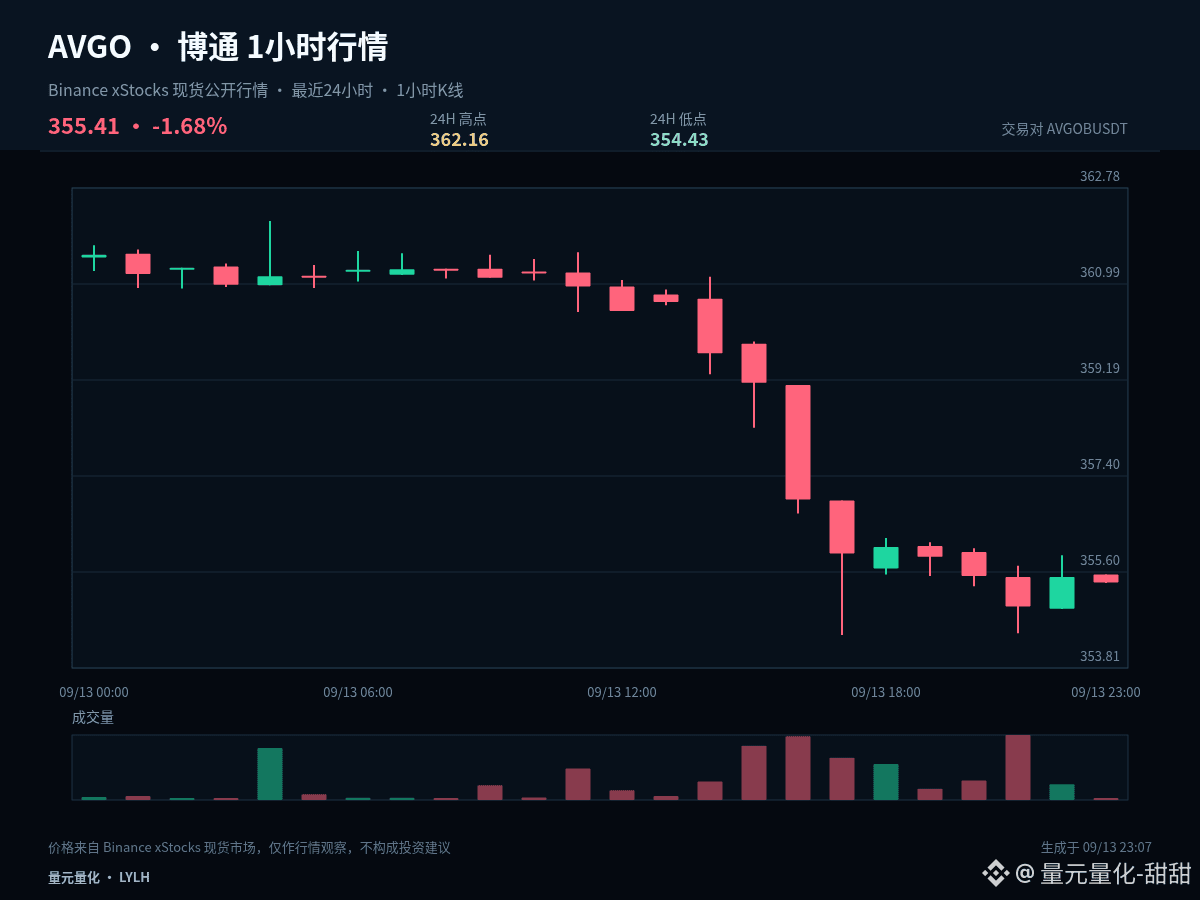
$AVGOB #AVGO After the momentum picks up, that’s when entry is prepared—more importantly, the position must first be assessed. Current performance: -0.03% in the last 1 hour, -1.66% in the last 24 hours. The space that has already been covered can’t simply be reused as the next segment that can be duplicated.
$AVGOB #AVGO is testing the lower edge of the past 24-hour range. The price may look lower, but the real trading value depends on whether the absorption can be sustained—not just on thinking it’s “cheap.”
In a weak phase, the easiest mistake is to misjudge a single rebound as a reversal. Before 358.295 is reclaimed, observe the repair first. If it breaks again below 354.43, it indicates that the downside still lacks valid absorption.
My scenario analysis isn’t betting on only one direction. If price breaks above 362.16 and can hold, it means the upside room has been reopened. If it breaks below 354.43 and cannot manage a rebound, it means the structure is further weakening. If price stays between the two, continue observing the closes on both sides of 358.295.
Existing positions can be handled in stages according to key levels to avoid making all decisions at once. Those without a position should wait for a breakout confirmation or for a pullback to stabilize. For U.S. stock-related instruments, also note the volatility caused by trading-session transitions. Your plan should be based on price conditions—not on emotions replacing execution.
Missing a stretch of the market won’t directly cause a loss. It’s chasing at the end of volatility without a plan that forces positions into passivity. A trading plan must include invalidation conditions. If your judgment is correct, you can realize it in stages. If it’s wrong, you must allow yourself to exit—you can’t use adding to positions to cover the fact that the original logic has changed. The market will evolve, and your view should adjust along with the evidence from price.
#ClarityActFacesProceduralVoteSept15
$AVGOB #AVGO is testing the lower edge of the past 24-hour range. The price may look lower, but the real trading value depends on whether the absorption can be sustained—not just on thinking it’s “cheap.”
In a weak phase, the easiest mistake is to misjudge a single rebound as a reversal. Before 358.295 is reclaimed, observe the repair first. If it breaks again below 354.43, it indicates that the downside still lacks valid absorption.
My scenario analysis isn’t betting on only one direction. If price breaks above 362.16 and can hold, it means the upside room has been reopened. If it breaks below 354.43 and cannot manage a rebound, it means the structure is further weakening. If price stays between the two, continue observing the closes on both sides of 358.295.
Existing positions can be handled in stages according to key levels to avoid making all decisions at once. Those without a position should wait for a breakout confirmation or for a pullback to stabilize. For U.S. stock-related instruments, also note the volatility caused by trading-session transitions. Your plan should be based on price conditions—not on emotions replacing execution.
Missing a stretch of the market won’t directly cause a loss. It’s chasing at the end of volatility without a plan that forces positions into passivity. A trading plan must include invalidation conditions. If your judgment is correct, you can realize it in stages. If it’s wrong, you must allow yourself to exit—you can’t use adding to positions to cover the fact that the original logic has changed. The market will evolve, and your view should adjust along with the evidence from price.
#ClarityActFacesProceduralVoteSept15