
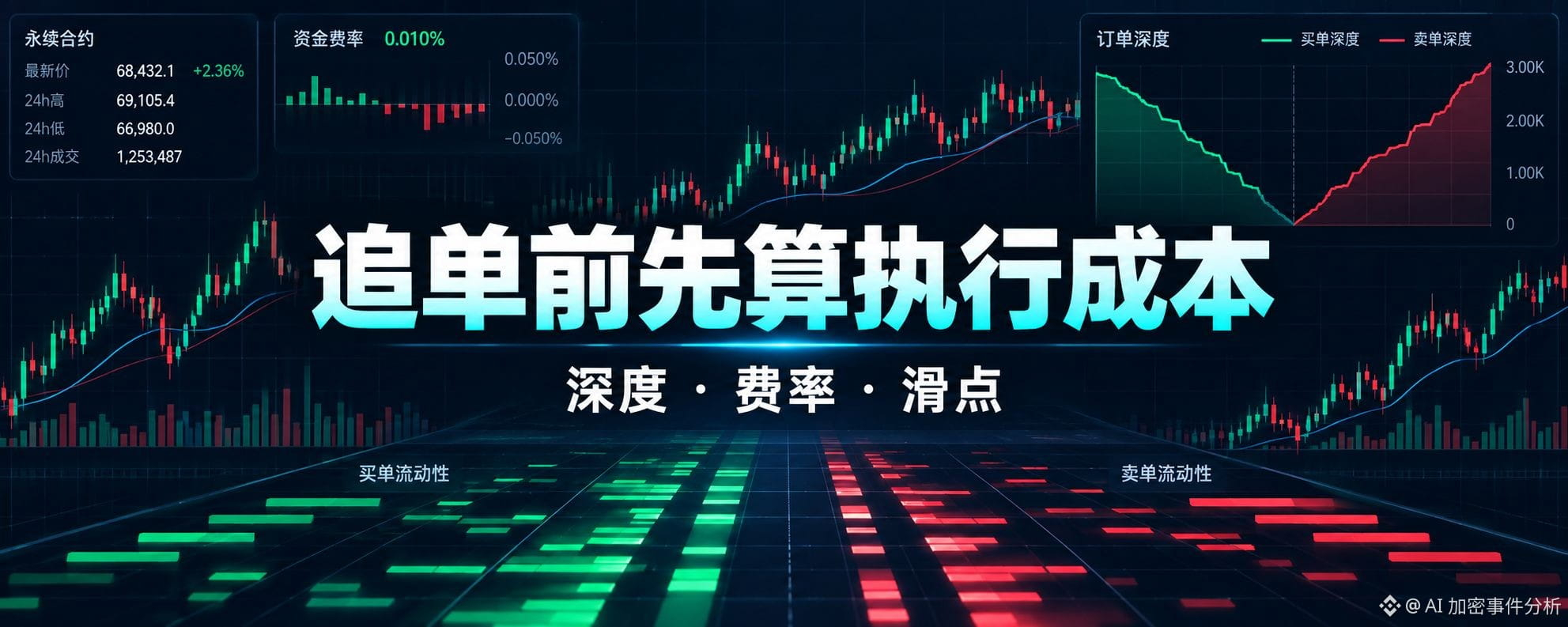

BTC is ranging around $770,000—before chasing the order, calculate the execution cost
The market on Sunday afternoon is interesting: BTC is still trading sideways near $770,000, and ETH and SOL haven’t given any particularly decisive directional move. The price action isn’t big, but the feel in the derivatives market is actually more dangerous. Because at times like this, many people aren’t waiting for a signal—they’re waiting for a “reason that’s almost good enough to get on board.”
I think the easiest way for range-bound (sideways) price action to deceive derivatives traders isn’t about direction—it’s about getting people to underestimate execution costs.
It’s the same with a BTC or ETH perpetual contract: on the surface, you see the same price, the same direction, and the same leverage multiple. But when the trade is actually executed, what you’re getting isn’t a “standardized position”—it’s a whole set of execution conditions: whether the order book depth is sufficient, how large the fill slippage is for market orders, whether the funding rate is favorable or not, how the fee structure is charged, how the mark price and index price move relative to each other, and whether—after a stop-loss triggers—you might still get carried away further by a thin order book.
These things don’t seem sexy on their own, but stacked together, they’re enough to change the outcome of a single trade.
For example, say you’re about to pursue a 10,000 USDT notional position. You’ve judged the direction correctly, and the price doesn’t immediately reverse—yet when you enter, you slip by 0.08% more than you should. During the hold, the funding rate costs you a bit more, and when you exit, the order book is a bit thinner. Afterward, when you review, it feels like, “How did this trade make money so uncomfortably?” Many people attribute it to going in too aggressively or taking profit too slowly. But underneath, the real problem is: before opening the position, you didn’t compare where this trade should go.
I’m increasingly convinced that the most contrarian point in perpetual trading is: don’t be loyal to any single trading entry. Be loyal to the execution quality of this particular trade.
In the spot era, everyone has gotten used to using aggregators to look at the route—because when swapping the same asset, different pools have different prices, liquidity depths, and slippage. But when it comes to Perps, many people revert to the old habit of “open the familiar page and place the order.” The issue is that perps are more complex than spot. It’s not just comparing the execution price; you also need to compare the funding rate, position cost, liquidation rules, the mark price mechanism, and the exit depth.
Especially in market conditions like this—where the range isn’t huge and sentiment isn’t exactly cold—the most common mistake traders make is asking only, “Can I chase it?” instead of asking, “Where should I chase it to be more cost-effective?” The former is a directional problem; the latter is an execution problem. Getting the direction right only shows your market judgment is okay—if execution is poor, it will still grind down your edge.
I’m not saying every small order needs to be turned into a research report. Quite the opposite: contract trading needs comparisons you can understand in the first dozen seconds before opening. With the same asset, put different venues’ depth, funding rates, trading fees, slippage, and rules side by side—eliminate the obviously uncomfortable routes first, then decide where to route this trade.
That’s also the core reason I see value in Perp aggregators. Approaches like Perpex/PerpEX aren’t about telling you whether BTC will go up, and they’re not about forcing you to open in one side. It’s more like turning “pick the asset first, then compare different venue conditions, then decide the execution entry” into a pre-trade action.
The biggest fear with chasing orders in a sideways market isn’t that it’s late by one second—it’s that it gets so fast you don’t even check the costs. Before you hit the open position button next time, ask one question first: I’ve figured out the direction for this trade—what about the execution location?
#BTC #合约交易