
Virus财智峰
213 Posts

Virus财智峰
meme是普通人翻身改命的地方!virus持币地址突破5900万 全链第一
210 Following
16.8K+ Followers
7.9K+ Liked
Posts
All
Quotes
Videos
Live
PINNED

PINNED


VIRUS-逍遥
·
--
[Replay] 🎙️ The virus will reward every diamond hand
01 h 08 m 43 s · 448 listens


Virus秦公子
·
--
What’s the difference between traditional burning and buyback airdrops? Why did Virus choose another path?
In the crypto market, as soon as anyone talks about “deflation,” most projects first think of two words: burning.
Send tokens to a black hole address to reduce circulating supply and create scarcity expectations—this is a traditional path that has already been validated by countless projects.
Virus chose another way: trading generates fees, the fees form a buyback, and the Virus obtained from the buyback doesn’t all go into the black hole—it’s further distributed to more BNB Chain addresses. One option is to “remove” tokens from the world; the other is to spread tokens to more wallets. On the surface, they both handle tokens in the market; in reality, they represent two completely different growth philosophies: traditional burning solves “how to reduce supply,” while buyback airdrops solve “how to expand the network.”
Send tokens to a black hole address to reduce circulating supply and create scarcity expectations—this is a traditional path that has already been validated by countless projects.
Virus chose another way: trading generates fees, the fees form a buyback, and the Virus obtained from the buyback doesn’t all go into the black hole—it’s further distributed to more BNB Chain addresses. One option is to “remove” tokens from the world; the other is to spread tokens to more wallets. On the surface, they both handle tokens in the market; in reality, they represent two completely different growth philosophies: traditional burning solves “how to reduce supply,” while buyback airdrops solve “how to expand the network.”

Partly True



VIRUS灰太狼
·
--
$VIRUS When Virus exists only on the trading page, it is still just a token.
Only when it enters memes, posters, songs, animations, everyday life scenes, and the global community does it begin to become culture.
From token to culture, from culture to symbol—this is Virus’s greater space for growth.
Only when it enters memes, posters, songs, animations, everyday life scenes, and the global community does it begin to become culture.
From token to culture, from culture to symbol—this is Virus’s greater space for growth.




virus二二
·
--
Over 63 Million Holder Addresses in Under a Year: What Did Virus Do Right?
The encrypted market has never lacked tokens that surge quickly. A token that doubles in a day can create hype; ranking on the charts in a week can attract a batch of attention. But if a project that was born less than a year ago can reach more than 63 million on-chain addresses, then this is no longer something a single candlestick can explain. Behind it, there must be a growth method fundamentally different from traditional Memes.
On December 31, 2025, Virus was publicly launched via Butterfly’s on-chain launch mechanism. As of the data released by the community on September 14, 2026, Virus’s token-holding addresses had already surpassed 63 million. From its birth to this milestone, it’s been less than 250 days. Butterfly’s public page records Virus’s creation time, the 3% buy tax, the 3% sell tax, and shows that its token-holding addresses have reached the 60 million level. Because the page cache time and the statistics update times differ, the numbers shown may vary, but Virus has already formed a super-large-scale address distribution—an on-chain fact that can be cross-observed.
On December 31, 2025, Virus was publicly launched via Butterfly’s on-chain launch mechanism. As of the data released by the community on September 14, 2026, Virus’s token-holding addresses had already surpassed 63 million. From its birth to this milestone, it’s been less than 250 days. Butterfly’s public page records Virus’s creation time, the 3% buy tax, the 3% sell tax, and shows that its token-holding addresses have reached the 60 million level. Because the page cache time and the statistics update times differ, the numbers shown may vary, but Virus has already formed a super-large-scale address distribution—an on-chain fact that can be cross-observed.


VIRUS UOB
·
--
🧧 Compared with hot-spot coins, what is the advantage of $Virus?
Compared with hot-spot coins, where does Virus have the advantage?
The encrypted world never lacks hot spots.
Every day, new tokens go live; every day, new narratives are born. When a hot spot appears, everyone rushes in; when it’s gone, everyone pulls out.
That’s perfectly normal. The logic of hot-spot coins is speed: quickly grab attention, quickly drive up prices, and quickly complete a round of wealth transfer. Then most hot-spot coins end up following the same curve: a meteoric rise, a sudden crash, silence, and finally being forgotten.
Virus is taking a different route.
It doesn’t aim to be the fastest. It aims to be the one that lasts the longest.
The encrypted world never lacks hot spots.
Every day, new tokens go live; every day, new narratives are born. When a hot spot appears, everyone rushes in; when it’s gone, everyone pulls out.
That’s perfectly normal. The logic of hot-spot coins is speed: quickly grab attention, quickly drive up prices, and quickly complete a round of wealth transfer. Then most hot-spot coins end up following the same curve: a meteoric rise, a sudden crash, silence, and finally being forgotten.
Virus is taking a different route.
It doesn’t aim to be the fastest. It aims to be the one that lasts the longest.



Virus明哥
·
--
🧧🧧Don’t be afraid—you’re temporarily behind. Life isn’t a 100-meter dash; it’s the one who can keep moving forward for the long term who wins.

Virus明哥
·
--
🧧🧧Actually, when you feel tired, it means you're walking a path that can only be completed through growth.


Virus思思
·
--
Virus thoughts🧧🧧🧧🧧
#Virus持币地址突破6300万
Don’t rush to prove yourself; first quietly improve yourself. When your strength is there, many answers will naturally appear.
#Virus持币地址突破6300万
Don’t rush to prove yourself; first quietly improve yourself. When your strength is there, many answers will naturally appear.



Virus梦琪
·
--
#美联储加息是否已成定局 I don't think they will raise interest rates!


virus琳达
·
--
🧧🧧🧧🧧🧧🧧 Price is emotion, and addresses are diffusion: The long-term significance of Virus’s 63 million holding addresses
In the crypto market, price is never an isolated number. It is jointly shaped by trades, expectations, fear, greed, liquidity, and narratives—an instant snapshot of market sentiment right now. A rise or fall in price records “the present”: how strong short-term consensus is, how excited capital is, and how fragile sentiment feels. Holding addresses, however, capture another dimension: who the project reaches, how many people see it, and the breadth at which it is held and propagated. It’s more like a slowly unfolding network map that reflects the boundaries of the project’s long-term diffusion.
According to the latest statistics from the Virus community, holding addresses have already exceeded 63 million. This number is striking, but it is first and foremost an on-chain statistical result, not an equivalent measure of user count. One address does not equal one independent user: the same person may hold multiple wallets. Exchanges, cross-chain bridges, smart contracts, and project treasuries also contribute large numbers of addresses; moreover, an air-drop expectation, volume-farming interactions, and sybil behavior may temporarily inflate address counts. Therefore, 63 million cannot be simply interpreted as 63 million independent users.
Even so, such a broadly distributed on-chain footprint remains a data asset worth studying over the long term. Because it provides raw material for observing how a project spreads: the speed of address growth, the retention of newly added addresses, the ratio of active addresses to holding addresses, balance tiering, concentration among the top 100 addresses, cross-chain repetition, and net inflows/outflows to exchanges. Only by combining these indicators can we determine whether growth reflects real adoption or is merely noise created by short-term incentives.
In the crypto market, price is never an isolated number. It is jointly shaped by trades, expectations, fear, greed, liquidity, and narratives—an instant snapshot of market sentiment right now. A rise or fall in price records “the present”: how strong short-term consensus is, how excited capital is, and how fragile sentiment feels. Holding addresses, however, capture another dimension: who the project reaches, how many people see it, and the breadth at which it is held and propagated. It’s more like a slowly unfolding network map that reflects the boundaries of the project’s long-term diffusion.
According to the latest statistics from the Virus community, holding addresses have already exceeded 63 million. This number is striking, but it is first and foremost an on-chain statistical result, not an equivalent measure of user count. One address does not equal one independent user: the same person may hold multiple wallets. Exchanges, cross-chain bridges, smart contracts, and project treasuries also contribute large numbers of addresses; moreover, an air-drop expectation, volume-farming interactions, and sybil behavior may temporarily inflate address counts. Therefore, 63 million cannot be simply interpreted as 63 million independent users.
Even so, such a broadly distributed on-chain footprint remains a data asset worth studying over the long term. Because it provides raw material for observing how a project spreads: the speed of address growth, the retention of newly added addresses, the ratio of active addresses to holding addresses, balance tiering, concentration among the top 100 addresses, cross-chain repetition, and net inflows/outflows to exchanges. Only by combining these indicators can we determine whether growth reflects real adoption or is merely noise created by short-term incentives.


VIRUS-逍遥
·
--
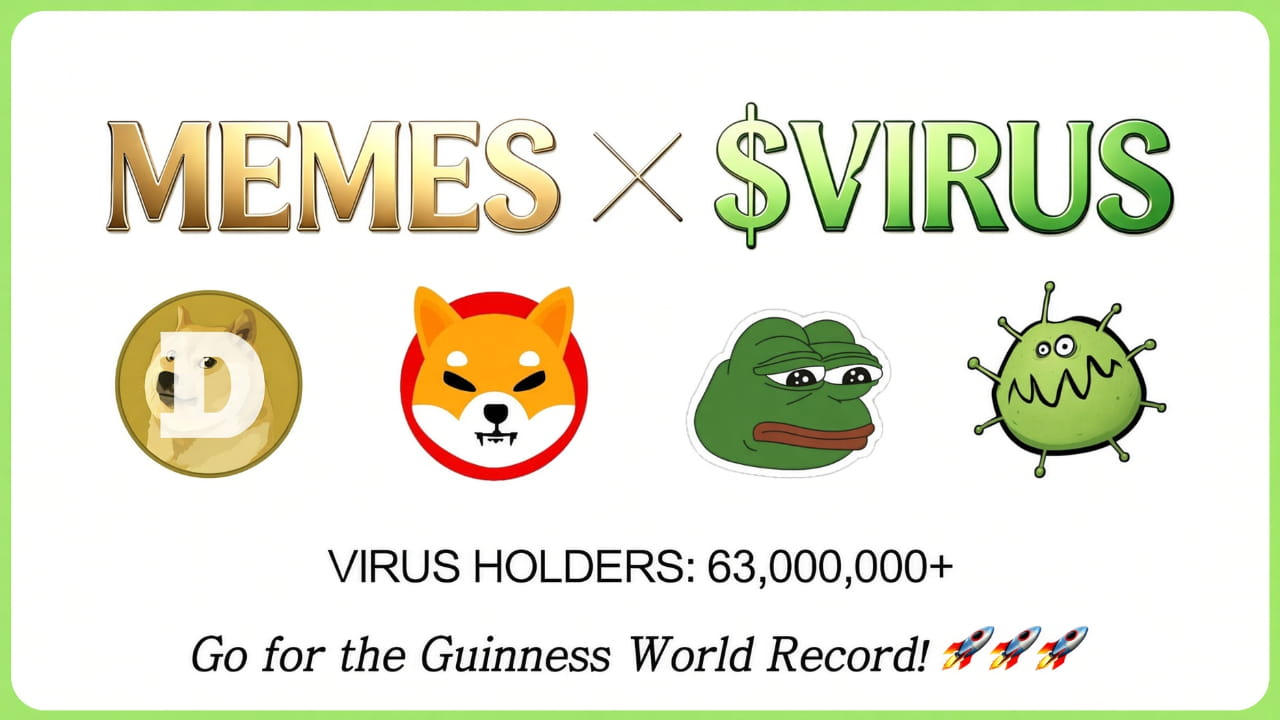
[Replay] 🎙️ The Next Stop for VIRUS: Guinness World Records
01 h 57 m 42 s · 1.3k listens
virus琳达
·
--
🧧🧧🧧🧧🧧🧧 Price is emotion, and addresses are diffusion: The long-term significance of Virus’s 63 million holding addresses
In the crypto market, price is never an isolated number. It is jointly shaped by trades, expectations, fear, greed, liquidity, and narratives—an instant snapshot of market sentiment right now. A rise or fall in price records “the present”: how strong short-term consensus is, how excited capital is, and how fragile sentiment feels. Holding addresses, however, capture another dimension: who the project reaches, how many people see it, and the breadth at which it is held and propagated. It’s more like a slowly unfolding network map that reflects the boundaries of the project’s long-term diffusion.
According to the latest statistics from the Virus community, holding addresses have already exceeded 63 million. This number is striking, but it is first and foremost an on-chain statistical result, not an equivalent measure of user count. One address does not equal one independent user: the same person may hold multiple wallets. Exchanges, cross-chain bridges, smart contracts, and project treasuries also contribute large numbers of addresses; moreover, an air-drop expectation, volume-farming interactions, and sybil behavior may temporarily inflate address counts. Therefore, 63 million cannot be simply interpreted as 63 million independent users.
Even so, such a broadly distributed on-chain footprint remains a data asset worth studying over the long term. Because it provides raw material for observing how a project spreads: the speed of address growth, the retention of newly added addresses, the ratio of active addresses to holding addresses, balance tiering, concentration among the top 100 addresses, cross-chain repetition, and net inflows/outflows to exchanges. Only by combining these indicators can we determine whether growth reflects real adoption or is merely noise created by short-term incentives.
In the crypto market, price is never an isolated number. It is jointly shaped by trades, expectations, fear, greed, liquidity, and narratives—an instant snapshot of market sentiment right now. A rise or fall in price records “the present”: how strong short-term consensus is, how excited capital is, and how fragile sentiment feels. Holding addresses, however, capture another dimension: who the project reaches, how many people see it, and the breadth at which it is held and propagated. It’s more like a slowly unfolding network map that reflects the boundaries of the project’s long-term diffusion.
According to the latest statistics from the Virus community, holding addresses have already exceeded 63 million. This number is striking, but it is first and foremost an on-chain statistical result, not an equivalent measure of user count. One address does not equal one independent user: the same person may hold multiple wallets. Exchanges, cross-chain bridges, smart contracts, and project treasuries also contribute large numbers of addresses; moreover, an air-drop expectation, volume-farming interactions, and sybil behavior may temporarily inflate address counts. Therefore, 63 million cannot be simply interpreted as 63 million independent users.
Even so, such a broadly distributed on-chain footprint remains a data asset worth studying over the long term. Because it provides raw material for observing how a project spreads: the speed of address growth, the retention of newly added addresses, the ratio of active addresses to holding addresses, balance tiering, concentration among the top 100 addresses, cross-chain repetition, and net inflows/outflows to exchanges. Only by combining these indicators can we determine whether growth reflects real adoption or is merely noise created by short-term incentives.
Virus明哥
·
--
🧧🧧The real thing that widens the gap in life is often not a single outburst, but steady growth day after day without stopping.

virus二二
·
--
The mutualistic relationship between Virus and the BSC ecosystem
I. From “parasitism” to “mutualism”
Many meme coins are built on public chains, yet they do not truly give back to the ecosystem. They use the public chain’s infrastructure to complete transactions and leverage the chain’s user base for dissemination, but their growth does not bring incremental value to the public chain. This is a “parasitic” relationship—projects take resources from the ecosystem without creating new value. Their existence only increases the numbers of on-chain transactions for the public chain, without truly expanding the user base of the chain.
VIRUS’s goals are completely different. Its growth itself is an expansion of the BSC user network: more wallets are created (to receive airdrops), more on-chain transactions occur (to participate in the mechanisms), more active addresses appear (wallets get activated), and higher BSC user retention results (assets are held in wallets). In other words, VIRUS’s growth, in essence, is about expanding BSC’s user network. VIRUS is not consuming BSC—it is amplifying BSC.
Many meme coins are built on public chains, yet they do not truly give back to the ecosystem. They use the public chain’s infrastructure to complete transactions and leverage the chain’s user base for dissemination, but their growth does not bring incremental value to the public chain. This is a “parasitic” relationship—projects take resources from the ecosystem without creating new value. Their existence only increases the numbers of on-chain transactions for the public chain, without truly expanding the user base of the chain.
VIRUS’s goals are completely different. Its growth itself is an expansion of the BSC user network: more wallets are created (to receive airdrops), more on-chain transactions occur (to participate in the mechanisms), more active addresses appear (wallets get activated), and higher BSC user retention results (assets are held in wallets). In other words, VIRUS’s growth, in essence, is about expanding BSC’s user network. VIRUS is not consuming BSC—it is amplifying BSC.

Log in to explore more content