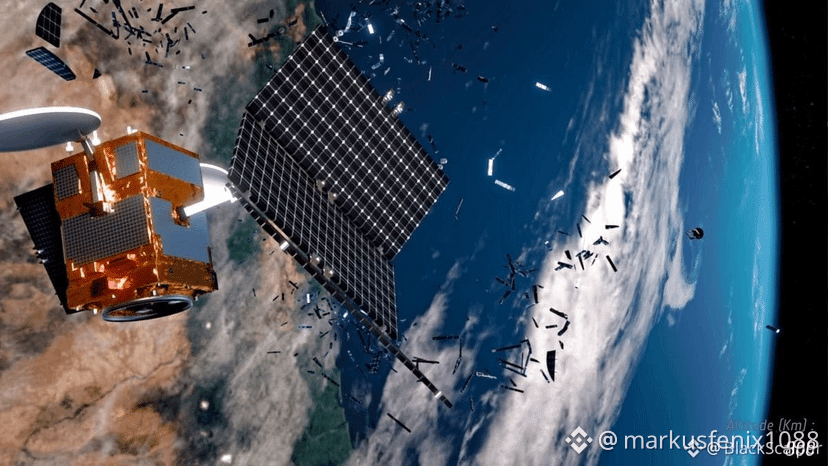
A Chinese military reconnaissance satellite disintegrated in orbit and scattered debris that could remain there for centuries. China has not said a word about it.
The U.S. Space Force has cataloged at least 43 fragments of debris from the Chinese satellite Yaogan-50 (02) in early September, after the vehicle fragmented sometime between late July and mid-August. What makes this especially problematic is where it happened: a rare retrograde orbit of 142 degrees at an altitude of 600 to 1,100 km, where atmospheric drag is almost nonexistent and the debris can last for hundreds of years.
The retrograde path matters beyond longevity. Most satellites orbit in the same direction as Earth’s rotation. Objects moving in the opposite direction create extremely high closing speeds in any collision, turning even small fragments into high-energy projectiles capable of generating even more debris. China’s 2007 anti-satellite test remains the benchmark for how bad things can get: that single event created thousands of pieces that are still being tracked to this day.
No removal mission is planned. There is no technology to collect debris economically at that altitude and inclination. U.S. operators will incorporate these new objects into collision-avoidance alerts. China, which tracked the fragments internally, has said nothing publicly and launched additional Yaogan satellites in September.
$REZ $ARK $BERA
The U.S. Space Force has cataloged at least 43 fragments of debris from the Chinese satellite Yaogan-50 (02) in early September, after the vehicle fragmented sometime between late July and mid-August. What makes this especially problematic is where it happened: a rare retrograde orbit of 142 degrees at an altitude of 600 to 1,100 km, where atmospheric drag is almost nonexistent and the debris can last for hundreds of years.
The retrograde path matters beyond longevity. Most satellites orbit in the same direction as Earth’s rotation. Objects moving in the opposite direction create extremely high closing speeds in any collision, turning even small fragments into high-energy projectiles capable of generating even more debris. China’s 2007 anti-satellite test remains the benchmark for how bad things can get: that single event created thousands of pieces that are still being tracked to this day.
No removal mission is planned. There is no technology to collect debris economically at that altitude and inclination. U.S. operators will incorporate these new objects into collision-avoidance alerts. China, which tracked the fragments internally, has said nothing publicly and launched additional Yaogan satellites in September.
$REZ $ARK $BERA