Anthropic’s founder’s latest article appears to proactively call for regulation to slow down AI and prevent it from getting out of control. In reality, it’s trying to use regulation to keep open-source models out of the “gate,” securing its business model—this is the actual claim of their interests.
No matter how the article argues throughout, its real objectives are antitrust exemptions, cracking down on distillation, compute resource control, and making systems retrievable and revocable.
Under Anthropic’s founder Amodei’s proposed compliance framework, the designed compliance obligations naturally require you to be able to identify users, monitor usage, revoke access, and take down versions. A hosted API can do these four things; after open-weight models are released, none of them can be done. So there’s no need to prohibit open source—just write these requirements as mandatory obligations, and open source will automatically become “non-compliant.” That keeps competitors out and protects their business model.
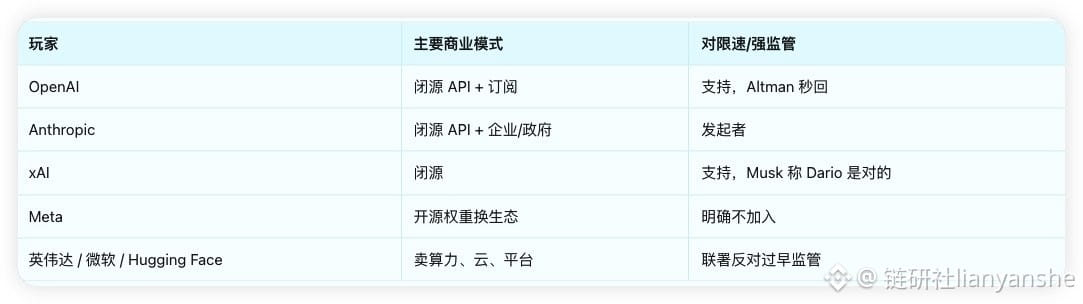
At present, both the open-source camp and the closed-source camp represent the interests behind them. The three closed-source model companies—OpenAI, Anthropic, and xAI—have all expressed support. In practice, they are already aligned against the open-source camp’s Nvidia. Not long ago, Nvidia CEO Jensen Huang even opened a special account on X/Twitter for this purpose, supporting open source and signing a joint letter opposing premature regulation.
Next month, Anthropic plans to IPO, raising roughly $100 billion and valuing it at about $2 trillion. A recent series of questionable maneuvers are high-risk plays they’ve made to offset the fact of slowing growth and preserve their moat.
Before the IPO, telling the story of “we have regulatory moat” writes policy certainty directly into the valuation model. Voluntarily slowing this down is a talisman for those already seated at the table, and a door-closing move for those who haven’t yet taken their seats. The fact that open-source models can’t meet the regulatory framework is also a form of indirect suppression.
Why are OpenAI and Anthropic—rarely, their two bitter enemies—standing on the same side this time? Because they understand that the rules they propose structurally favor the closed-source hosted model, and they happen to be the biggest beneficiaries of that model. It also lets them serve as the most advantaged party against later competitors.
If this framework takes hold in the United States, the winners would be closed-source API companies and compliance infrastructure, while the harmed would be small and medium-sized firms building applications on top of open-source weights.
Now that the topic of AI regulation has been raised, the next key lies in the Trump administration’s stance. The current main axis of AI policy from the White House is acceleration. If the White House doesn’t take up the proposal, the valuations of the two AI giants will also be harmed.
No matter how the article argues throughout, its real objectives are antitrust exemptions, cracking down on distillation, compute resource control, and making systems retrievable and revocable.
Under Anthropic’s founder Amodei’s proposed compliance framework, the designed compliance obligations naturally require you to be able to identify users, monitor usage, revoke access, and take down versions. A hosted API can do these four things; after open-weight models are released, none of them can be done. So there’s no need to prohibit open source—just write these requirements as mandatory obligations, and open source will automatically become “non-compliant.” That keeps competitors out and protects their business model.
At present, both the open-source camp and the closed-source camp represent the interests behind them. The three closed-source model companies—OpenAI, Anthropic, and xAI—have all expressed support. In practice, they are already aligned against the open-source camp’s Nvidia. Not long ago, Nvidia CEO Jensen Huang even opened a special account on X/Twitter for this purpose, supporting open source and signing a joint letter opposing premature regulation.
Next month, Anthropic plans to IPO, raising roughly $100 billion and valuing it at about $2 trillion. A recent series of questionable maneuvers are high-risk plays they’ve made to offset the fact of slowing growth and preserve their moat.
Before the IPO, telling the story of “we have regulatory moat” writes policy certainty directly into the valuation model. Voluntarily slowing this down is a talisman for those already seated at the table, and a door-closing move for those who haven’t yet taken their seats. The fact that open-source models can’t meet the regulatory framework is also a form of indirect suppression.
Why are OpenAI and Anthropic—rarely, their two bitter enemies—standing on the same side this time? Because they understand that the rules they propose structurally favor the closed-source hosted model, and they happen to be the biggest beneficiaries of that model. It also lets them serve as the most advantaged party against later competitors.
If this framework takes hold in the United States, the winners would be closed-source API companies and compliance infrastructure, while the harmed would be small and medium-sized firms building applications on top of open-source weights.
Now that the topic of AI regulation has been raised, the next key lies in the Trump administration’s stance. The current main axis of AI policy from the White House is acceleration. If the White House doesn’t take up the proposal, the valuations of the two AI giants will also be harmed.