$ETHFI #ETHFI In a strong market, pullbacks often reveal real support better than accelerated pumps. The current 1-hour change is 0.00%, and the 24-hour change is +1.89%, so we need to judge whether this is normal cooling off or a weakening structure.
At present, the 1-hour 0.00% and 24-hour +1.89% readings do not form a sufficiently clear aligned move across both periods. In a range-bound market, chasing strength or selling weakness has a lower margin for error. It is more suitable to use the upper boundary to confirm direction, the lower boundary to confirm support, and the midpoint only as a dividing line between strength and weakness.
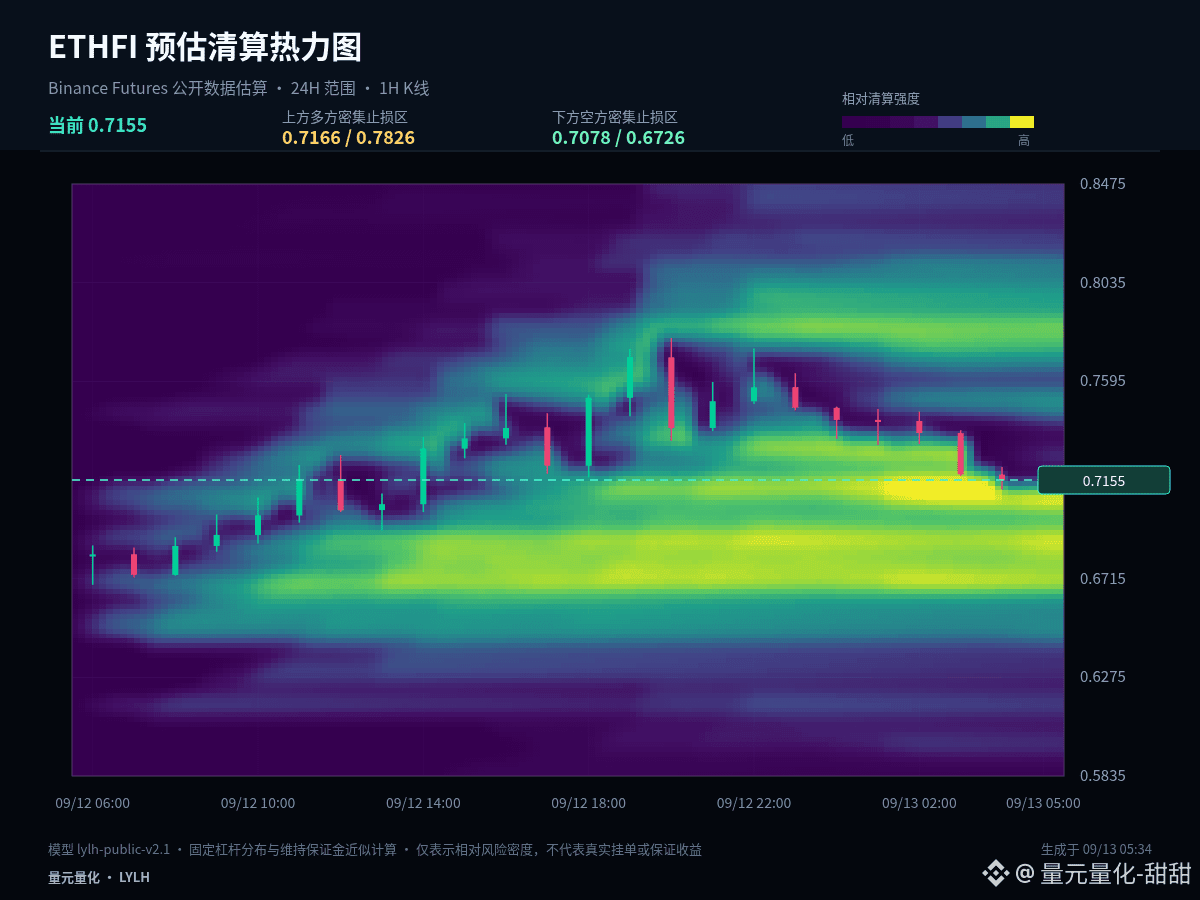
Short-term initiative has not been clearly damaged yet, and 0.72465 is the primary standard for judging pullback quality. Holding above it and then retesting 0.7793 would indicate relatively strong consolidation; if the midpoint is broken and price stays below it, then the focus of observation should be lowered to 0.67.
In execution, set clear conditions: after breaking above 0.7793, confirmation is needed rather than chasing an instant surge; after dipping to 0.67, watch whether it can quickly recover rather than buying just because it is falling; when the mid-range does not offer sufficient reward-to-risk, waiting is also part of the strategy.
For those already in positions, the key is to manage based on whether support fails, rather than being driven by every fluctuation; for those without positions, prioritize waiting for a breakout and retest or support confirmation. Spot positions can be built in batches, while futures should shorten the decision chain: first determine the stop-loss level, then decide whether to participate.
Risk control still comes before the conclusion: act only when conditions appear, and reassess promptly when the price invalidates the setup; the greater the volatility, the more restrained each position should be. The above is a market analysis based on the current 1-hour and 24-hour data and does not constitute a promise of returns.
#EtherRalliesAsBearishBetsLiquidate
At present, the 1-hour 0.00% and 24-hour +1.89% readings do not form a sufficiently clear aligned move across both periods. In a range-bound market, chasing strength or selling weakness has a lower margin for error. It is more suitable to use the upper boundary to confirm direction, the lower boundary to confirm support, and the midpoint only as a dividing line between strength and weakness.
Short-term initiative has not been clearly damaged yet, and 0.72465 is the primary standard for judging pullback quality. Holding above it and then retesting 0.7793 would indicate relatively strong consolidation; if the midpoint is broken and price stays below it, then the focus of observation should be lowered to 0.67.
In execution, set clear conditions: after breaking above 0.7793, confirmation is needed rather than chasing an instant surge; after dipping to 0.67, watch whether it can quickly recover rather than buying just because it is falling; when the mid-range does not offer sufficient reward-to-risk, waiting is also part of the strategy.
For those already in positions, the key is to manage based on whether support fails, rather than being driven by every fluctuation; for those without positions, prioritize waiting for a breakout and retest or support confirmation. Spot positions can be built in batches, while futures should shorten the decision chain: first determine the stop-loss level, then decide whether to participate.
Risk control still comes before the conclusion: act only when conditions appear, and reassess promptly when the price invalidates the setup; the greater the volatility, the more restrained each position should be. The above is a market analysis based on the current 1-hour and 24-hour data and does not constitute a promise of returns.
#EtherRalliesAsBearishBetsLiquidate