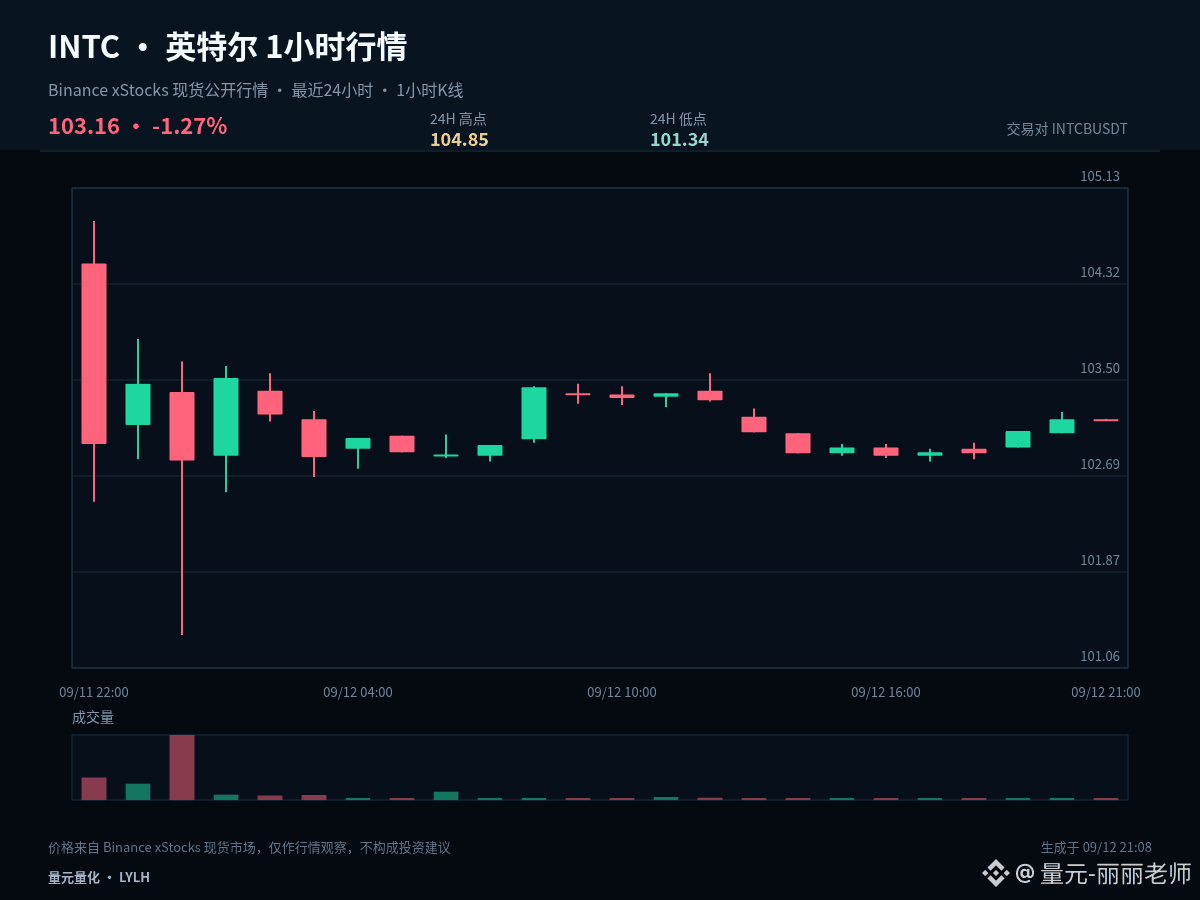
$INTCB #INTC Over the past 24 hours, the high-low amplitude is about 3.4%, and the current price is 103.16. This is not a calm market that’s suitable for casually opening a position. When volatility expands, you should first adjust your position size, and only then discuss direction.
$INTCB #INTC is still rotating repeatedly within the past 24-hour range, and there isn’t a clear directional advantage. The middle area is the toughest test of patience—waiting for boundary signals is usually more effective.
Currently, 1-hour: -0.01%; 24-hour: +0.09%. The two timeframes have not formed a sufficiently clear alignment in the same direction. In range-bound markets, the tolerance for chasing or killing the move is low. It’s better to use upper-bound confirmation to go long and lower-bound confirmation for support/reversal. The midline should only be used as a line dividing relative strength.
For key price levels: 103.095 is the midline that must be reclaimed for weak repairs to hold. If price cannot stand back above here, rebounds should still be viewed as technical, corrective moves. Below, 101.34 still has the possibility of being tested again; only after reclaiming the midline do we have the right to further observe 104.85.
In high-volatility phases, the execution principles are to reduce single-exposure risk, avoid repeatedly chasing prices back and forth in the middle of the range, and write the invalidation conditions before entering. If price does not provide confirmation, it’s better to do one less trade than to make up uncertainty with a larger position.
In execution, set clear conditions: after a breakout above 104.85, you need confirmation—not just seeing a momentary surge and chasing. After a dip to 101.34, you need to see whether price can be quickly reclaimed—not automatically catching every drop. When the middle region doesn’t offer enough reward-to-risk, waiting itself is part of the strategy.
Your trading plan must include invalidation conditions. If you’re right, you can realize profits in stages. If you’re wrong, you must also allow yourself to exit—don’t use adding to positions to mask the fact that the original logic has changed. The market will update, and your viewpoint should adjust to price evidence.
#EtherRalliesAsBearishBetsLiquidate
$INTCB #INTC is still rotating repeatedly within the past 24-hour range, and there isn’t a clear directional advantage. The middle area is the toughest test of patience—waiting for boundary signals is usually more effective.
Currently, 1-hour: -0.01%; 24-hour: +0.09%. The two timeframes have not formed a sufficiently clear alignment in the same direction. In range-bound markets, the tolerance for chasing or killing the move is low. It’s better to use upper-bound confirmation to go long and lower-bound confirmation for support/reversal. The midline should only be used as a line dividing relative strength.
For key price levels: 103.095 is the midline that must be reclaimed for weak repairs to hold. If price cannot stand back above here, rebounds should still be viewed as technical, corrective moves. Below, 101.34 still has the possibility of being tested again; only after reclaiming the midline do we have the right to further observe 104.85.
In high-volatility phases, the execution principles are to reduce single-exposure risk, avoid repeatedly chasing prices back and forth in the middle of the range, and write the invalidation conditions before entering. If price does not provide confirmation, it’s better to do one less trade than to make up uncertainty with a larger position.
In execution, set clear conditions: after a breakout above 104.85, you need confirmation—not just seeing a momentary surge and chasing. After a dip to 101.34, you need to see whether price can be quickly reclaimed—not automatically catching every drop. When the middle region doesn’t offer enough reward-to-risk, waiting itself is part of the strategy.
Your trading plan must include invalidation conditions. If you’re right, you can realize profits in stages. If you’re wrong, you must also allow yourself to exit—don’t use adding to positions to mask the fact that the original logic has changed. The market will update, and your viewpoint should adjust to price evidence.
#EtherRalliesAsBearishBetsLiquidate