
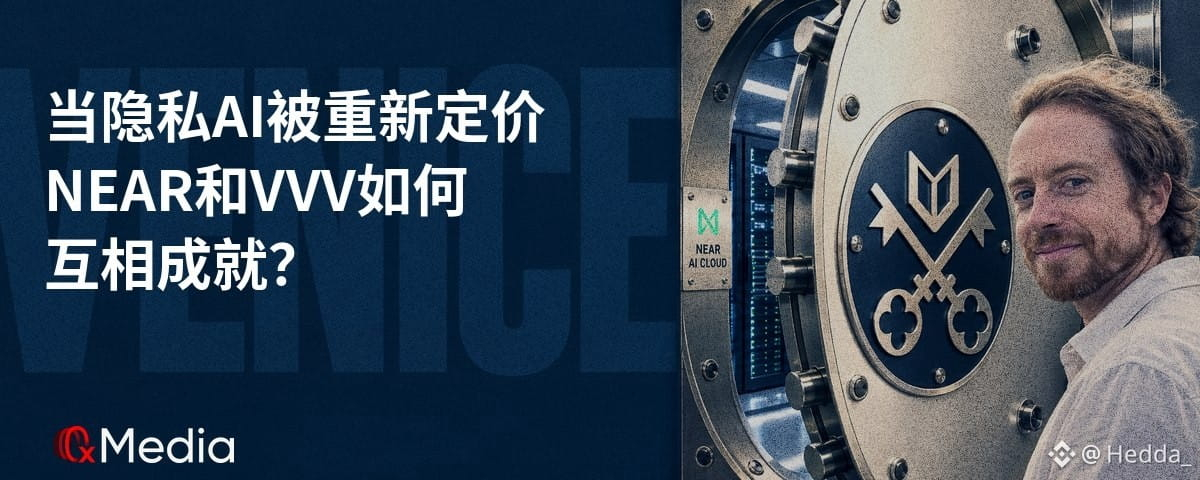


VVV recently surged to a new all-time high. What matters more than the price is the synergy between Venice and NEAR around Privacy AI. This collaboration not only gives Venice verifiable privacy capabilities such as TEE, E2EE, and remote proofs, but also provides NEAR AI Cloud with real, large-scale inference scenarios. On one hand, both parties jointly build the technical infrastructure for Private Inference; on the other hand, they amplify each other’s value through users, compute power, and ecosystem needs—giving this Privacy AI narrative a deeper logic than a mere price increase.
VVV surged to $29, with its market cap breaking $1.2 billion—so why did it happen?
On September 9, Venice’s token VVV topped out at $29.15, hitting a new all-time high. VVV is currently around $23, with a circulating market cap of about $113 million and an FDV close to $1.9 billion. You might not know that just two months ago, Venice completed a $65 million funding round at a $1 billion equity valuation. That means the market pricing of VVV’s circulating valuation is already in the same ballpark as the previous equity valuation of the entire company.
In the past year, Venice has seen too many developments. User and API business growth has been rapid, with an annualized revenue run rate exceeding $100 million. VVV emissions have continued to decline. DIEM packages AI compute into an on-chain asset, and this March its partnership with NEAR AI Cloud added another layer of verifiable privacy infrastructure. These threads ultimately came together, leading the market to start repricing privacy infrastructure.
From ShapeShift to Venice: Why does crypto veteran Voorhees bet on privacy AI?
Venice founder Erik Voorhees is arguably a well-known veteran face on-chain in the Crypto industry. After getting exposed to Bitcoin in 2011, he quickly entered one of the earliest batches of Bitcoin startups and became one of the early core members at BitInstant, responsible for marketing and branding.
The founder of BitInstant was the later controversial Charlie Shrem, with Roger Ver as an early investor; the Winklevoss brothers also later put in funds. Voorhees has been in the same startup circle as this group of figures who would later become emblematic of Crypto from very early on—back when Bitcoin’s price was still only single digits to a few tens of dollars.
Here’s a little cool fact: today everyone is familiar with Blockchain.com—its co-founder Nicolas Cary is his university friend, and the two had known each other since University of Puget Sound. In 2012, Voorhees repeatedly recommended Bitcoin to Cary, and Cary started buying when BTC was still priced at only single digits to teens of dollars.
And the most legendary part of his own story is SatoshiDICE. What started as a side project Voorhees did while working at BitInstant, at one point contributed more than half of the Bitcoin network’s transactions, becoming one of the largest Bitcoin applications of that time.
In 2013, he sold the project for 126,315 BTC—at a price of roughly $11.5 million then—becoming one of the most well-known early crypto exit cases. After that, he invested in multiple crypto projects, and in 2014 founded ShapeShift, continuing to build it as a product that does not custody user assets and reduces reliance on centralized intermediaries.
Around 2021, ShapeShift began transitioning toward a DAO model. He gradually faded from day-to-day management, and in his spare time he also started thinking about another question: if Bitcoin and Crypto solve the problem of who controls money, then when more and more people search, write, code, and even form judgments through models like ChatGPT, what comes next is who controls intelligence.
After 2023, the generative AI boom made this concern more concrete. Users hand models their questions, files, ideas, and even business information, while the processing still remains centralized in the hands of a few platforms. At the same time, model providers can determine what the model can answer through system rules and content policies.
For Voorhees, once AI begins to replace search, analysis, and information retrieval, this control is no longer just a data issue—it increasingly becomes a question of information entry points and cognitive entry points. Therefore, he believes the market needs an AI option that is more open, privacy-friendly, and as free from licensing restrictions as possible.
This also extends his longstanding message about separating money and the state into separating thought and the state. Crypto/cryptopunks hope to protect communication with cryptography; Bitcoin hopes to reduce the monetary system’s reliance on centralized institutions. Voorhees believes that as machine intelligence becomes more deeply involved in information retrieval, expression, and even thinking, machine intelligence also should not be fully controlled by a small number of companies.
That’s why Venice launched in 2024. On the surface, the product is similar to ChatGPT, Claude, or Grok—you can chat, write code, and generate images and videos, and you can also access it via API for developer applications. But it’s closer to a multi-model AI entry point. Currently, the platform provides more than 200 text, image, video, and audio models, and it also differentiates models by their privacy capabilities.
At the July 2026 funding round, Venice disclosed it already has 3.5 million registered users, processes about 1.3 trillion Tokens per month, has roughly 2 million developer API calls per day, and reaches a peak of 300,000 inference requests per hour.
But new problems also emerge: as user numbers and inference scale keep expanding, it’s no longer enough to rely solely on not storing chat logs to support Venice’s privacy promise. Users also want to know whether their prompts might be seen by the platform during inference, whether data while the model runs could be read, and whether the privacy claimed by the platform can be verified by technical means.
For Venice, this means it needs to move privacy from product policies further down to the infrastructure layer—so that throughout the entire process, from data entering the model, to completing inference, to returning results, trust in centralized operators is reduced as much as possible.
So Venice chose to cooperate with NEAR, hoping to use technologies such as trusted execution environments, end-to-end encryption, and remote attestation to turn private inference into a verifiable infrastructure. For Venice, this solves the core trust problem in large-scale AI services. For NEAR, Venice’s millions of users and high-frequency inference requests also provide a real-world large-scale application scenario, so that its privacy computing infrastructure doesn’t remain at the concept level.
The collaboration between Venice and NEAR is a key piece for understanding why VVV can be priced.
Venice’s original architecture already reduced one layer of risk. Conversation history is mainly stored on users’ devices, and Venice does not persist complete conversation history like traditional chat products. However, even in the Private mode with a zero-data-retention promise, there is still a degree of trust assumption regarding privacy. After integrating NEAR AI Cloud, Venice starts transferring part of that trust to hardware isolation and cryptographic verification.
One layer is TEE, i.e., Trusted Execution Environment—trusted execution environment.
You can think of a standard cloud server as an office building. While the data is placed in the office, theoretically the person managing the whole building still controls the infrastructure. TEE is like creating, inside the server, a closed room that is isolated by hardware. When the model truly executes inference, the Prompt is processed only within this isolated environment.
TEE solves the problem of the inference execution environment, while E2EE extends this protection chain all the way to the user’s device. Venice’s E2EE first generates temporary encryption keys on the client, establishes a shared key via ECDH on secp256k1, then derives encryption keys using HKDF-SHA256, and finally encrypts the Prompt using AES-256-GCM. The content input by the user becomes ciphertext before leaving the device; only a verified TEE has the conditions needed to perform decryption and inference.
This set of technologies sounds complex, but when you place it in a real-life case, it becomes easy to understand.
Suppose an on-chain user’s wallet holds a large amount of ETH, NEAR, and stablecoins. They want to rebalance their assets based on their holdings, but they do not want the full wallet structure, the assets they plan to sell, and their target positions to be directly exposed to an AI service provider.
They send an instruction to an on-chain agent integrated with Venice: analyze my current wallet holdings; without selling NEAR, reduce my risk exposure by 20%; and generate the most suitable on-chain transaction plan for me.
If you use a model with end-to-end encryption supported by Venice, this instruction and the related position information are not directly sent to Venice in plaintext. The user’s device first verifies the trusted execution environment responsible for inference, confirming that the execution environment, the public key, and the model state match expectations. Then it encrypts the request locally. At that point, what is transmitted through the Venice network is ciphertext. Venice itself cannot directly see which assets the user holds, nor can it know what kind of trades the user plans to make.
After the request enters a verified trusted execution environment, it is decrypted. In this isolated environment, the model can read wallet information provided with the user’s authorization, analyze the position ratios between ETH, NEAR, and stablecoins, market prices and liquidity, and produce a plan—for example, selling part of the ETH and swapping into stablecoins—while preserving all of the NEAR. If the agent has also integrated on-chain trading tools, it can further generate the corresponding swap routes, trade parameters, and transactions to be signed, while the actual signing is still performed by the user’s wallet.
This is where privacy matters very directly. For normal chat, what could be leaked might only be a piece of a question. But for on-chain users, the prompt might contain wallet assets, trading plans that are not yet public, target prices, the tokens they plan to buy, or even a complete set of trading strategies. Once such information is seen by an intermediary service provider before trade execution, it could create risks like front-running, strategy leaks, or attacks targeting specific wallets.
This is also the part where the Venice–NEAR partnership is especially worth paying attention to. Trusted execution environments ensure the model processes these sensitive data within an isolated space, and end-to-end encryption further reduces the chances that Venice itself encounters plaintext.
Currently, Venice supports multiple models for TEE and E2EE, including GLM, Qwen, Gemma, GPT-OSS, and Venice’s own models. The related infrastructure is provided by NEAR AI Cloud and Phala Network. In the product interface, Venice also directly labels the privacy mode associated with each model, so users know whether they are currently using normal Private, TEE, or E2EE.
Therefore, the relationship between Venice and NEAR does not stop at the level of ecological collaboration. Venice provides user entry points, model aggregation, and API demand that has already reached scale, while NEAR AI Cloud provides a verifiable Confidential Inference infrastructure. The former gives the latter real inference workloads and user scenarios, and the latter allows Venice’s privacy commitments to move even further into the hardware and cryptography layers.
This design also helped it raise $65 million in funding, with a group of old-school Crypto investors simultaneously getting equity and VVV.
After product growth, Venice accepted external capital for the first time in July this year. The Series A round totaled $65 million, led by Dragonfly, with participation from North Island Ventures, Coinbase Ventures, F-Prime, Archetype, Liquid 2 Ventures, Morgan Creek, and others. The company’s equity valuation reached $1 billion. For an AI company founded in 2024, reaching unicorn status within two years is already strikingly fast.
According to Voorhees’s disclosure, Venice received $65 million in exchange for 8.98% equity. At the same time, investors obtained 1.5 million VVV tokens with vesting, as well as warrants to buy up to 5 million VVV over the next eight years. If all those warrants are exercised, investors would need to pay Venice about $66.5 million, bringing the total potential funding amount for the round up to approximately $131.5 million. The Token Grant and Warrants are locked for one year first, and then the tokens vest linearly over the following three years.
VVV was issued on January 27, 2025, with a Genesis Supply of 100 million tokens. 50% was allocated to Venice users and the Crypto × AI community, 35% was kept for Venice’s development, 10% went to an Incentive Fund, and 5% went to liquidity. No public pre-sale was conducted. In March 2025, Venice then burned 33,539,739 VVV tokens, with a significant portion coming from unclaimed Airdrops.
VVV has no fixed Max Supply, because the protocol continues to issue new coins as staking rewards. When it first launched, the yearly emission reached 14 million tokens, implying an initial annual inflation rate of about 14%. With DIEM launching in August 2025, annual emissions first dropped from 14 million to 10 million. Later the same year in October, they fell further to 8 million, and in February 2026 they dropped to 6 million. After that, the reduction speed accelerated noticeably: down to 5 million in May, 4 million in June, 3 million in July. On September 1 this year, it dropped again to 2.5 million, and the plan for October 1 is to reduce it to 2 million.
From 14 million to 2 million, annual emissions decline by about 85.7%, and Venice did not leave VVV as a simple Staking Token.
After users stake VVV, they receive sVVV. Then, by locking sVVV, they can mint DIEM. Each DIEM generated per staked token provides a $1 Venice API Credit per day, and that credit is refreshed daily. DIEM itself is an ERC-20 on Base, so it can be traded, transferred, or sold to other AI users. During the period when sVVV is locked, the underlying VVV still receives 80% of the normal Staking Yield. If a user wants to get their original sVVV back, they need to burn the corresponding DIEM.
This design splits AI Compute into an independent, tradable asset. A developer who has long been calling a model used to only be able to continuously top up an API account; now they can also directly hold DIEM to receive a fixed, refreshed daily inference quota. Agents can also hold their own Compute Capacity.
And all DIEM must be generated from VVV, which adds another layer of demand closer to real business use for VVV. The more people want to hold Venice’s AI inference quota long-term, the more sVVV theoretically needs to be locked. This year Venice also raised its target supply for DIEM from 38,000 to 40,000, and released new Mint Capacity in phases—showing that the project is trying to expand this Tokenized Compute market.
Meanwhile, every new Venice subscription triggers a programmatic buyback. Pro, Pro+, and Max correspond to $2, $5, and $10 in VVV Buy & Burn, respectively. API Credits follow another rule: for every $100 of Credits purchased, $5 is used to buy and burn VVV in the public market.
So currently, VVV is roughly driven by three forces acting together: staking lockups, DIEM lockups, and secondary-market trading created by Venice’s business revenue.
And if, in the future, Burn can reliably exceed Emission while DIEM continues to expand the locking demand for VVV, then this economic model will enter a new phase—though the prior all-time high around $29 has already priced in that expectation.
After all, a valuation in the tens of billions of dollars already implies it’s not just a single AI token. It answers a different question: as AI becomes increasingly embedded in the most sensitive layers of personal and enterprise data, how much will privacy ultimately be worth?
Original text: https://x.com/0xmediaco/status/2098757647847862748