
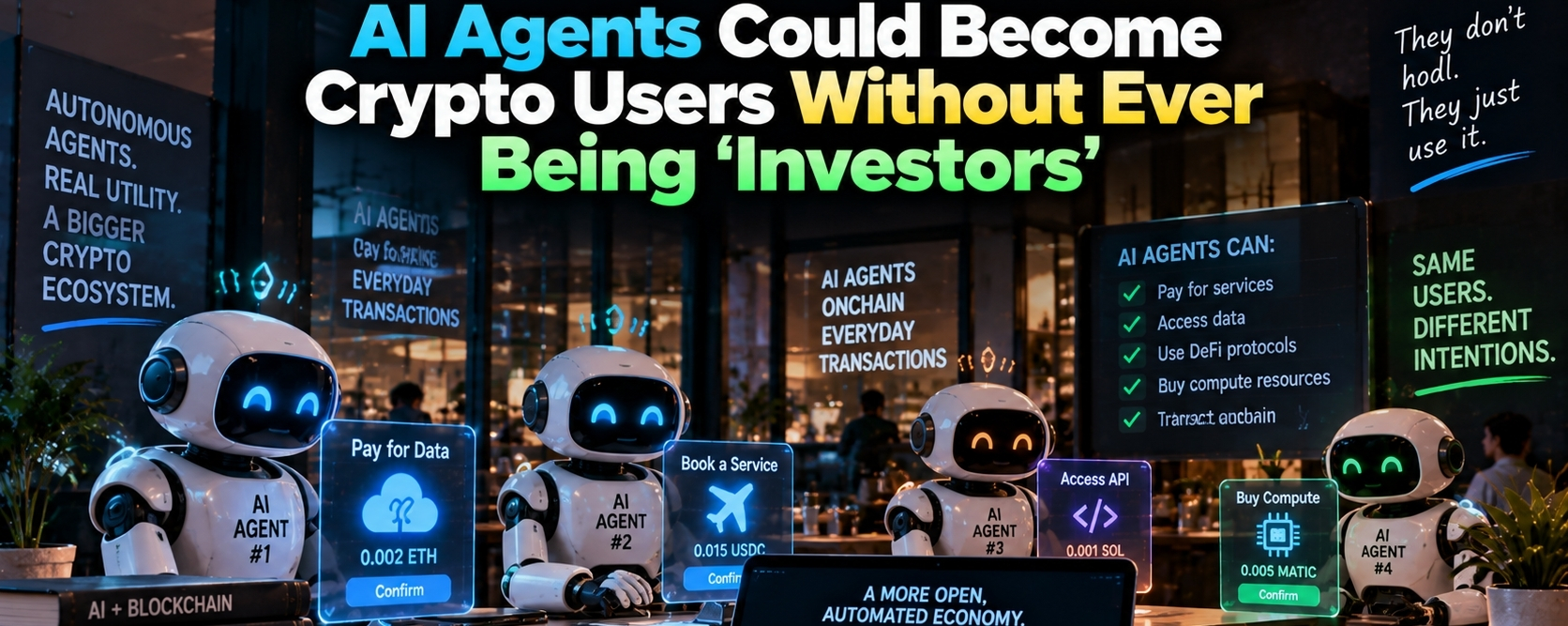


When people imagine the next wave of crypto adoption, they usually think about millions of new human users buying Bitcoin, opening wallets, trading tokens and exploring DeFi.
But the next major group of blockchain users might not be people at all.
It could be AI agents.
An AI agent doesn't need to believe Bitcoin will rise. It doesn't need to follow crypto influencers or wait for an altseason.
It may simply need a way to receive money, make payments and interact with digital services automatically.
That could make crypto useful to AI for a completely different reason.
What Is an AI Agent?
An AI agent is software designed to perform tasks with some degree of autonomy.
Instead of answering a single question and stopping, an agent can potentially work toward a goal, use digital tools, communicate with other services and make decisions within limits set by its user or developer.
Imagine an AI system responsible for managing a digital service.
It might need to purchase computing resources, pay for data, access an API or compensate another automated service.
Suddenly, the AI doesn't only need intelligence.
It needs economic infrastructure.
AI Has a Money Problem
The internet was primarily designed around humans and organizations.
Traditional financial accounts normally require identity verification, legal agreements and banking relationships.
Software can't simply walk into a bank and open an account for itself.
Crypto introduces a different model.
A blockchain wallet can interact with digital assets through software.
That makes blockchain-based payments potentially interesting for autonomous systems.
An AI agent doesn't necessarily need a traditional bank card if it can operate through a properly controlled digital wallet.
Machines Don't Need to Become Investors
This is the key distinction.
Humans often use crypto because they expect an asset to increase in value.
AI agents wouldn't necessarily care.
An agent might receive a stablecoin and spend that stablecoin minutes later.
It isn't investing.
It's transacting.
That means AI adoption of crypto could look completely different from previous waves of adoption.
The important metric might not be how many machines are “holding” tokens.
It could be how much economic activity machines conduct through blockchain rails.
Stablecoins Could Be a Natural Fit
Price stability matters when paying for services.
Imagine an AI agent needs to purchase $20 worth of computing power.
Using an asset that could move sharply in price creates unnecessary complexity.
A dollar-linked stablecoin provides a much simpler unit of account.
The agent can understand that $20 is approximately $20 without constantly managing large price fluctuations.
This is why the AI-and-crypto story may ultimately be more about stablecoins and payments than speculative AI tokens.
Imagine AI Paying AI
This is where things become more interesting.
Imagine one AI agent needs specialized data.
Another automated service provides it.
The first agent sends a small payment.
The second service delivers the information.
No human needs to manually approve every tiny transaction, assuming the system has appropriate permissions and spending limits.
Now multiply that interaction across millions of automated services.
Machines could potentially become economic participants on the internet.
Micropayments Could Matter
Traditional payment infrastructure isn't always designed for extremely small, frequent machine-to-machine payments.
Transaction fees, settlement delays and account requirements can make tiny payments inefficient.
Blockchain-based systems could potentially provide alternative ways to handle some of these transactions.
An AI agent might pay a tiny amount for one API request, a piece of data, computing time or another digital resource.
Instead of buying a monthly subscription, software could potentially pay only for what it uses.
That could create entirely new business models.
Crypto Could Become Invisible
One of the most interesting possibilities is that future users may not even know they're interacting with blockchain technology.
Today, crypto applications often require users to understand wallets, addresses, networks, transaction fees and tokens.
That complexity remains a barrier.
AI agents could hide much of it.
A person might simply tell an assistant to complete a task.
Behind the scenes, the software could interact with digital services and blockchain-based payment infrastructure.
The human sees the result.
The agent handles the complexity.
Crypto adoption could therefore increase while becoming less visible.
AI Agents Could Need Their Own Economic Identities
If autonomous software begins conducting transactions, another question appears.
How do we identify which agent performed which action?
Blockchain systems can provide transparent records of transactions between addresses.
This doesn't automatically solve digital identity, trust or fraud.
But it could become one component of a broader machine economy where software needs verifiable ways to transact and prove certain actions occurred.
Identity, reputation and payments could eventually become closely connected.
Smart Contracts Add Another Layer
Payments aren't the only possible use.
AI agents could interact with smart contracts.
An agent might follow predefined rules for spending, exchanging assets or accessing services.
Smart contracts could also impose restrictions.
For example, an agent might be authorized to spend only a certain amount or interact only with approved applications.
That could create a system where automation exists without giving software unlimited financial control.
The safeguards would be just as important as the automation itself.
Security Could Become the Biggest Challenge
Giving software access to money creates obvious risks.
An incorrectly configured agent could make unwanted transactions.
A compromised agent could expose funds.
Malicious instructions could potentially manipulate automated systems.
Smart-contract vulnerabilities could add another layer of risk.
Crypto transactions can also be difficult or impossible to reverse.
So an AI-powered machine economy would require strong security, permissions, spending limits and human oversight.
Autonomy without controls would be dangerous.
Not Every AI Token Will Benefit
This may be one of the biggest misconceptions around the AI-crypto narrative.
AI adoption doesn't automatically mean every token labeled “AI” becomes valuable.
The real beneficiaries could be completely different.
Stablecoins could handle payments.
Blockchains could provide settlement.
Infrastructure protocols could connect services.
Developers could build applications on top.
Meanwhile, many speculative AI tokens might have little connection to actual AI-agent activity.
Investors should distinguish between AI branding and genuine utility.
Follow Usage, Not Just Narratives
If AI agents genuinely become important blockchain users, traders will need better ways to evaluate the trend.
Instead of simply asking which token has “AI” in its description, the better questions will involve real activity.
Are agents actually making transactions?
Are they paying for useful services?
Is transaction volume increasing?
Are developers building infrastructure around machine payments?
And most importantly, does the token being purchased actually capture value from that activity?
Those questions matter more than hype.
The Internet Could Gain a Machine Economy
The internet connected billions of people.
AI could eventually add enormous numbers of autonomous software participants.
Those agents may communicate with one another, purchase services and exchange digital value.
Traditional finance wasn't originally designed for that world.
Crypto wasn't specifically designed for AI either.
But programmable money, digital wallets and smart contracts create tools that could potentially fit a machine-driven internet surprisingly well.
Final Thoughts
The biggest AI-crypto opportunity might not involve AI predicting Bitcoin prices or traders buying the next AI token.
It could be much simpler.
AI needs a way to pay.
If autonomous software begins buying data, computing power, APIs and other digital services, blockchain-based payment infrastructure could become one way of enabling those transactions.
The most interesting part is that these AI agents wouldn't need to care whether crypto is in a bull or bear market.
They wouldn't need to become investors at all.
They would simply become users.
And if millions of machines eventually start using crypto without thinking of it as crypto, that could represent a very different kind of adoption from anything the industry has seen before.