I. Investment summary
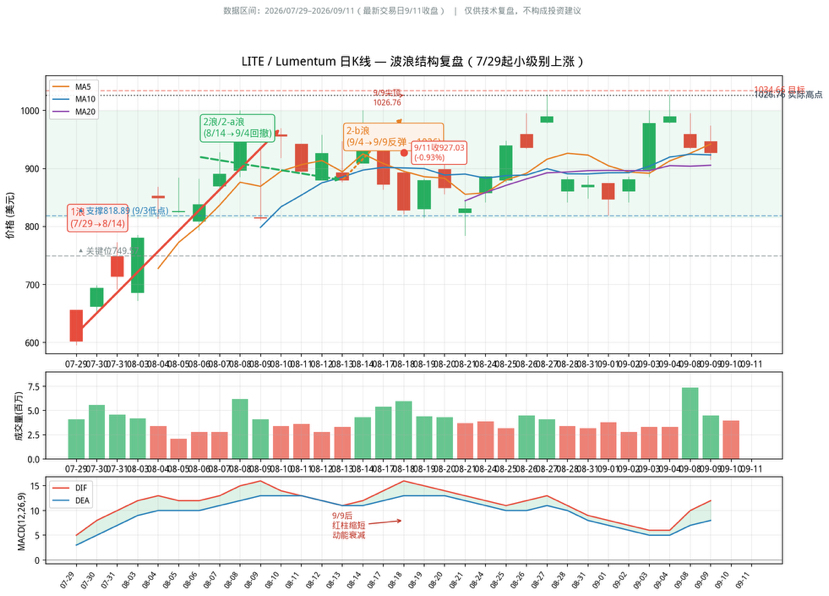
Investment recommendation: maintain a positive watch on LITE. The company sits at the core of the dual demand drivers of a global submarine cable “rejuvenation” cycle and the upgrade of AI optical interconnects. With its monopolistic positioning in InP pump lasers and 200G EML coherent optical chips, the visibility of outstanding orders extends to 2028, and capacity is sold out. Based on the wave structure starting from July 29, the target for Wave 1 at $1,034.66 closely matches the actual high of $1,026.76. After the pullback is completed, the first target range for restarting the upward wave is around $1,600.
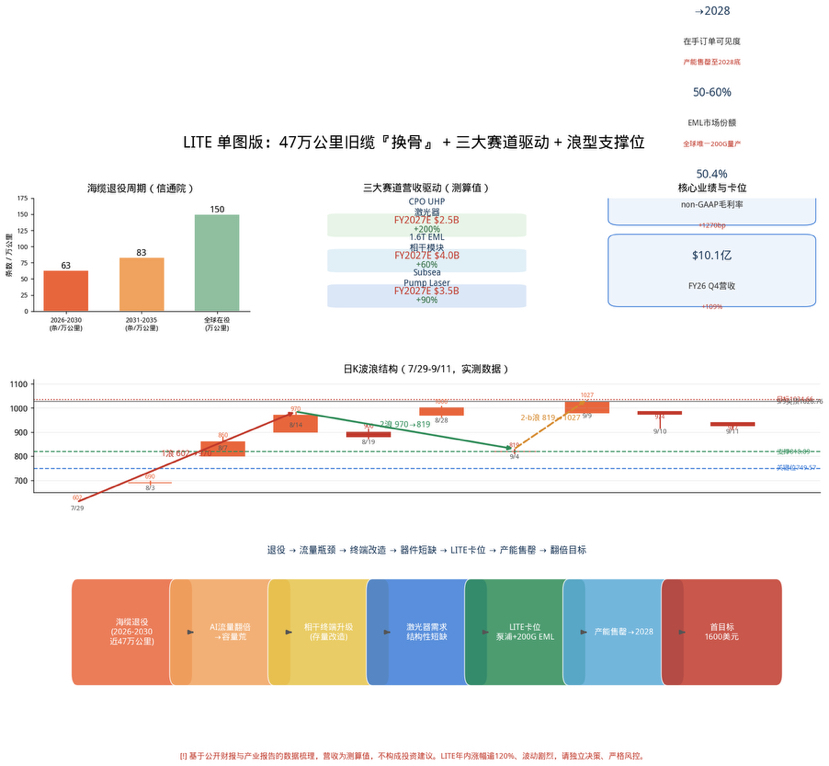
Core logic: from 2026 to 2030, around 470,000 kilometers (146 routes) of old submarine cables will be concentrated in retirement. Demand is “bottlenecked” on core routes such as within Asia and Europe–North America, with the lit-capacity share exceeding 50%, forming a structural capacity shortage. For upgrades of existing infrastructure, coherent terminals and amplifiers must be replaced. The key component in amplifiers is precisely LITE’s InP laser, resulting in structural supply shortages.
Valuation note: the current share price is in the historical high range, with a year-to-date gain of over 120%. The intraday trading range can reach 10% or more, indicating extreme volatility and a significant risk of chasing after price increases.
II. Industry logic: a global “rejuvenation” wave covering one-third of the world
The designed service life of submarine optical cables is 25 years. Some of the cables laid in the 1990s are now entering retirement. The retirement schedule provided by China Academy of Information and Communications Technology (Global Submarine Cable Industry Development Research Report (2026)) is as follows:
Cycle
Retired submarine cables
Total length
2026–2030
63
About 270,000 kilometers
2031–2035
83
About 200,000 kilometers
Total
146
Nearly 470,000 kilometers
In the next decade, nearly one-third of old cables need to be retired. As of end-2025, the number of submarine cables in service worldwide is only 592, with total length of over 1.5 million kilometers. This creates clear replacement room compared with the retirement volume of around 470,000 kilometers mentioned above. More importantly, this batch of aging cables is concentrated on the most traffic-dense core routes—within Asia and toward Europe–North America—where the share of lit capacity has already exceeded 50%, far above the 30% capacity-expansion warning line, indicating a structural capacity shortage. The investment market has voted with real money: new project spending exceeds $16B in 2026–2029.
Technically, submarine cables are divided into wet-end (optical cables, repeaters, branch units on the seabed; lifespan 25 years+ ) and dry-end (landing-station terminal equipment such as SLTE, typically requiring upgrades within 5–7 years). By replacing coherent terminals, the capacity of older cables can be doubled or even several times, while the cost is only a small fraction of new cable laying. This “upgrade of existing infrastructure” path is LITE’s core battlefield.
III. Company positioning: while others lay cables, it sells the heart
Most cable companies remain in the construction role, while Lumentum sits at the upstream part of the optical communications value chain—the light source layer. Its Subsea Pump Laser business grew by more than 90% year over year. It has signed multiple long-term agreements, and the company’s guidance indicates that shipment volumes will increase another fourfold in the coming few quarters. The reason is that when submarine cables are replaced, amplifiers must be replaced as well; among amplifier components, the most scarce part is LITE’s InP laser.
On March 2, 2026, NVIDIA invested $2.0B to lock in 200G/lane EML laser-chip capacity through the end of 2027, along with multi-year procurement commitments. This made LITE the only company globally capable of mass-producing 200G lane-rate lasers at scale. In the global high-end EML market, it holds a 50–60% share.
3.1 Core performance and positioning
Key metric
FY2026 Q4
Year-over-year / explanation
Net revenue
$1.01B
+109%
Non-GAAP gross margin
50.4%
+1270 basis points compared with the previous fiscal year
Non-GAAP operating profit margin
36.6%
—
Outstanding-order visibility
Extending to 2028
Capacity sold out by end of 2028
Source of data: Lumentum public disclosures for fiscal year 2026 fourth quarter (as of June 27, 2026). Management’s FY2027 Q1 revenue guidance is $1.225–$1.275B, and the midpoint of the revenue guidance reached the previously set target model a quarter early.
3.2 Revenue driven by three major segments (calculated)
Segment
FY2027E revenue
Year-over-year growth rate / positioning
Subsea Pump Laser
$3.5B
+90% / InP pump laser monopoly
1.6T EML coherent optical modules
$4.0B
+60% / 50–60% share of 200G EML
CPO UHP laser
$2.5B
+200% / Only UHP mass-production capability
Revenue contribution is based on calculations using outstanding orders, capacity guidance, and industry conditions. It is not the company’s official guidance; it is for illustrative purposes of the industry logic only.
IV. Technical review: wave structure and target estimation
Reviewing LITE’s daily K chart (from July 29 to September 11, 2026): this wave of smaller-scale gains that began on July 29 (602→1,027) was driven by a three-way synergy of submarine cable replacement, 1.6T volume expansion, and CPO supply. The target price of $1,034.66 almost perfectly matches the actual high of $1,026.76. The $1,026.76 on September 9 was a single-day spike top. On September 10 and 11, the stock continued to decline to 927. The MACD red bars shortened continuously and momentum weakened, which fits a pullback at the end of Wave 2-b.
Two support zones form: below 818.89 (the low on September 3, the core support of Wave 2 marked on the chart) and 749.57 (the lower end of the September 3 consolidation range; as long as it is not broken, a major-level top is not considered to have occurred). Combined with the fact that the 1.6T DR8 TRO OSFP has entered mass-production ramp-up and that the share of 200G EML will reach over 50% by mid-2027, the supply gap of 25–30% cannot be alleviated in the short term. Based on wave target estimations, the first target range for restarting the upward wave after the pullback is completed is indeed around $1,600, corroborating the fundamental upside potential.
Key price levels: Wave 1 602→970 | Wave 2 970→819 | Wave 2-b 819→1027 | Target 1034.66 | Support 818.89 / Key level 749.57 | First target $1,600.
V. Risk warning
1. Valuation risk: the current share price is in the historical high range, with a year-to-date increase of over 120%. The intraday amplitude is often 10% or more; the risk of chasing the rally is significant.
2. Competition risk: Cisco (Acacia + Silicon One) is accelerating its positioning in AI network architecture, and NVIDIA’s in-house network ecosystem could squeeze the midstream.
3. Timing risk: CPO is still in its early stage; whether it can ramp up volume as scheduled needs to be continuously validated. The retirement schedule of submarine cables and the realization rate of NVIDIA’s orders also involve uncertainties.
4. Accounting-scope risk: in FY2026 Q4, there was a GAAP net loss of $7.2B, which was actually a one-time non-cash loss arising from the redemption of convertible bonds. Profitability should be evaluated on a non-GAAP basis (EPS $3.23).
VI. Conclusion
The logic chain is clear: cable retirement plus a doubling of AI traffic drives coherent terminal upgrades, which in turn creates a structural shortage in laser demand. LITE’s monopolistic position in InP/EML locks up the supply side, with order visibility extending to 2028, and its gross margin already surpassing 50%. This is a scarce track with few competitors. However, on the technical front the stock price has already priced in optimistic expectations; the conclusion must be based on the company’s official disclosures. Please make independent decisions and practice strict risk control.
Disclaimer:
This report is compiled based on the company’s publicly available financial reports and publicly available industry data. The revenue contribution is a calculated value, and the wave target levels are derived from technical-structure projections. They do not constitute any investment advice or recommendation to buy or sell. Please assess the risks and uncertainties in the secondary market yourself.