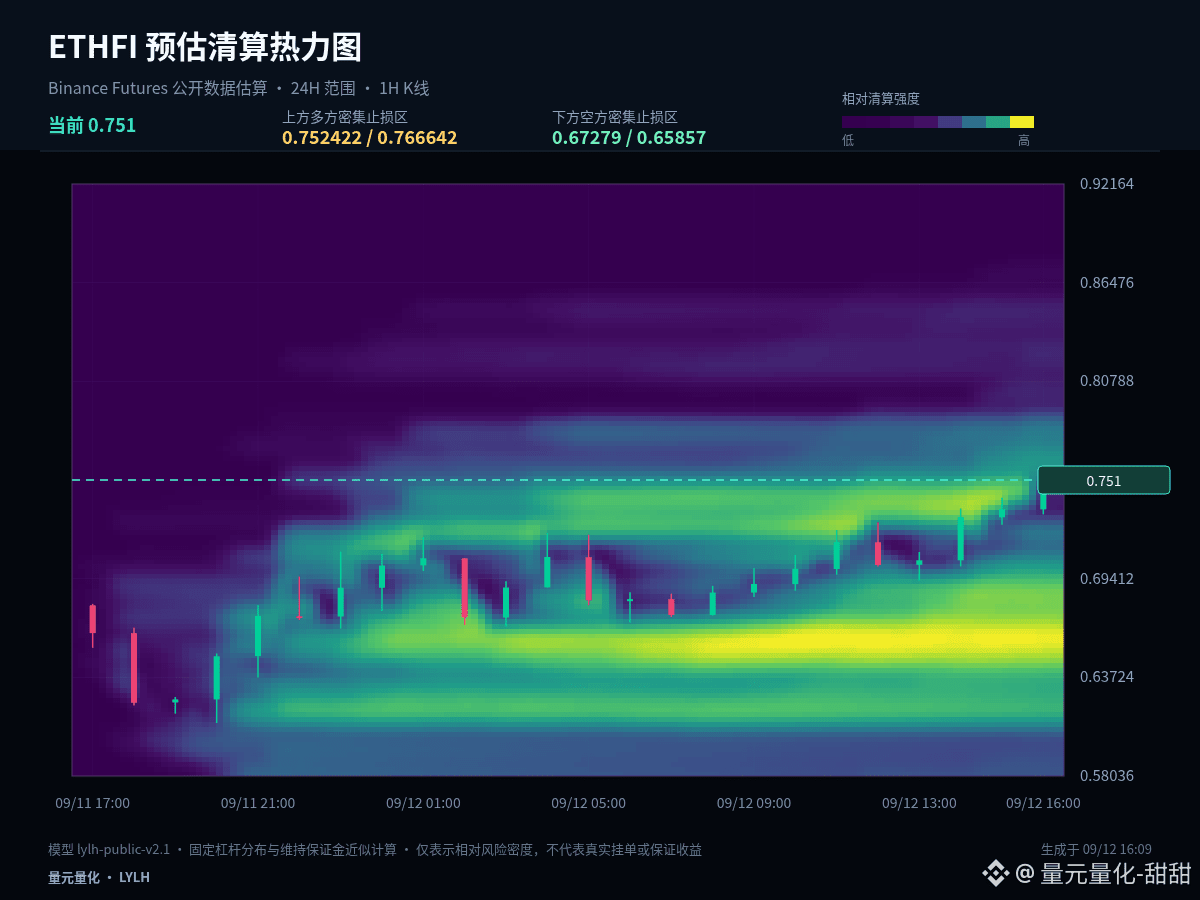
$ETHFI #ETHFI This time, we break down the situation from the position perspective. In the same chart, what you see with an existing position is different from what you see with no position. Current price: 0.7523, +2.35% in 1 hour, +11.4% in 24 hours.
The current price is near the upper edge of the past 24-hour range: +2.35% in 1 hour and +11.4% in 24 hours. The most important thing at the high is to confirm acceptance after a breakout: if the price can stay above the upper edge, it indicates the market recognizes a higher range. If it only briefly pierces and then quickly pulls back, you need to guard against a false breakout.
For those holding positions already, first observe whether there is continuous rejection around 0.7547, with 0.6832 serving as the protective structure. For those with no position, don’t chase near the resistance area; instead, wait for acceptance after a pullback to the midline, or for a second confirmation after breaking the resistance.
There are three ways to handle the next path: if price moves up and holds above 0.7547, wait and reassess only after a pullback that doesn’t break; if it breaks down below 0.6117, prioritize risk control and wait for new support; if it keeps oscillating around 0.6832, treat it as a range turnover and avoid repeatedly chasing direction in the middle.
For people with existing positions, the key is to manage based on whether support fails—not to be carried away by every fluctuation. For people with no position, prioritize waiting for a breakout plus pullback confirmation, or for support confirmation. Spot can be scaled in, while for derivatives you should shorten the decision chain: first determine the stop-loss level, then decide whether to participate.
A trading plan must include invalidation conditions. If your judgment is correct, you can take profits in stages; if it’s wrong, you must also allow yourself to exit. Don’t use adding positions to cover the fact that the original logic has already changed. The market will update, and your view should adjust according to price evidence.
#CPIWatch
The current price is near the upper edge of the past 24-hour range: +2.35% in 1 hour and +11.4% in 24 hours. The most important thing at the high is to confirm acceptance after a breakout: if the price can stay above the upper edge, it indicates the market recognizes a higher range. If it only briefly pierces and then quickly pulls back, you need to guard against a false breakout.
For those holding positions already, first observe whether there is continuous rejection around 0.7547, with 0.6832 serving as the protective structure. For those with no position, don’t chase near the resistance area; instead, wait for acceptance after a pullback to the midline, or for a second confirmation after breaking the resistance.
There are three ways to handle the next path: if price moves up and holds above 0.7547, wait and reassess only after a pullback that doesn’t break; if it breaks down below 0.6117, prioritize risk control and wait for new support; if it keeps oscillating around 0.6832, treat it as a range turnover and avoid repeatedly chasing direction in the middle.
For people with existing positions, the key is to manage based on whether support fails—not to be carried away by every fluctuation. For people with no position, prioritize waiting for a breakout plus pullback confirmation, or for support confirmation. Spot can be scaled in, while for derivatives you should shorten the decision chain: first determine the stop-loss level, then decide whether to participate.
A trading plan must include invalidation conditions. If your judgment is correct, you can take profits in stages; if it’s wrong, you must also allow yourself to exit. Don’t use adding positions to cover the fact that the original logic has already changed. The market will update, and your view should adjust according to price evidence.
#CPIWatch