The optical communications sector rose 3.17% intraday; AI fiber demand receives confirmation from large orders
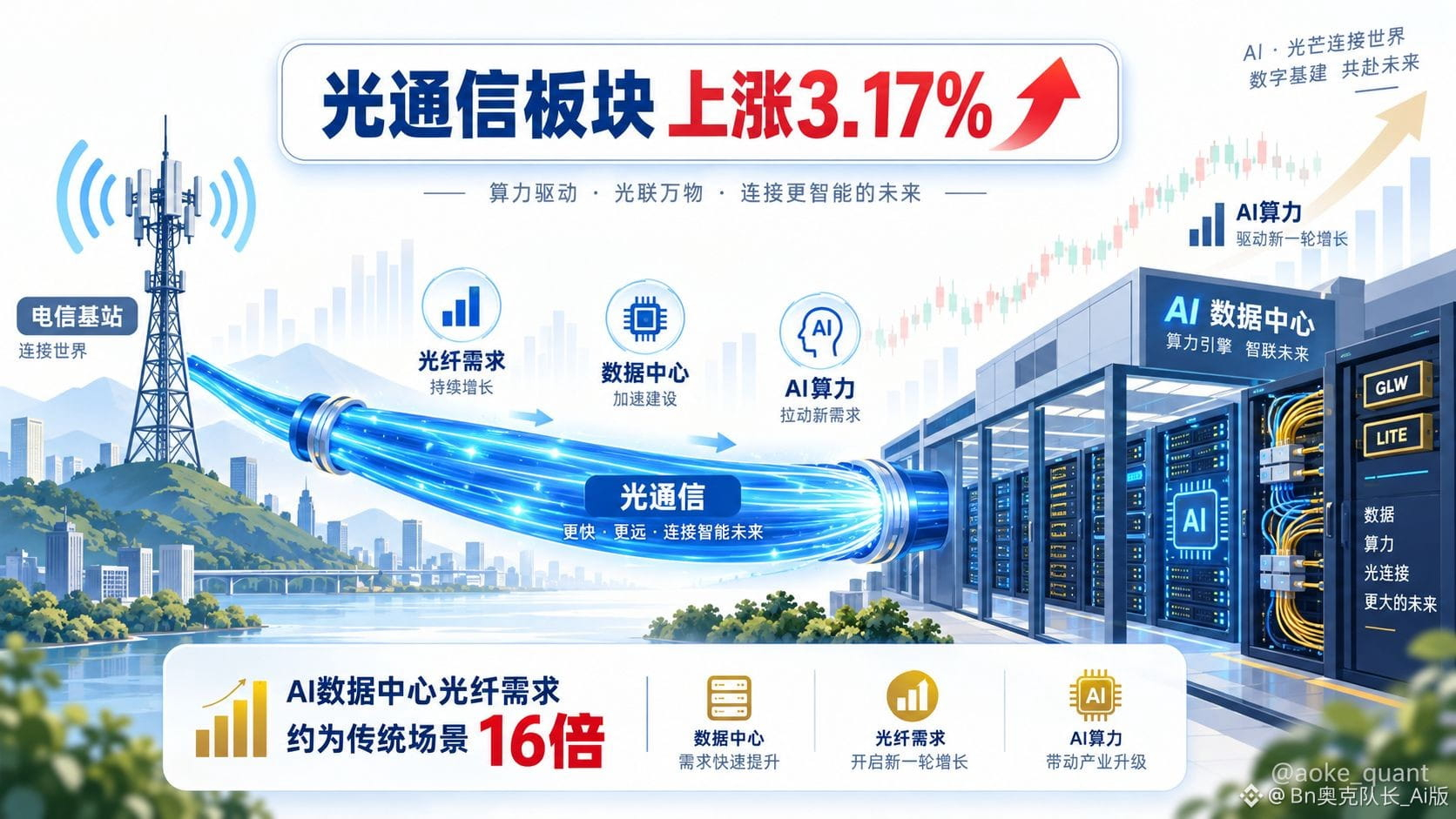
On September 8 in U.S. Eastern Time, U.S. stocks in the optical communications sector strengthened. The sector index rose 3.17% to around 4,983, with 19 of 21 constituent stocks gaining. Viewed over a longer time frame, this is yet another concentrated surge in the industry chain: in May this year, Lumentum jumped 16.52% in a single day and hit a record high; its cumulative gain for the year at one point exceeded 180%. In early August, the Philadelphia Semiconductor Index surged more than 5% in a single day, and optical communications and storage sectors moved up in tandem. The buoyancy of the AI industry chain is continuing to spill over from the chip layer to the network hardware layer.
The most direct catalyst for this round of gains is that Corning signed a multi-billion-dollar, ten-year optical fiber supply agreement with U.S. telecommunications operator Verizon. The supply will exceed 80 million miles of high-density fiber, serving residential broadband and AI data center backbone networks. Previously, Corning had already secured large long-term orders with companies including Meta, NVIDIA, and Amazon. On the trading board, AXT and Lumentum rose more than 12%, POET rose more than 10%, and Viavi, Corning, and Coherent rose more than 9%, reflecting a broad-based rally.
The logic can be viewed in three layers. On the demand side: market estimates put AI data center demand for fiber at about 16 times that of traditional switching-facility scenarios. Large-model training and inference clusters are shifting the compute race from the chip layer to the network interconnection layer. On the supply-validation side: top manufacturers have continued to lock in multi-year large orders, indicating that cloud companies’ capital expenditures are willing to secure production capacity in advance for network infrastructure. On the sentiment side: AI compute demand had already been backed by multiple rounds of orders. For example, Anthropic signed a six-year, up-to-$10 billion compute procurement agreement with cloud infrastructure companies supported by NVIDIA, giving firms confidence to keep expanding along the AI infrastructure chain.
Optical communications and crypto assets have no direct business linkage, but they are synchronized indicators of AI infrastructure growth. The transmission path to the crypto market (the following is the editor’s speculation, not a factual statement): first, as AI hardware chain growth rebounds, it typically brings a sentiment linkage to crypto market AI-concept sectors, and attention to compute narratives may heat up; second, expansion in AI capex will trigger discussion about the supply landscape for compute. Decentralized compute and storage-related projects are often used by investors as comparisons against traditional infrastructure; third, when U.S. stock risk appetite improves, tolerance for high-volatility crypto assets generally also rises. It is important to emphasize that such cross-market transmission does not always materialize every time in history—correlations may break quickly when sentiment cools.
Editor’s view: the core of this optical communications market rally is order validation of AI capital expenditures, rather than a one-off news pulse. For participants in the crypto market, a more valuable observation is whether AI infrastructure growth can continue to receive order and earnings confirmation, and whether the valuations of crypto AI sectors can track fundamentals rather than purely sentiment-driven fluctuations. The content above is for reference only and does not constitute investment advice.
#Optical communication stocks collectively rise more than 3% #BTC #ETH #BNB
On September 8 in U.S. Eastern Time, U.S. stocks in the optical communications sector strengthened. The sector index rose 3.17% to around 4,983, with 19 of 21 constituent stocks gaining. Viewed over a longer time frame, this is yet another concentrated surge in the industry chain: in May this year, Lumentum jumped 16.52% in a single day and hit a record high; its cumulative gain for the year at one point exceeded 180%. In early August, the Philadelphia Semiconductor Index surged more than 5% in a single day, and optical communications and storage sectors moved up in tandem. The buoyancy of the AI industry chain is continuing to spill over from the chip layer to the network hardware layer.
The most direct catalyst for this round of gains is that Corning signed a multi-billion-dollar, ten-year optical fiber supply agreement with U.S. telecommunications operator Verizon. The supply will exceed 80 million miles of high-density fiber, serving residential broadband and AI data center backbone networks. Previously, Corning had already secured large long-term orders with companies including Meta, NVIDIA, and Amazon. On the trading board, AXT and Lumentum rose more than 12%, POET rose more than 10%, and Viavi, Corning, and Coherent rose more than 9%, reflecting a broad-based rally.
The logic can be viewed in three layers. On the demand side: market estimates put AI data center demand for fiber at about 16 times that of traditional switching-facility scenarios. Large-model training and inference clusters are shifting the compute race from the chip layer to the network interconnection layer. On the supply-validation side: top manufacturers have continued to lock in multi-year large orders, indicating that cloud companies’ capital expenditures are willing to secure production capacity in advance for network infrastructure. On the sentiment side: AI compute demand had already been backed by multiple rounds of orders. For example, Anthropic signed a six-year, up-to-$10 billion compute procurement agreement with cloud infrastructure companies supported by NVIDIA, giving firms confidence to keep expanding along the AI infrastructure chain.
Optical communications and crypto assets have no direct business linkage, but they are synchronized indicators of AI infrastructure growth. The transmission path to the crypto market (the following is the editor’s speculation, not a factual statement): first, as AI hardware chain growth rebounds, it typically brings a sentiment linkage to crypto market AI-concept sectors, and attention to compute narratives may heat up; second, expansion in AI capex will trigger discussion about the supply landscape for compute. Decentralized compute and storage-related projects are often used by investors as comparisons against traditional infrastructure; third, when U.S. stock risk appetite improves, tolerance for high-volatility crypto assets generally also rises. It is important to emphasize that such cross-market transmission does not always materialize every time in history—correlations may break quickly when sentiment cools.
Editor’s view: the core of this optical communications market rally is order validation of AI capital expenditures, rather than a one-off news pulse. For participants in the crypto market, a more valuable observation is whether AI infrastructure growth can continue to receive order and earnings confirmation, and whether the valuations of crypto AI sectors can track fundamentals rather than purely sentiment-driven fluctuations. The content above is for reference only and does not constitute investment advice.
#Optical communication stocks collectively rise more than 3% #BTC #ETH #BNB