Today we continue discussing the issue of rate hikes
Last night’s August CPI year-over-year came in at 3.4% and core at 2.4%, both in line with expectations, but the month-over-month figure at +0.4% was the largest one-month increase since May 2026.
Yields jumped immediately after the data release, reflecting that the market cares more about the slope than the annual level.
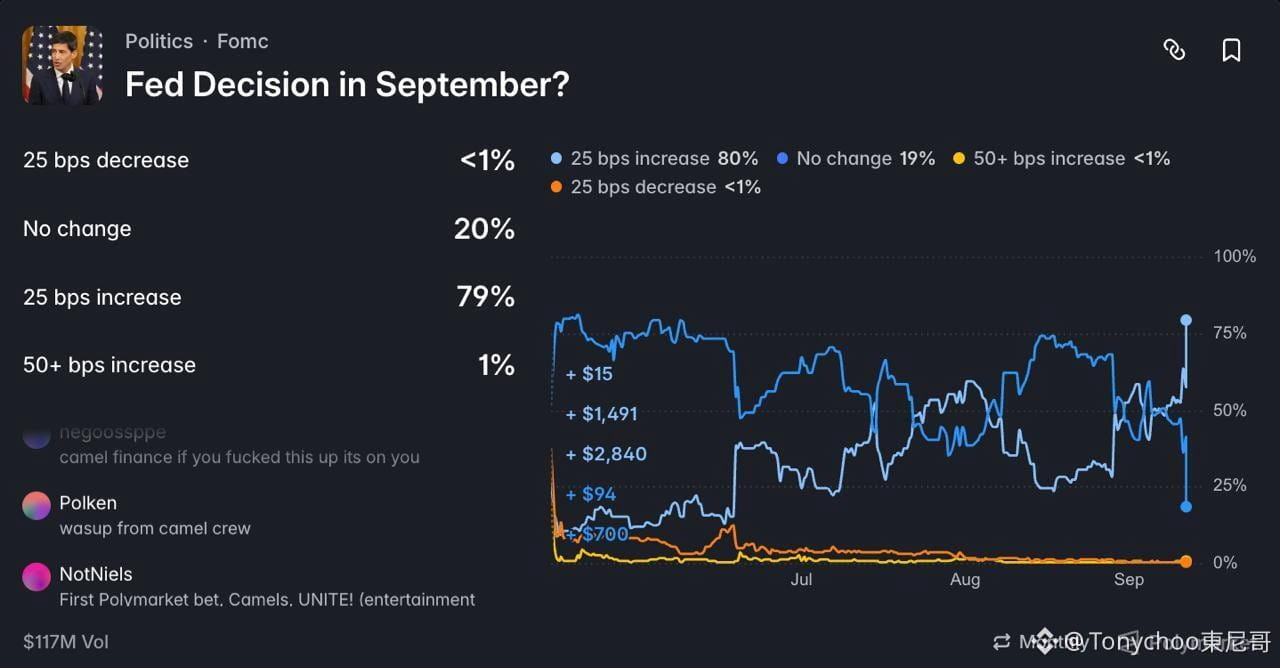
Combined with PPI inflation rising to 5.4%, August adding 162,000 new jobs above expectations, and oil prices breaking above 100, inflation is at least 140 basis points higher than the Fed’s target. The market’s benchmark scenario has been repriced to include a cumulative four rate hikes by July 2027, reversing the initial expectation from early 2026 of four rate cuts—a massive 200-basis-point turnaround. This is the most hawkish expectation adjustment since the rate-hike cycle began in March 2022.
(<t-2/> #CPI数据来袭能否触发9月加息 )
But another camp offers a completely opposite interpretation:
Seasonally adjusted annualized CPI is actually falling. After removing seasonal noise, employment has not overheated. With a $4 trillion government bond market, there is little feasibility for further rate hikes. Current nominal interest rates (3.5%–3.75%) are already above inflation (3.4%), putting us in a positive real-rate environment. Monetary policy has been continuously exerting pressure, and the market’s pricing of a 90% probability of a rate hike has been criticized as an overreaction.
This disagreement is directly reflected in last night’s price action:
After the data came out, price first dipped with a quick puncture, then violently rebounded. ETH rose as much as 8%, clearly outperforming BTC. The ETH/BTC exchange rate appears to have decoupled; two hours later, the rebound momentum faded. Starting around 11 p.m., the market shifted into a typical range-bound “gate” trading pattern, and neither side managed to gain a decisive advantage.
The capital flow data provides a relatively clear signal:
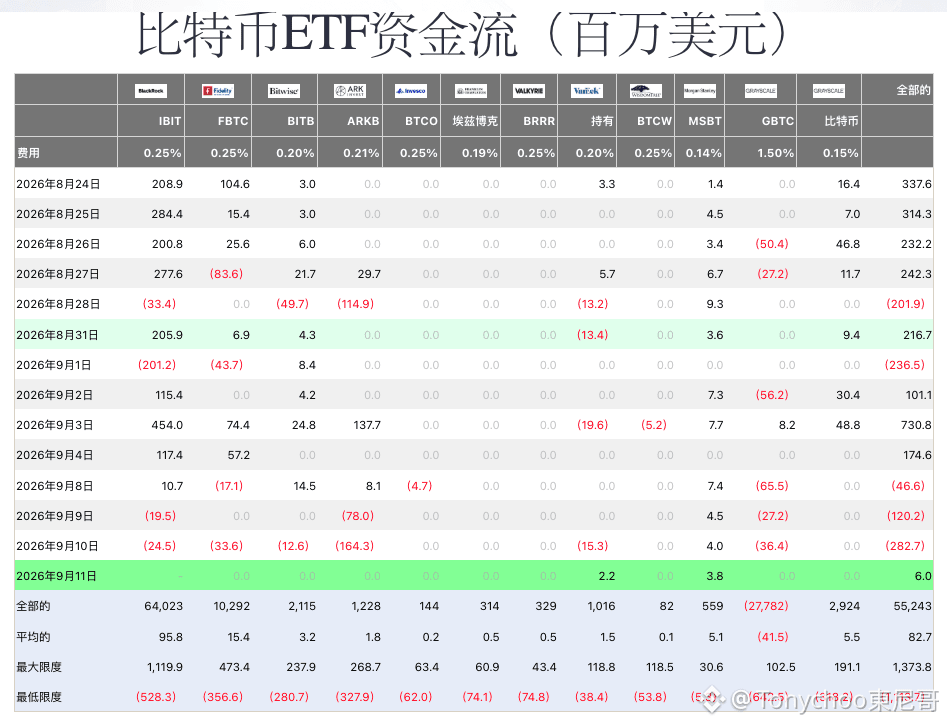
After BTC ETF accelerated outflows for three consecutive days ended, on September 11 it only swung slightly back into positive territory by $60,000;
(<t-2/> (圖2))
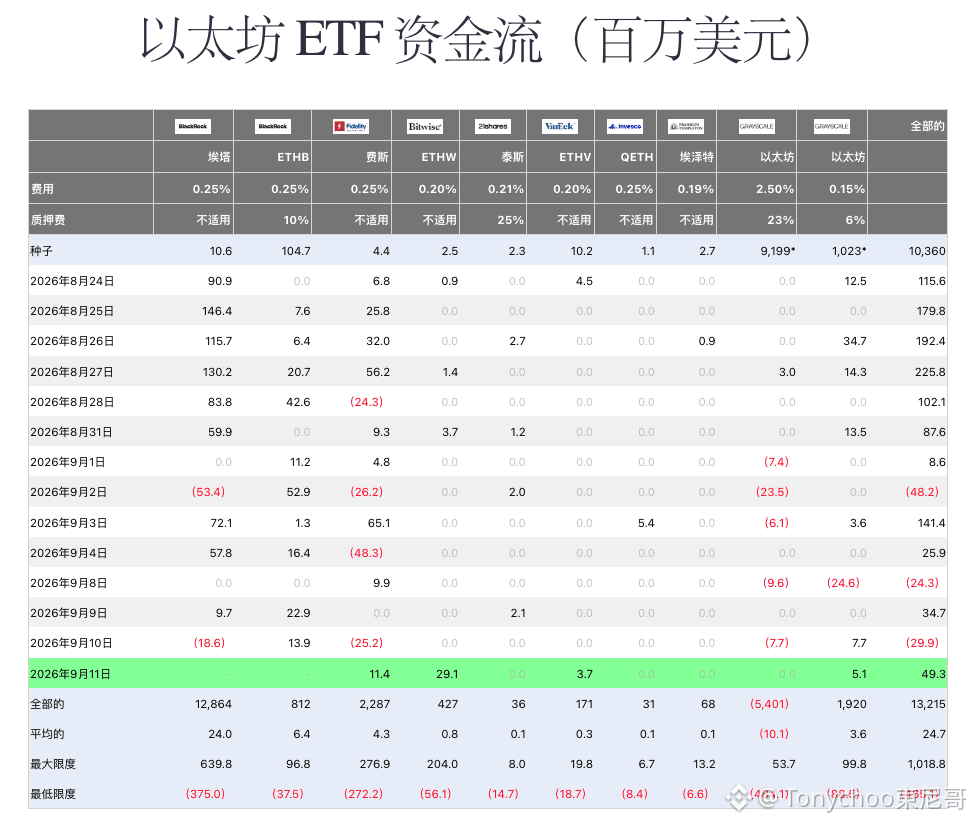
On the same day, ETH ETF saw net inflows of $49.3 million. (Fig. 3)
At this juncture, capital clearly favors ETH over BTC, which aligns strongly with ETH’s relative strength on the chart. #以太坊时隔七个月重返2600美元
Tony Ge believes:
Given the structural constraints that the U.S. fiscal system cannot bear large-scale rate hikes, and the fact that real interest rates have turned positive, I think the final outcome is unlikely to follow the market’s most extreme hawkish repricing scenario. However, the sheer volatility of expectations themselves is enough to keep generating volatility. Before September 16–17, it is not advisable to take a heavy position betting in only one direction.
Last night’s August CPI year-over-year came in at 3.4% and core at 2.4%, both in line with expectations, but the month-over-month figure at +0.4% was the largest one-month increase since May 2026.
Yields jumped immediately after the data release, reflecting that the market cares more about the slope than the annual level.
Combined with PPI inflation rising to 5.4%, August adding 162,000 new jobs above expectations, and oil prices breaking above 100, inflation is at least 140 basis points higher than the Fed’s target. The market’s benchmark scenario has been repriced to include a cumulative four rate hikes by July 2027, reversing the initial expectation from early 2026 of four rate cuts—a massive 200-basis-point turnaround. This is the most hawkish expectation adjustment since the rate-hike cycle began in March 2022.
(<t-2/> #CPI数据来袭能否触发9月加息 )
But another camp offers a completely opposite interpretation:
Seasonally adjusted annualized CPI is actually falling. After removing seasonal noise, employment has not overheated. With a $4 trillion government bond market, there is little feasibility for further rate hikes. Current nominal interest rates (3.5%–3.75%) are already above inflation (3.4%), putting us in a positive real-rate environment. Monetary policy has been continuously exerting pressure, and the market’s pricing of a 90% probability of a rate hike has been criticized as an overreaction.
This disagreement is directly reflected in last night’s price action:
After the data came out, price first dipped with a quick puncture, then violently rebounded. ETH rose as much as 8%, clearly outperforming BTC. The ETH/BTC exchange rate appears to have decoupled; two hours later, the rebound momentum faded. Starting around 11 p.m., the market shifted into a typical range-bound “gate” trading pattern, and neither side managed to gain a decisive advantage.
The capital flow data provides a relatively clear signal:
After BTC ETF accelerated outflows for three consecutive days ended, on September 11 it only swung slightly back into positive territory by $60,000;
(<t-2/> (圖2))
On the same day, ETH ETF saw net inflows of $49.3 million. (Fig. 3)
At this juncture, capital clearly favors ETH over BTC, which aligns strongly with ETH’s relative strength on the chart. #以太坊时隔七个月重返2600美元
Tony Ge believes:
Given the structural constraints that the U.S. fiscal system cannot bear large-scale rate hikes, and the fact that real interest rates have turned positive, I think the final outcome is unlikely to follow the market’s most extreme hawkish repricing scenario. However, the sheer volatility of expectations themselves is enough to keep generating volatility. Before September 16–17, it is not advisable to take a heavy position betting in only one direction.