


On September 10, under macroeconomic pressure, the crypto market weakened again. This morning, Bitcoin fell below $78,000, and on-chain liquidity has also faced a significant pullback. But ZEC didn’t fall along with it. When the broader market retreated, its price at one point nearly touched $1,300; the 9-day high was around $1,296–1,298. It’s currently still digesting moves in the $1,210–$1,240 range, maintaining the fierce uptrend of this round.
For a token that started at $50, surged toward $1,300, and has seen a roughly 45%–50% strong rise over nearly a week, the fact that “the broader market is down but it doesn’t follow” is itself the most striking signal of this cycle. Over the past 30 days, ZEC/BTC has climbed about one and a half times; its market cap has returned to around $20 billion, holding steady in the top ten. During the Orchard turmoil in June, it was still hovering near $250, but it has since carved out its own independent trend.
But the issue that comes with it is this: is the durability simply the essence of a narrative and valuation reshuffle, or is it the last tail-end of momentum after the高潮 (peak)? 👀
The editor compiled representative KOL long/short views from the recent market for everyone to take a look at. ⬇️
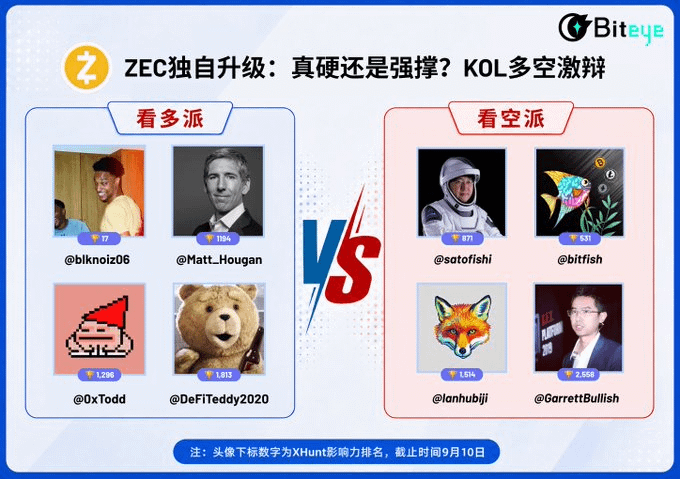
📈 Bullish camp: Independent market confirmation proves strong logic
1⃣ Ansem
@blknoiz06
| Trader / BullpenFi | XHunt global ranking: 17
🔥 Judgment: The core long-term holders’ positions in ZEC are stable, and the narrative is still expanding.
💡 View: Ansem believes the combination of "hard money + private value storage" has never been so complete. Zcash has a group of core holders that don’t set short-term selling targets. He put ZEC into the mainstream portfolio watchlist and thinks that if privacy continues to dominate this round of market mindshare, the funds won’t stay only among old coin holders—on-chain speculators could also be pulled in. As long as the broader market corrects but the price doesn’t break, it matches his judgment that this isn’t a "short-term distribution" crowd.
2⃣ Matt Hougan
@Matt_Hougan
| Chief Investment Officer at Bitwise | XHunt global ranking: 1194
🔥 Judgment: Privacy will become an independent asset class, and ZEC is one of the assets allocated on a ten-year horizon.
💡 View: Hougan compresses the next ten years into three lines: BTC hedges against currency devaluation, ZEC hedges against privacy demand, plus tokenization. The more Bitcoin moves into institutional markets, the more it will separate out some demand for assets outside the traditional system. In his view, Zcash is filling this position. Today’s "BTC is weak while ZEC is resilient" is the intuitive sign that the two types of assets are starting to diverge into separate tracks.
3⃣0xTodd
@0xTodd
| XHunt global ranking: 1296
🔥 Judgment: The rally first came from the channel and structure—not because everyone suddenly started using privacy.
💡 View: Monero’s privacy forced on it was delisted one after another by Binance, Coinbase, etc. ZEC allows transparent addresses and privacy addresses to coexist, and liquidity and trading channels aren’t constrained on the same level. This camp in the Chinese community doesn’t deny the controversy, but believes that in this round, the price primarily reflects this scarce position: "privacy coins that institutions can still buy."
4⃣ DeFi Teddy
@DeFiTeddy2020
| XHunt global ranking: 1813
🔥 Judgment: Western capital is hot on ZEC because it’s like a "privacy + leverage" version of Bitcoin.
💡 View:
1. Monetary policy benchmarked against BTC—i.e., 21 million supply cap, PoW, and Bitcoin fork lineage—while using zero-knowledge proofs to cover the privacy gap that a transparent ledger can’t solve.
2. The West places more weight on privacy than the East, so there’s even more FOMO.
3. It has already been established as the privacy leader.
4. Optional privacy makes ZEC easier to pass compliance than Monero’s forced privacy, so regulatory pressure is relatively reduced.
📉 Bearish camp: ZEC narrative is pure FOMO, but the fundamentals aren’t appealing
1⃣ Wang Chun
@satofishi
| Co-founder of F2Pool | XHunt global ranking: 871
🔥 Judgment: This round of ZEC is a narrative bid, not a fundamentals re-evaluation.
💡 View: Wang Chun posted multiple times on September 8, saying that a large market cap doesn’t mean it deserves a top-ten spot. He dug up four old issues in a row:
· Early 20% block rewards as Founders’ Reward
· Privacy is optional, not default
· Long-term governance tug-of-war
· Orchard vulnerability has been lurking for about four years, and the shielded pool can’t verify total supply in the same way Bitcoin can
In his view, today’s ability to resist downside could simply be that the funds tied to the privacy theme haven’t fully dispersed yet. That doesn’t mean Zcash has become a network at the same level as Solana or Hyperliquid.
2⃣ Shen Yu
@bitfish
| Co-founder of F2Pool | XHunt global ranking: 531
🔥 Judgment: Not touching it long-term personally.
💡 View: Shen Yu mentioned that on the night Zcash launched, a mine’s transformer was hit by lightning, and after that, individual wallets never again showed any ZEC. While this has a personal angle, it also indicates that this BTC OG never treated ZEC as "his own coin" from the start. Layered together with Wang Chun, it forms the most typical background of Chinese-community OGs—not that they don’t understand why it’s going up; they just don’t recognize the legitimacy of that bet.
3⃣ Blue Fox
@lanhubiji
| XHunt global ranking: 1514
🔥 Judgment: The ideological disputes and the price can be separated, but the path-origin sin won’t disappear.
💡 View: Blue Fox thinks whether ZEC has a mastermind behind it and whether it can make money are two different questions. The real core of disagreement isn’t whether it will go up—it’s that from the very beginning, it never took the BTC/Monero path of "no owner, default privacy, fair launch." Corporate-style development, founder rewards, optional privacy, and Viewing Keys make it easier to pass compliance, but also harder to win over the old-school crypto community.
4⃣ Garrett Jin
@GarrettBullish
| Proxy for the "1011 inside whale" | XHunt global ranking: 2558
🔥 Judgment: What’s driving ZEC up is crowded trading and short squeezes—not a second store-of-value asset that has already finished being priced in. Keep using leveraged shorts to express this view.
💡 View: In early July on Hyperliquid, when shorting the average price was around $444; after the price went up to 1200, he was up to an unrealized loss of over $20 million, yet he added to the position. The short size once expanded to about $47 million, with a liquidation price around $2,292.
During the June Orchard incident, he skipped a round and still made over ten million, then kept switching between long and short. Now, as the largest player, he is clearly shorting in plain sight and hasn’t admitted defeat or exited—suggesting ZEC is still being treated as a theme-driven hype peak.
⭐ Summary:
This round of ZEC is no longer just "a classic old altcoin catching up after lagging." Put it back into the pricing framework of the crypto world, and the more accurate judgment is: it has entered a stage where "strong narrative" and "strong capital" coexist—basically the crypto world’s "Davis double-tap."
In the English-speaking world, it’s written as "insurance for Bitcoin": the same 21 million supply cap and halving, with privacy added to what the transparent ledger can’t provide. AI monitoring, Bitcoin institutionalization, wealth taxes, and on-chain analytics take this anchor point from a geek-only topic and turn it into a shareable asset story. And the Grayscale spot ETF completes the final step—privacy is no longer just an internet-dark-web association; it can show up in a brokerage account.
But is the application logic of privacy coins really on the same track as Web3 mass adoption? Will Zcash still see early reward blocks dumping pressure, and other privacy vulnerabilities? These still need to be measured on a scale of years—perhaps even a decade.