


What relationship could a packet of MSG have with the most cutting-edge AI chips? It sounds like a joke, but it’s a real industrial spectacle. Ajinomoto, a long-established seasoning maker, now has a market value of over 3.3 trillion yen. It firmly holds the key to global AI chip packaging with a thin insulating film. Even Nvidia’s newest large chips from the Blackwell and Rubin series, in order to be produced smoothly at scale, have to line up and wait for it to ship. In 2026, competition over this film will heat up across the board—turning it into a public lesson for China’s manufacturing industry about “scarcity” and “substitution.” A thin film blocks the global AI computing bottleneck
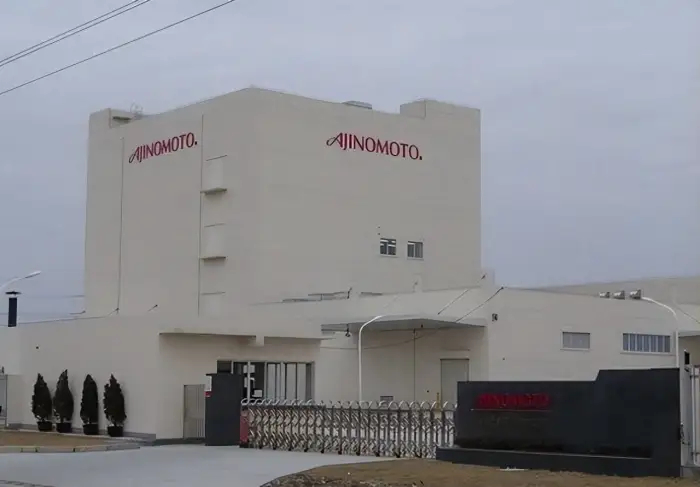
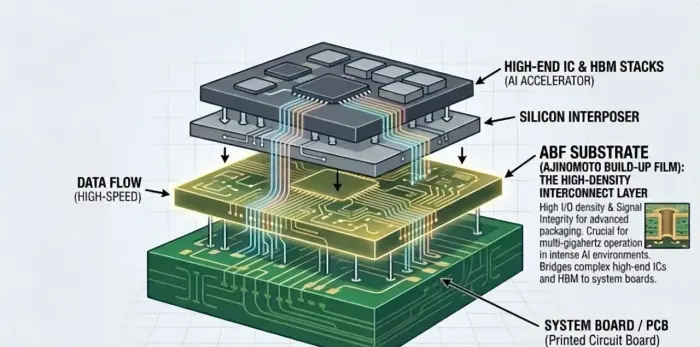
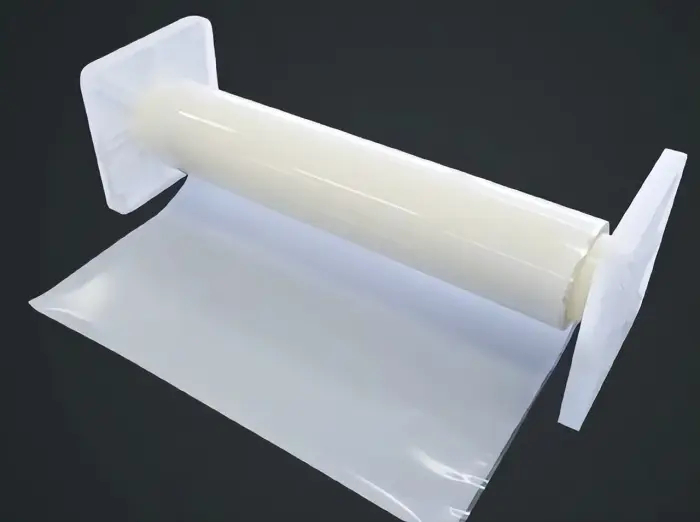
Ajinomoto’s main product is called Ajinomoto Build-up Film, abbreviated as ABF in the industry—i.e., Ajinomoto’s build-up film. The name is a bit awkward, but its function is straightforward: the insulating thin film between the upper layer and each layer of a chip packaging substrate. Inside a chip, there are tens of thousands of nanometer-scale signal lines that must transition layer by layer from the substrate to millimeter-scale circuit boards; the film in between provides separation, insulation, and prevents crosstalk. If any layer is not up to standard, the chip will short-circuit and be scrapped. A typical desktop computer CPU needs only four to six layers of ABF, while high-compute AI chips like NVIDIA H100 and Blackwell increase the number directly to eight to sixteen layers. According to TrendForce (a.k.a. TrendForce Consulting/集团?), the ABF consumption per single AI large chip is five to ten times that of a typical PC chip. By the time Rubin Ultra enters mass production in 2026, the stacked-layer count already exceeds eighteen layers, and usage will rise even further. Demand expansion is visibly rapid. In 2025, the global ABF market size was about $8 billion, with AI-related applications accounting for more than half. Industry institutions generally expect the figure to exceed $15 billion by 2028, with the share of AI use rising to around 75%, officially replacing traditional PCs and servers as the largest downstream.
The problem is right here. Nearly all of the high-end ABF capacity is effectively taken up by Ajinomoto alone. According to public materials from Ajinomoto’s electronic materials subsidiary Ajinomoto Fine-Tech (Ajinomoto Fine Technology?), in the field of insulation materials for high-performance CPUs, its global market share is about 95%, almost approaching 100%. Japanese media and industry analysis reports released in January 2026 both indicate that the only competitor that can be counted on is Sumitomo Chemical, but it has only made breakthroughs in certain data-center subsegments; in the highest-end AI chip arena, Ajinomoto is still essentially the sole player. Ajinomoto is not expanding production blindly as demand surges. According to the company’s disclosed mid-term ASV operating roadmap to 2030, the average annual pace of ABF capacity expansion is only around 10%, far behind the growth speed of AI orders. Market analysts predict that by the second half of 2026, the global ABF supply-demand gap will widen to around 10%, and by around 2028 it could expand to nearly half. The bigger the gap, the stronger the negotiating power of whoever controls the supply. A century of amino-acid accumulation forging a monopoly moat. Some might ask: it’s just a thin film. With so many chemical giants worldwide, why can’t they learn to make it?
Look back more than a hundred years. Ajinomoto was founded in 1909. Its main business is the fine chemical processing of amino acids—starting with seasonings such as monosodium glutamate (MSG), and gradually extending into pharmaceutical intermediates, feed amino acids, and special resins. Around the 1970s, the company began to extend research on byproducts from the amino-acid production process to epoxy resin modification agents—an important step that laid the raw-material foundation for later ABF. According to Ajinomoto’s official account of the technical origins, ABF development began in 1996 spearheaded by the then-current CEO (Chairman) Shigeru Nakamura, and in 1999 it was formally mass-produced and commercialized, first adopted through Intel certification. Back then, personal computers were switching from the DOS era to the Windows era; CPU pins increased rapidly from dozens to over a thousand. Chip substrates therefore had to shift from simple structures to complex multi-layer packaging. Liquid-deposited insulation materials were unstable, had many bubbles, and suffered poor yields. Ajinomoto turned it into a “chip-style” film-forming morphology, reducing the process from four steps to one—making it an industry new standard in one stroke. After the technical path was connected, Ajinomoto built extremely high patent walls. Public information shows that the company laid out more than 200 core patents around ABF resin formulations, coating processes, film-forming equipment, etching treatments, and other stages—forming a closed-loop protection from raw materials to process. A patent analysis article published in November 2025 by a Japanese semiconductor researcher pointed out that a series of foundational patents issued under Shigeru Nakamura in the late 1990s through the 2010s formed an intellectual-property barrier that later entrants could not easily bypass.
Besides patents, Ajinomoto’s expertise in yield is also a hard metric. For high-end ABF, achieving micron-level thickness uniformity, heat resistance without deformation, and matching AI chips’ long-term, high-load operation is required—while keeping mass-production yields stable at 95% or higher for the long term. By contrast, trial-production yields of other new entrants worldwide generally fluctuate in the 75% to 85% range, and the cost gap widens immediately. Next, consider customer relationships: since Ajinomoto completed initial certification with Intel in the 1990s, it has gradually bound itself to packaging and chip leaders such as TSMC, NVIDIA, AMD, and ASE. In high-end semiconductor materials, a single certification cycle takes one to three years. Chipmakers are extremely sensitive to material stability; once switching occurs, the risk is huge and the replacement cost is surprisingly high. This is the most difficult moat to break. For this reason, the market has long expected Ajinomoto’s pricing power. Since 2026, Japanese media have repeatedly reported that multiple investors have asked Ajinomoto to raise ABF prices by more than 30%, and to split off and list its electronic materials business separately in order to unlock valuation more fully. This “scarcity + rigid demand” combination is creating a phenomenon sometimes called “physical inflation” within the industry: it’s not that more money is being printed, but that core industrial materials are naturally scarce, expansion is slow and difficult, and pricing power is firmly in the hands of a small number of players. Chinese MSG producers are stepping in to catch up and make a hard push.
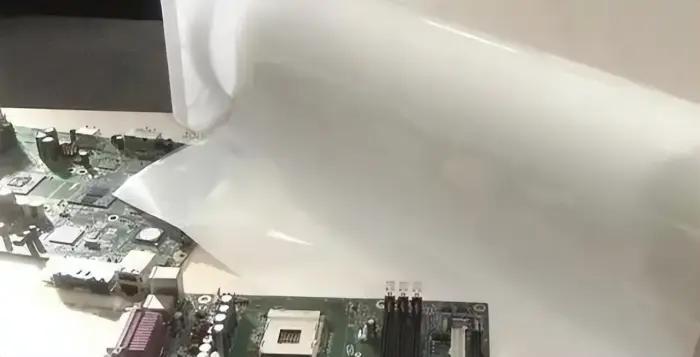
Ajinomoto’s playbook faced an even more complex international situation in 2026. According to a report on August 19, 2026 by (Tom’s Hardware), citing China’s industrial media “Jiemi Network,” Ajinomoto notified customers in Mainland China that it would cut ABF film supply volumes by about 30%. This move immediately sent shockwaves through the domestic advanced packaging supply chain. At that time, Mainland China’s self-sufficiency rate for high-end ABF films was less than 5%; a 30% cutoff effectively pushes the domestic substitution timeline forward by a large step. Interestingly, the banner-holder is none other than a long-established domestic MSG factory: Lianhua Holdings. In April 2026, Lianhua Holdings’ platform company acquired 51% of the equity of Shenzhen Neufys (Newfies?) for about 103 million RMB, officially entering the domestic ABF track. Neufys’ independently developed NBF stacked-film technology had already achieved technical breakthroughs, and can cover packaging needs for ordinary servers, consumer electronics, and mid-to-low-end chips—its cost-performance route has been very steady. From Lianhua MSG to compute IDC, and then to semiconductor stacked films, this cross-industry curve from a Henan old brand wasn’t made on a whim. Traditional fermentation-based chemical factories have large land footprints and sufficient energy-consumption indicators; power and land costs are controllable, naturally matching compute room construction. Lianhua Holdings had already laid out smart computing and data center businesses in its Jixiang/ Jixiang? base; this time it filled in the upstream material gap to form a complete chain from underlying materials to compute operations. Logically, it makes sense; in terms of timing, it was also well-calibrated.

In the short term, completely replacing Ajinomoto is still unrealistic. In the most difficult scenarios—such as ultra-high-tier stacking beyond 16 layers for domestic ABF materials, HBM memory package integration, and top-tier AI large-chip packaging—there is still a gap between domestic products and Ajinomoto’s mature offerings in dielectric performance, thermal stability coefficients, long-term reliability, and mass-production yields. What can truly form large-scale commercial use in the near term is the consumer electronics and mid-to-low-end server chip markets. Industry analysis generally believes that in the short term, domestic manufacturers are better suited to a steady route of “mid-end profitability to fund high-end R&D.” Besides Lianhua Holdings, multiple teams in China are pushing forward at the same time. HuaZheng New Materials, together with the International Innovation Research Institute of Advanced Electronic Materials in Shenzhen, is developing CBF materials; according to public reports, mass-production yields have already stabilized above 85%. Reliability tests have passed system verification such as Huawei Ascend. Eoptics? (Xinxing?) technologies? and ShenNan Circuit are conducting customer certification. HuaZheng New Materials’ first production line with an annual capacity of 3 million square meters is operating at full load; the second production line of the same scale is planned to start production by the end of 2026. Across the domestic ABF track, it is moving from the stage of “can it be made?” to the critical stage of “can it be mass-produced?” Looking back at the whole story: a MSG factory with a market cap of 3 trillion is the one that has choked NVIDIA, giving the world a lesson. The core conclusion of this lesson isn’t complicated: in top-tier technology competition, the deciding factor isn’t necessarily the most dazzling end-product. Often, it lies in the most unremarkable raw-material stage. A thin insulating film—backed by more than a hundred years of amino-acid chemistry accumulation, over twenty years of patent barriers, and yield control of more than 90%—has managed to keep the most money-burning compute expansion in the AI era on schedule. This is also one of the lessons Chinese manufacturing is focusing on to fill right now: a true moat isn’t about stacking capacity in the short term or trying to win with subsidies, but about day after day for decades perfecting a core process so deeply that others can’t replace it. Lianhua Holdings’ investment of more than 100 million yuan into a small film-materials company may seem insignificant, but it is precisely taking this hard yet correct path. #币安广场